

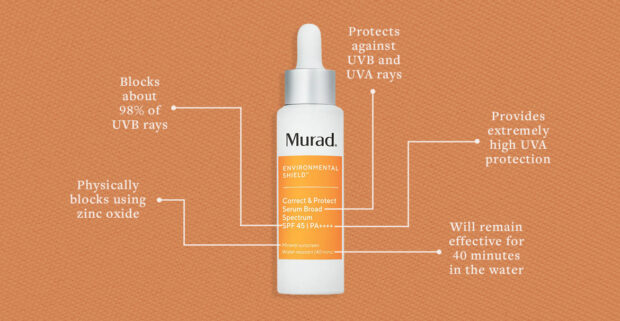
“You just want to pick up the bottle and go, but there are so many things to think about,” says Debra Jaliman, MD, a board-certified dermatologist in New York City. Here’s where to start.
How to read a sunscreen bottle, line by line
UVA
Sunscreen protects us from two types of ultraviolet rays: ultravioletA (UVA) and ultavioletB (UVB). “UVA rays are the rays that penetrate deeper,” says Dr. Jaliman. “They’re the rays that cause changes in pigment, but also the rays that cause skin cancer and cause premature aging.”
UVB
“For several decades, what was largely recognized as the source of sun damage were UVB rays,” says Ranella Hirsch, MD, a board-certified dermatologist in Cambridge, Massachusetts. “They are the principal reason we turn red and burn, though a touch of UVA causes this too.”
Related Stories
Broad-spectrum
“As science and the dermatologic community started to better understand the importance of UVA rays to sun damage, sunscreens were developed to include UVA protection, and the term broad-spectrum is what manufacturers used to indicate that,” Dr. Hirsch says. “At that point though, we had not yet introduced a standardized form of testing for that protection. So in 2011, the Food and Drug Administration, the regulatory body in the United States that oversees sunscreen regulations, introduced certain standards for what qualified for UVA protection ample to meet the broad-spectrum label.”
So if you have a sunscreen that doesn’t say broad-spectrum, you’re only getting UVB protection. You’ll be protected from burns but not long-term damage that can cause skin cancer and accelerate signs of aging.
SPF
This is the label we’re all most familiar with. “SPF stands for Sun Protection Factor,” says Lindsey Zubritsky, MD, a board-certified dermatologist in Pennsylvania. “It’s a measurement of how well the sunscreen protects our skin from burning with exposure to UVB rays, as well as a measurement of how long protected skin takes to burn compared to unprotected skin.”
Dermatologists recommend that you use sunscreen with a minimum of SPF 30. “SPF 30 offers sunscreen protection from 97 percent of UVB light, an SPF 50 offers sunscreen protection of 98 percent, and an SPF 100 protects 99 percent,” says Dr. Jaliman. “There’s a slight difference when you go from a 50 to 100. It isn’t as much as you would think.”
For many, wearing more than SPF over 30 isn’t really necessary. Some exceptions? “Let’s say you’re somebody who’s a redhead and you have very pale skin or you’re taking medication that makes you sun sensitive, like doxycycline for Lyme disease, then maybe you’d want to go for an SPF 50,” says Dr. Jaliman. “It also may depend on where you live and what you do. If you live near the equator, or if you’re somebody who’s out teaching tennis and you have so much sun exposure in the midday sun, then you may want to choose a higher SPF because you have so much sun exposure.”
A higher SPF is also helpful if you’re not great at applying enough sunscreen, which is two fingers worth for the face and a shot glass for the body. That’s because if you don’t put on enough sunscreen, you’re actually not getting the SPF on the label. So if you apply half the amount of required sunscreen using an SPF 100, you’re getting half the amount of protection.
PA++++
The PA system stands for the Protection Grade of UVA. So it’s like SPF but for UVA rays. It was developed in Japan in 1996, and has since been adopted by other countries. It’s based on PPD, persistent pigment darkening. “PPD measures the multiple increases of UVA a person can be exposed to without experiencing skin darkening,” says Dr. Hirsch.
“It’s a good thing because otherwise you really don’t know how much UVA protection you have,” says Dr. Jaliman. The plus signs next to PA denote how much UVA protection the sunscreen provides. ” PA+ offers some UVA protection. PA++ offers moderate UVA protection. PA+++ offers high UVA protection. And PA++++ is extremely high UVA protection.”
Chemical
Common chemical blockers include avobenzone, homosalate, octinoxate, and oxybenzone. “Chemical sunscreens get absorbed into your skin, and then it absorbs the ultraviolet rays and converts those rays to heat and inactivates them,” says Dr. Jaliman. Chemical sunscreens are a bit controversial. FDA research from 2020 shows that when the correct amount of chemical sunscreen is applied to the skin, it gets absorbed by the bloodstream. From there, it can remain in the body for an extended period of time. The agency is doing more research to determine if lingering sunscreen chemicals have any impact on health. But for now, chemical blockers remain FDA-approved and are also recommended by the American Academy of Dermatologists (AAD). “Claims that sunscreen ingredients are toxic or a hazard to human health have not been proven,” reads the AAD website.
Although Dr. Jaliman prefers mineral sunscreens over chemical, she says chemical sunscreens are very good at providing sun protection. “The chemicals, I have to say, they work really well,” she says. “If you have avobenzone, any of those, it’s going to protect your skin. There’s no question. That’s why they use them because they do protect your skin very well.” And while researchers explore the safety of chemical sunscreens there’s one thing we know for sure: Sun damage can lead to skin cancer, and chemical sunscreens are great at protecting against that.
“Chemical sunscreens are also typically easier to rub in and have less chance of leaving a white cast compared to mineral sunscreens,” adds Dr. Zubritsky.
Mineral
Mineral sunscreens use two physical blockers: titanium dioxide and zinc oxide. While there are 16 FDA-approved sunscreens (both mineral and chemical sunscreens) these two mineral blockers are the only ones that are well-researched enough to have GRASE (generally recognized as safe and effective) status. Dr. Zubritsky notes that “those with sensitive skin can occasionally develop allergies to chemical sunscreens, so mineral ones are best for that skin type.”
It’s generally accepted that what sets mineral sunscreens apart from chemical is that they reflect sunlight instead of absorbing it. However, a 2015 study shows that physical blockers also work by absorbing UV rays. “In fact, they both [chemical and mineral sunscreens] largely function by absorbing the UV and converting it into heat, though with mineral, there is a small percent (around 5 to 10 percent) that is reflected,” says Dr. Hirsch.
While physical sunscreens mostly absorb UV rays, Shirley Chi, MD, a board-certified dermatologist in Southern California, notes that they reflect a good amount of visible light. Visible light is quite literally the light you can see. (UV rays are invisible to the human eye.) “Modern-day, nanoparticle-sized mineral ingredients reflect up to 50 percent of visible light, which we now know is very important in preventing pigment conditions like melasma,” says Dr. Chi. “That’s why I still love mineral sunscreens so much, even with more and more great chemical sunscreen options.”
Mineral sunscreens have historically left behind a chalky white or purple cast on the skin, especially on skin of color. However, “they now have nice ones that blend right into the skin and they look cosmetically elegant,” says Dr. Jaliman.
Water-resistant
If you’re going to be spending time in the water, you need water-resistant sunscreen. Just know that you need to check the label to see how often you need to reapply if in water. “Some sunscreens are water-resistant for 40 minutes,” says Dr. Jaliman, “and some sunscreens are water-resistant for 80 minutes.”
How to apply sunscreen, the right way: