

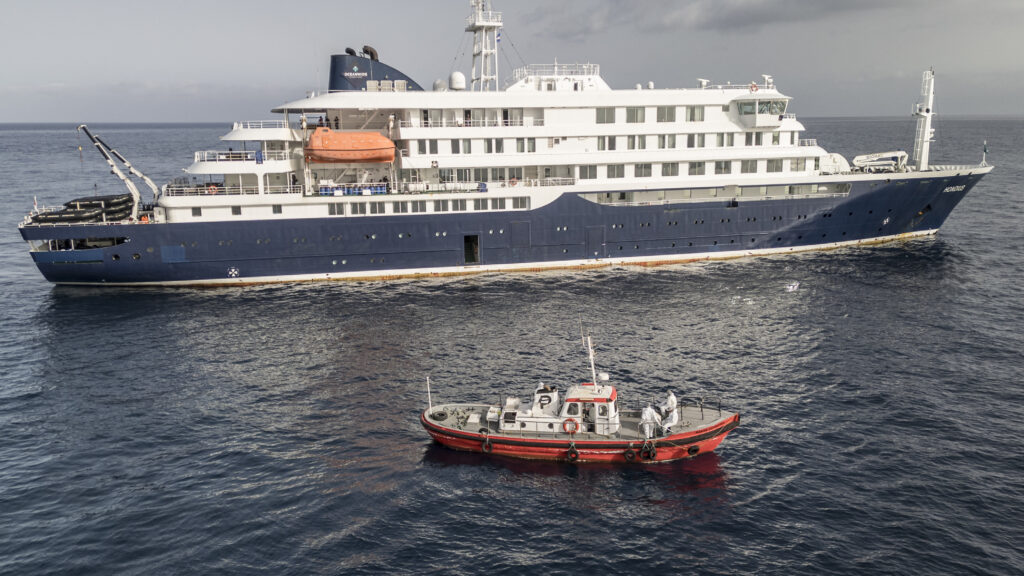
The outbreak of hantavirus on a cruise ship moored off the western coast of Africa is gripping a world primed by recent painful experience to be on edge for the next Covid-19-like event. It’s no wonder: People trapped on a ship where a deadly disease might be spreading triggers flashbacks of the early days of Covid.
Scientists and public health experts are gripped by the hantavirus situation too, but for different reasons. They are worried that hantaviruses haven’t been as well studied as they ought to be. They have some concern that more passengers could fall ill. They are not fearful that the MV Hondius is ground zero for the next big one.
“It’s not the next pandemic,” said Michael Osterholm, director of the University of Minnesota’s Center for Infectious Diseases Research and Policy.
“This is one where everyone should just take a breath and know that we are going to bring this to resolution,” he said. “With adequate respiratory protection, [they could] very well stop all transmission from this point forward.”
Make no mistake: The outbreak on the cruise ship demands careful handling and thorough investigation. Hantavirus infections, though rare, cause serious disease and have a high fatality rate. The fact that at least some of the potentially eight cases (so far) were probably infected through person-to-person spread — exceedingly rare with hantaviruses — underscores how crucial it is that contacts of known cases are traced and that passengers and crew still onboard are followed up for weeks after they are allowed to disembark. The number of confirmed cases could still rise.
But there’s a difference between an outbreak that has scientific and public health importance and one that poses widespread risk to the population at large. This outbreak is the former, not the latter.
Martin Cetron, who for years ran the Division of Global Migration and Quarantine at the Centers for Disease Control and Prevention, said the public may not fully understand what the World Health Organization and others mean to convey when they say — as they are now — that the overall risk to the public is low.
“What they’re trying to say … is that you could have a rare consequential big event that is unusual and it can be terrifying in the story you hear about it. But that is not necessarily the same as finding something which is exceedingly contagious via an airborne route and has … the superpowers that SARS coronavirus 2 had,” Cetron, who retired from the CDC about four years ago, told STAT in an interview.
Part of the reason for the heightened concern could be the fact that hantaviruses — though found widely around the globe — aren’t especially well known, said Florian Krammer, a virologist at Mount Sinai’s Icahn School of Medicine in New York and director of the Ignaz Semmelweis Institute at the Medical University of Vienna.
“Three days ago, nobody knew what a hantavirus was. I think that’s part of it,” he said.
Given that fact, a little background may be in order.
There are a variety of types of hantaviruses, with different ones found across the globe. The viruses are carried by rodents. People who become infected do so by having exposure to the droppings, urine, or saliva of infected rodents. Human cases aren’t common; the CDC website says between 1993 and 2023, 890 cases were recorded in the United States. About 35% of those cases were fatal. (STAT asked the Department of Health and Human Services for an interview with a CDC expert on hantaviruses but the request was declined.)

Cleaning out a cabin after the winter — sweeping up mouse droppings — has been associated with hantavirus cases in the United States. And for most people in the U.S. right now, that type of activity poses a greater risk of infection than does the MV Hondius, said Gustavo Palacios, a professor of microbiology at the Icahn School of Medicine at Mount Sinai.
To date, only one type of hantavirus, the Andes virus, has been seen to have the capacity to spread from person to person on rare occasions. This is the virus responsible for the outbreak on the MV Hondius. The strain is found primarily in Argentina, the ship’s point of departure. The first two cases in this outbreak traveled in Argentina before boarding the ship.
Tom Ksiazek, a renowned virologist and expert in emerging infectious diseases, said the Andes virus grows to higher concentrations in the body than most hantaviruses do, which may help explain its ability to transmit person to person.
A professor at the University of Texas Medical Branch and director of the Galveston National Laboratory’s BSL4 lab (the highest level of biosecurity), Ksiazek is more worried about the United States being outside the WHO at a time like this than he is about the pandemic potential of this situation.
“We’re not in the loop on this, and so I and other scientists who might have a direct interest in this are very much dependent on simple press reports,” he said.
An outbreak investigation Palacios was involved in several years ago helped to illustrate the capacity of the Andes virus to transmit among people. An infected individual in Epuyén, Argentina, attended a birthday party with about 100 other people. Five people who had close contact with the individual became ill, sparking an outbreak that involved 34 confirmed cases and 11 deaths.
The outbreak was brought under control after confirmed cases were told to isolate and contacts of the sick were asked to self-quarantine.
Though Epuyén is the largest known outbreak of the Andes virus — and there are only a few other incidents when person-to-person spread is known to have taken place — the scale of that event makes scientists pay extra attention, Krammer said.
Palacios said a cruise ship — particularly this type of cruise ship — is possibly an ideal setting for transmission of this virus, if it is introduced to the environment. The ship, small by cruise liner standards, travels to the Antarctic. “It’s obviously prepared to keep heat in,” he said.
But not all cases of Andes infection lead to person-to-person spread. In 2018, a woman from Delaware became infected while traveling in Argentina, though she was only diagnosed upon her return. Public health authorities traced 51 contacts — health care professionals who had cared for her, family members, people who sat near her on her flight home, flight attendants, and even a person with whom she shared a hospital room. None contracted the virus.
While the experts STAT spoke to believe this outbreak will be contained, all acknowledge a lot of work remains to get the nearly 150 passengers and crew — including 17 Americans — off the ship and safely repatriated to their home countries.
And they point out that the event stresses a need for more research on these viruses. Palacios said even after the Epuyén outbreak, funding bodies were reluctant to approve grant applications because of the perception this virus family poses a low risk.
Andrew Pollard, a professor of infection and immunity at the University of Oxford’s Pandemic Sciences Institute, agreed.
“This outbreak highlights the importance of simple public health measures to recognise new infections and reduce spread and severe illness/deaths,” he said in an email. “It is also a reminder that there are many dangerous viruses out there and we remain at risk from them in sporadic outbreaks like this.”