

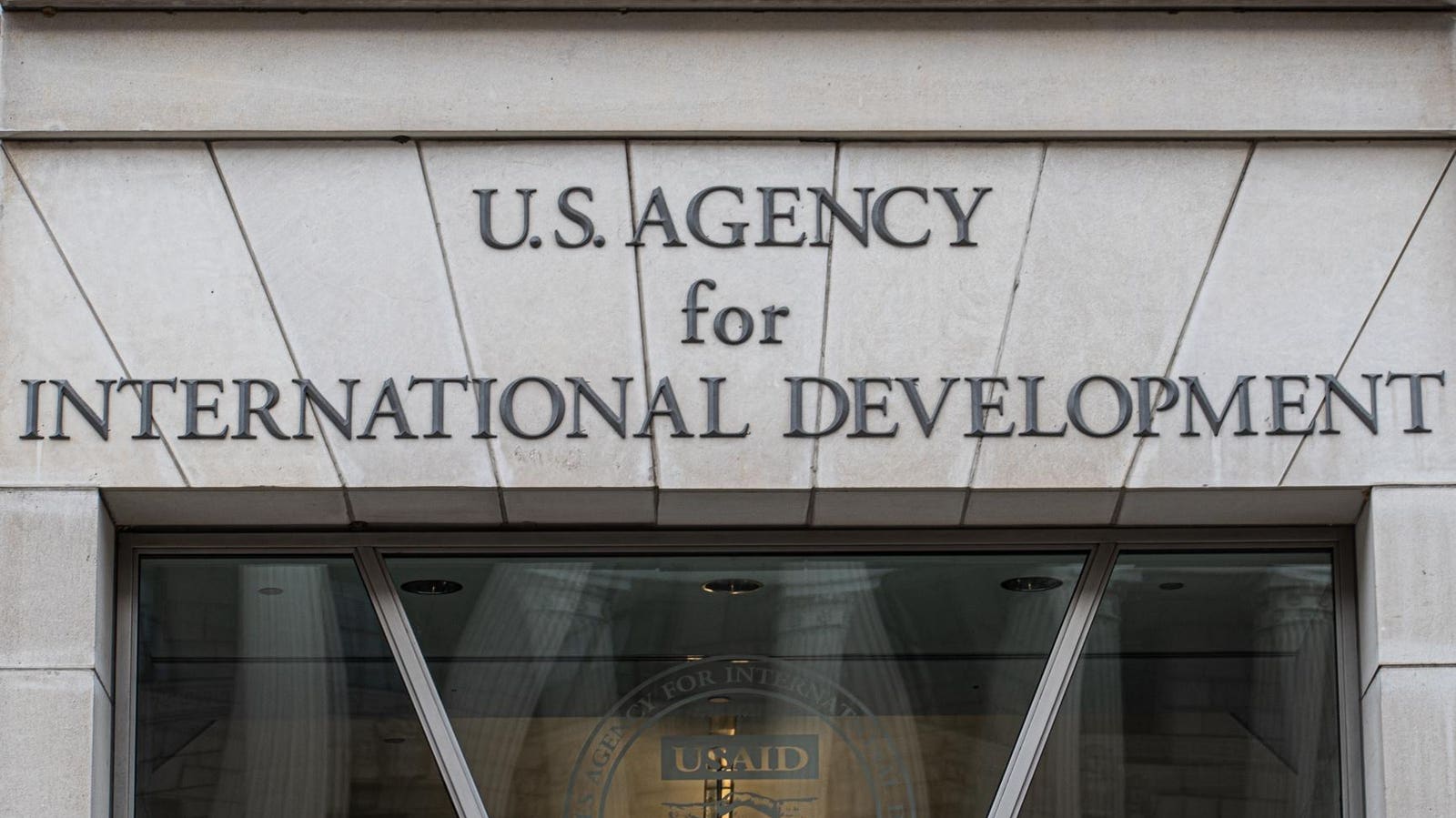
WASHINGTON, DC – A worker removes the U.S. Agency for International Development sign on their headquarters on February 07, 2025 in Washington, DC. (Photo by Kayla Bartkowski/Getty Images)
Getty Images
On July 1, 2025, the United States Agency for International Development (USAID), a 64-year-old institution operating in more than 130 countries that prevented between four and five million deaths per year, ceased to exist as an independent agency. By March 2025, 83% of its contracts were canceled. What remained was absorbed into the State Department, which now operates a 200-person Bureau of Disaster and Humanitarian Response with a fraction of USAID’s former budget.
The Trump administration’s case for closing USAID was waste, inefficiency, and that it created a culture of dependency. According to the administration’s America First Global Health Strategy, less than 40% of U.S. health foreign assistance reached frontline services, with the rest absorbed by overhead and program management.
Yet USAID was closed abruptly without a plan for a replacement. The issue is that many across the world were dependent on that funding.
Now, the administration has its answer: trade. On April 27, 2026, Ambassador Michael Waltz launched the ‘Trade Over Aid’ initiative declaring that private-sector investment and bilateral trade agreements would replace development grants as America’s primary tool of global engagement. Thirty-five countries signed on.
How the substitution may impact on-the-ground populations in need of support is a central question facing global public health right now.
What USAID Actually Did Before It Was Shuttered
At its peak, USAID disbursed roughly $40 billion annually, funding everything from antiretroviral supply chains and childhood vaccination programs to agricultural development and disaster relief. The United States accounted for approximately 47% of the global humanitarian aid supply.
A 2025 Lancet analysis using data from 133 countries over two decades found that USAID funding was associated with a 65% reduction in HIV/AIDS mortality, a 51% reduction in malaria deaths and a 50% reduction in deaths from neglected tropical diseases. Altogether, USAID programs prevented more than 91 million deaths between 2001 and 2021: roughly 4.3 million lives per year, including 30 million children under five.
The President’s Emergency Plan for AIDS Relief (PEPFAR) alone is credited with saving more than 26 million lives. The President’s Malaria Initiative helped prevent an estimated 1.1 billion malaria cases.
What was eliminated in 2025 was not just funding but an underlying public health infrastructure: supply chains for antiretrovirals and tuberculosis (TB) diagnostics were disrupted; HIV clinics closed in South Africa; nutrition centers shuttered in Yemen; the United Nations Children’s Fund (UNICEF) reported a 27% increase in children admitted for severe acute malnutrition in Myanmar.
Projections On The Health Impacts of Closing USAID
The projection is that the funding cuts could lead to more than 14 million additional deaths by 2020, including 4.5 million children under five. A second Lancet study in May 2026, incorporating cascading cuts from the UK, Germany, and Canada, raised the projected toll to at least 9.4 million.
The Center for Global Development, applying cost-per-life-saved estimates to documented spending cuts, estimated between 500,000 and 1,000,000 lives lost in 2025, with future commitment declines implying up to 1.6 million additional deaths per year. By January 2026, Boston University’s real-time ImpactCounter dashboard exceeded 762,000 estimated deaths, with PEPFAR disruptions, childhood pneumonia and malnutrition accounting for the largest shares. Disease-specific models project 268,600 additional TB deaths by 2030 under a moderate disruption scenario — and more than 2.2 million in the worst case.
What Actual Data Show On The Human Toll
Despite the modeling evidence, no one knows with any precision how many people have actually died from USAID’s closure. In fact, the closure itself is the reason we do not know.
The clinics that compiled mortality data in remote communities have closed. The non-governmental organizations (NGOs) that tracked program outcomes are defunded. The PMI malaria program’s public data website went dark and has not been restored. PEPFAR’s monitoring and evaluation data lapsed during the transition to State Department management.
So how many have actually died? Secretary of State Marco Rubio told Congress in May 2025 that “no one has died because of USAID cuts.” The truth likely lies between official denial and worst-case projections. Encouragingly, some gaps have been partially filled: country governments have stepped up in South Africa and Nigeria, and European donors have partially backfilled programs in some regions. These mitigations are real, even if they are difficult to quantify precisely given the absence of monitoring infrastructure.
The Trump Administration’s Proposed Replacement Is “Trade Over Aid”
The initiative works by replacing government-to-government grant funding with direct bilateral investment compacts, private sector partnerships, and trade access agreements. Recipient countries are asked to co-invest and gradually assume full ownership of their own development programs. The underlying logic is not new: African leaders have advocated for trade over aid since the 1970s, arguing that market access creates more durable prosperity than grant cycles and dependency.
The America First Global Health Strategy outlines bilateral government-to-government compacts, co-investment requirements, and private-sector partnerships. To date, the administration has signed bilateral health agreements with 32 African countries, committing $11.1 billion over five years with recipient nations pledging matching funds.
Congress, meanwhile, pushed back on the White House’s proposed 84% cut to international programs and passed a $50 billion FY 2026 foreign aid package. This is a signal that the funding architecture, though restructured, is not disappearing entirely.
Yet serious questions remain about implementation. Concerns have been raised that the administration has been negotiating these agreements with minimal public disclosure. This has fueled concerns among health experts and recipient governments that the deals are structured around U.S. economic and resource extraction interests rather than public health outcomes. As of April 2026, none of the bilateral agreements had been funded or fully implemented, leaving a gap of more than a year between the dismantling of the old system and the activation of the new one.
Here’s What Could Happen Next With International Aid And Public Health
Where this goes next depends on several factors like how much of the Congressional $50 billion the administration actually spends. Additionally, whether the bilateral health compacts are funded and produce a real functioning service delivery And finally, whether the African Growth and Opportunity Act (AGOA), the 25-year-old U.S. program providing duty-free market access for sub-Saharan African nations, is renewed in a meaningful form before it expires again in December 2026.
The most concerning scenario is a slow-moving catastrophe that never fully enters public consciousness due to largely absent data. Excess mortality from collapsed vaccine programs, interrupted antiretroviral supply chains, and shuttered nutrition clinics may accumulate invisibly.
The most hopeful is that the bilateral model proves nimbler than critics expect. In particular, that the leaner, performance-linked compacts deliver better outcomes per dollar than the diffuse overhead-heavy model they replaced. And that country governments rise to the co-investment challenge in ways that produce durable self-reliance.
Yet, what remains difficult to argue is that trade alone can substitute for public health infrastructure on the timelines that matter most. Trade builds wealth over decades. Antiretrovirals need to reach patients this month.
The Trade Over Aid initiative attempts to reorient American engagement toward self-reliance and away from dependency, which are laudable goals. Whether the execution matches the ambition will depend on decisions being made right now about how much to spend, where to direct it and whether the data systems needed to measure success get rebuilt.
Ultimately, the difference will be visible in the data, if anyone figures out a way to collect it.