

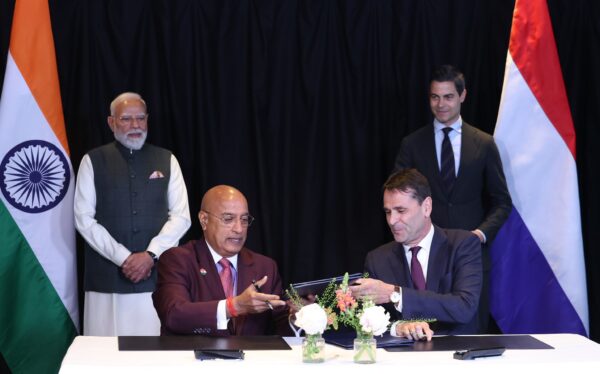
When Prime Minister Narendra Modi was in the Netherlands on May 16, he shook hands with two CEOs: ASML’s Christophe Fouquet and Tata Electronics’ Randhir Thakur. The symbolism was clear: India is joining the most exclusive club of the world’s chip industry. However, there is more substance to the geopolitics than the ceremonial photographs showed.
The celebratory occasion that Modi oversaw was the signing of an MoU between Tata Electronics and ASML. The Dutch technology firm has agreed to help Tata establish and ramp up its fabrication facility in Dholera, Gujarat, by providing a comprehensive portfolio of lithography tools and solutions and enabling the city to build up its talent pool, supply chain resilience, and R&D infrastructure. In partnership with Taiwan’s PSMC, the Dholera fab will produce $11 billion worth of chips, covering nodes from 28 nanometers to 110 nm, for automotive, AI and mobile applications. Construction is progressing; the first Indian-origin commercial chips are expected before the end of this year.
In order to grasp the significance of this particular partnership, it is important to understand that ASML of the Netherlands is not just a tech firm. It is the only company in the world to offer Extreme Ultraviolet (EUV) lithography systems, which are crucial for the production of advanced-node chips. All the world’s major semiconductor manufacturers – including Taiwan Semiconductor Manufacturing Co., South Korea’s Samsung, and the United States’ Intel – rely on ASML machines to manufacture their chips. There is no other supplier available.
After years of work and billions of dollars invested in the technology, no country has duplicated it – not even China. Chinese imports of semiconductor equipment hit a record $26 billion in 2024, which included stockpiling ahead of more stringent sanctions. But while Chinese equipment manufacturers are making progress, China is still far from being able to produce its own advanced EUV lithography machines.
This is the first reason that this deal is different from India’s previous semiconductor deals. This is more than obtaining the equipment; the deal with ASML brings India into the supply chain of the one company whose cooperation cannot be replaced for any serious chipmaking operation.
Why India Needs This, and Why Now
Until recently, India’s semiconductor saga had been one of a specific asymmetry. The nation accounts for about 20 percent of the world’s semiconductor design expertise and is home to the bulk of Taiwan’s fabless industry companies, which create chip designs and outsource the manufacturing to Taiwan. In other words, India was not an architect of its own value chain but rather a node in someone else’s.
Semiconductors are no longer just a product of consumer electronics; they are a central part of technological sovereignty and a national power. Microchips power today’s economies, ranging from AI systems to sophisticated military technologies, from vehicles to data centers. This pandemic shed light on the world’s reliance on just a few manufacturing centers, with interruptions in production affecting everything from car-making to telecoms and consumer electronics.
India’s answer came in the form of the India Semiconductor Mission, which is in its second phase. The government has approved 12 semiconductor projects across six states under the ISM with a total investment of around 1.64 trillion rupees as of May 5, 2026. The government had notified a Special Economic Zone for Tata Semiconductor in Dholera on April 9. The site is now recognized as an inland container depot and granted permission to handle cargo on the premises, enabling easier logistics and improved efficiency. There is considerable co-investment: The government of India is putting up 50 percent of the investment in the Dholera fab, which is equivalent to 450 billion rupees ($5.5 billion).
This is not about market discovery; it is about industrial policy. The Indian government has determined that semiconductors are too critical an industry to be left to market forces. That’s a fair statement. The question now is whether the policy framework being established around this goal is strong enough.
The China Problem Is Not Going Away
That’s where the euphoric encapsulation of the ASML deal needs to be policed. Though one critical chokepoint is referred to in the MoU (lithography), the other, far older and more ubiquitous dependency remains largely unaddressed. India remains dependent on China for the critical minerals used in chips, manufacturing of chips, and downstream products used by chips.
China accounts for 60-70 percent of global rare earth elements production, 85-90 percent of rare earths processing, over 90 percent of graphite processing, and 65-74 percent of cobalt processing. These are not background inputs. They are used in a variety of permanent magnets, specialty alloys, and process materials used in any semiconductor facility throughout its production process.
What’s more, China has effectively used these minerals in geopolitical contests. There is no hesitation by Beijing to leverage its power. China implemented an export ban on critical elements such as terbium and dysprosium on April 4, 2025, in response to U.S. President Donald Trump’s “Liberation Day” tariffs. Indian manufacturers such as Bajaj Auto and Maruti Suzuki sounded the alarms straight away.
China then enacted a new rule, MOFCOM Notice No. 61 of October 9, 2025, which extends the scope of its rare earth export control regime to include extraterritorial effects: foreign companies will be required to obtain a Chinese export license if their products contain any traces (0.1 percent) of Chinese-origin rare earths or include Chinese rare earth-related technology.
The numbers speak for themselves. India’s trade deficit with China reached a new high of $99.2 billion in 2024-25, driven by an increase in imports to $113.5 billion. India’s exports to China were worth just $14.3 billion. More than 90 percent of rare earth magnets and metals supplied to India came from China.
India’s National Critical Mineral Stockpile was announced in October 2025 in direct response to China’s export ban on compound semiconductors’ key ingredients: gallium, germanium and antimony. If a blockade scenario occurs, it would in an instant affect 90 percent of advanced chip production.
The fab in Dholera may produce “Made in India” chips using ASML lithography equipment, but if it sources its rare earth requirements from Chinese supply chains, India is yet to attain true self-sufficiency. It’s just moved the dependency one step upstream, where it’s not as obvious or politically easier to tackle.
The Larger Geopolitical Architecture
The Tata-ASML pact comes as India and the Netherlands increasingly look to strengthen their economic and technological ties. The world’s semiconductor industry is being restructured by geopolitical and export control tensions between the United States and China, a major competitor in the chip technology sector. As semiconductor firms in the Netherlands diversify into new markets and regions, India is trying to emerge as a significant manufacturing and technology center.
ASML must find partners outside of East Asia as Taiwan’s risk concentrations increase. India is a partner outside the region that is politically and economically attractive to the Netherlands. More than nominal geographic distribution, India offers supply chain security. Advanced chip companies can diversify their production to geographically separated but politically aligned democracies. India also has a comparative advantage: 20 percent of the world’s chip engineers are already in India, and 110 mining and engineering colleges are churning out a scalable talent pool.
According to the Ministry of External Affairs press release, Modi’s meetings in the Netherlands explored “close cooperation across various sectors, from defense to security, innovation to green hydrogen to semiconductors.” The appearance of semiconductors and defense cooperation together in the same sentence is no coincidence; both governments are well aware of the growing overlap between the worlds of semiconductors and security.
The China-U.S. technology rivalry is causing a clear division into two parallel technological worlds: the U.S.-centric one, which seeks to maintain a technological upper hand with its trusted partners, and the Chinese one, which strives for self-sufficiency and to become the world’s indispensable supplier of mature-node chips. India has made a conscious choice to join the first sphere, as the country is a member of the Quad and inked agreements with ASML, PSMC, Intel, and Micron.