

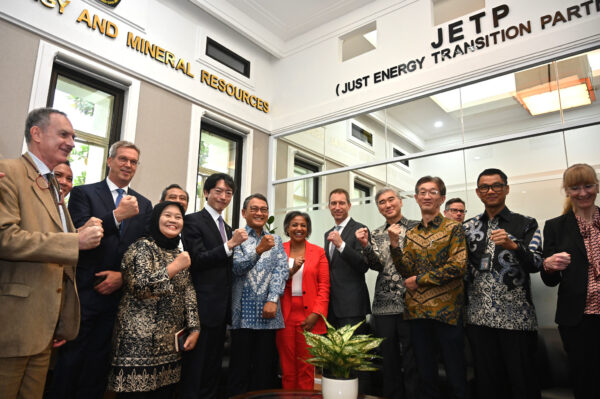
In 2021, the world’s first Just Energy Transition Partnership (JETP) was announced at COP26 in Glasgow. Hailed as a breakthrough, an International Partners Group, consisting of the United States, United Kingdom, European Union, France and Germany, pledged $8.5 billion in climate finance to assist South Africa in its transition to clean energy.
At the 2022 G20 Summit in Bali, Indonesia unveiled its own $20 billion JETP with a similar slate of partners. Vietnam followed a few months later with a $15.5 billion deal. (A smaller EUR 2.5 billion JETP with Senegal was announced in 2023 and a much larger one with India was negotiated but never finalized.) These programs aimed to take climate finance to another level, promising greater impact by targeting countries that are pivotal for the global energy transition: major emerging economies with a large share of coal in their energy mix. And they set ambitious schedules, aiming to raise and deploy the pledged capital well before 2030.
In addition to securing tens of billions of dollars to finance energy transitions in emerging markets, what set the JETPs apart was their commitment to putting climate justice at the center of international climate finance. Not only would they channel billions of dollars into renewable energy, early retirement of coal-fired power plants and upgrading transmission grids; they would also help coal-dependent communities adjust to economic disruption as economies pivoted toward clean energy.
It has been four years since COP26 in Glasgow, and the evidence is clear: the Indonesian, South African, and Vietnamese JETPs have all made slow progress. After President Donald Trump returned to the White House in early 2025, the United States withdrew from the partnerships. Yet even before that, the JETP platforms were struggling to generate the investment and transformational policy reforms envisioned when they were launched. Why have these large-scale, high-profile partnerships stalled?
The main reason is that while the JETP integrated notions of justice into clean energy and climate finance, it paid insufficient attention to the political-economic realities of the recipient countries and the difficulty of enacting deep and often politically unpalatable structural reforms. In emerging markets like Indonesia, South Africa, and Vietnam, financially fragile but politically powerful state-owned utilities often dominate the supply and distribution of electricity. The government’s main priority is often to ensure reliable access to electricity at stable and affordable prices, and it is wary of accumulating external liabilities on the balance of payments, such as large foreign debts. The politics of reforming powerful state-owned utilities, unsurprisingly, is proving to be a complex undertaking.
The JETPs encourage recipient countries to embrace pro-market reforms in order to create favorable conditions for private investors and developers. If enacted, many of these reforms would shift a significant amount of market risk onto the state, lead to higher prices for consumers, require politically risky overhauls of state-owned electric utilities, and increase exposure to market-rate debt. Indonesia, South Africa, and Vietnam have been slower to embrace and implement these reforms than expected.
Appeals to climate justice have proven less important than more pragmatic issues such as who will pay, on what terms and how risks and rewards are allocated. The difficulty in reaching consensus on these critical points and sufficiently accounting for the political and economic realities of energy in these countries spawned a series of ambitious partnerships that have yet to fully deliver on their lofty goals.
South Africa
South Africa was the first JETP candidate because of its heavy reliance on coal, its aging fleet of coal-fired power plants, and the need for foreign investment and technology to accelerate its clean energy transition. Since 2007, South Africa has been experiencing rolling blackouts due to aging infrastructure, especially its fleet of coal-fired power plants, almost all of which were built in the 1980s or earlier. Anchoring electricity generation with coal was a decision that made sense back then, given that South Africa is the world’s seventh largest producer of coal, most of which is consumed domestically. Coal is a linchpin of the country’s political economy, but also a liability as new capacity needs to come online quickly to close the energy deficit. The JETP was designed to address these issues.
The JETP investment roadmap was published in 2022 and estimated that South Africa’s total transition funding requirements from 2023 to 2027 would be $98 billion, including sizable investments in green hydrogen, electric vehicles, and renewable energy. Investment in electricity generation and grid upgrades alone was expected to reach $69 billion. The initial $8.5 billion under the JETP was to be composed of around $6 billion in grants and concessional loans from European countries, and $2.6 billion in market-rate financing and equity investment, including $1 billion from the United States. The U.S. did not offer any financing or investment below market rates.
Initial commitments under the JETP were less than 10 percent of total estimated needs, and roughly a quarter was to be at market rather than concessional rates. Just $50 million was allocated for economic diversification, re-skilling and social inclusion. JETP planners were aware that $8.5 billion in funding was insufficient, but hoped the program would catalyze more investment at scale. So far, this has not happened. According to Eskom’s annual report, as of March 2025, solar and wind accounted for just 8 percent of total electricity supplied.
One of the main roadblocks is state-owned electric utility Eskom. Eskom has dominated the supply and transmission of electricity in South Africa for over a century, and became heavily indebted in the process. When South Africa’s JETP was announced in 2021, Eskom had negative earnings of $1.1 billion (at an exchange rate of 16 South African rand to the dollar), and noted in their annual report that operating cashflow was inadequate to meet debt servicing requirements.
For the JETP to work as envisioned, Eskom needs to transform itself into a more functional market-maker that is both financially self-sustaining and has the credibility to attract private investment. A restructuring process is underway to accomplish this, including separating Eskom into three different entities (generation, transmission, and distribution) with more independent oversight. However, this remains an ongoing process, and the ultimate effect it will have on the South African energy market, as well as investor confidence, remains an open question.
In 2025, Eskom turned a profit of $1 billion, thanks to a large debt relief package from the government. Revenue also rose 67 percent between 2021 and 2025 as a series of price increases on consumers went into effect. Even so, net cash from operations remains inadequate to cover debt servicing and investment in renewable energy is below target.
Next year is the end of South Africa’s initial five-year JETP timeframe. While Eskom is now moving toward a sounder financial and operational footing, the restructuring process has taken longer than anticipated and consumers and the state have shouldered most of the costs. Whether these costs will be justified by unleashing the hoped-for wave of private investment remains to be seen. Interestingly, many of the issues slowing down South Africa’s JETP implementation can also be found in Indonesia and Vietnam.
Indonesia
When the JETP Secretariat unveiled Indonesia’s Comprehensive Investment and Policy Plan (CIPP) in 2023, it contained many of the same elements as South Africa’s. The initial commitment was $20 billion in energy transition funding, half of which was to come from the private sector at market rates. Total investment needs through 2030 were estimated at $97 billion, meaning the JETP would only cover a portion of the required amount. The goal, as in South Africa, was for the JETP to serve as a catalyst for increased private investment.
The JETP aimed for peak emissions in 2030, with renewable energy expected to account for 34 percent of total electricity generation by then. In order to do so, solar and wind power would need to increase dramatically from 0.2 percent in 2022 to 14 percent by 2030. To facilitate this, the JETP proposed a series of regulatory and policy reforms to make the clean energy sector more attractive to private investors and developers.
As of early 2026, the JETP is behind schedule. According to the 2025 Progress Report, $2.9 billion of loan or equity investment had been approved under the JETP framework. However, this includes $1.8 billion from JICA to finance the construction of the Jakarta Mass Rapid Transit system. This project, and public transit more generally, was not part of the JETP’s original remit. Most of the remaining $1.1 billion consists of policy loans earmarked for capacity building in the Indonesian government.
Only a small amount of approved funding has been allocated for specific clean energy projects. Consequently, few utility-scale solar or wind projects have reached financial closing or entered construction in Indonesia since JETP was launched. Many of those that have, such as the Cirata floating solar farm, were done outside of the JETP framework. The CIPP envisioned Indonesia generating at least 2 percent of its energy from solar and wind by 2025, but the realized amount is a fraction of that. Achieving the 14 percent target by 2030 will be challenging.
A major obstacle is that the interests of key stakeholders have struggled to align. A critical assumption was that in exchange for access to investment, Indonesia would enact wide-ranging structural reforms. Referred to as “enabling policies,” these measures included relaxing domestic content requirements, raising electricity prices for consumers in line with higher operating costs, and removing domestic price caps so that coal could be bought and sold at its true market price. The Indonesian government was also expected to provide sovereign guarantees for priority projects.
State-owned electric utility PLN, which supplies electricity to 98 percent of Indonesian households, was expected to take a step back and act more as a market-maker and investment facilitator, de-risking projects for the private sector by handling difficult preparatory tasks such as land acquisition. PLN would also develop a more bankable contract template with favorable terms for investors, such as denominating payments to independent power producers in U.S. dollars.
If enacted, these enabling policies would shift much of the market risk from private sector investors and developers onto PLN and the Indonesian state, while asking for politically unpalatable concessions such as raising the price of electricity for Indonesian consumers. The JETP reforms would effectively require PLN to give up considerable market power and assume more risk, something that the utility was not likely to agree to.
The 2025 Progress Report acknowledges that some aspects of the JETP were under-developed in its first iteration, such as the challenging politics of early retirement of coal-fired power plants. There also appears to be more openness to co-development of clean energy projects through joint ventures with PLN. Whatever the final form, the JETP in Indonesia is unlikely to make significant headway until a more equitable distribution of risks and rewards becomes a serious part of the conversation.
Vietnam
Vietnam’s JETP follows a familiar formula, with international partners pledging $15.5 billion for clean energy development, half to come from the private sector. Vietnam was skeptical from the beginning, agreeing to a preliminary framework and announcement after specific language was included, promising that at least $7.5 billion in financing would be made available at rates lower than what could be obtained on the open market. Neither Indonesia nor South Africa insisted on similar assurances.
Of the three JETP countries, Vietnam is the only one that has experienced a clear and unambiguous clean energy boom. In 2023, Vietnam generated 44.2 percent of its electricity from renewables (including hydropower), almost the same amount as it produced from burning coal. Wind and solar have experienced tremendous growth, rising from 0.4 percent of electricity generated in 2018 to 14 percent in 2023. However, virtually all of this activity happened outside of the JETP framework, and much of it before the JETP was launched.
Rapid growth can be attributed to a generous Feed-in-Tariff established in 2017. The FIT guaranteed a rate of 9.35 U.S. cents per kilowatt hour for projects that reached commercial operation by June 30, 2019. Investor response was highly positive and as a result, solar power grew dramatically from 2019 onward as developers rushed to get projects in before the deadline. But it came at a cost, one largely borne by state-owned electric utility EVN and Vietnamese consumers.
EVN’s operating costs rose sharply as a wave of private developers entered the market and the utility was obligated to buy power from them at an above market rate. Payments to external service providers increased from $4.7 billion in 2018 to $11.8 billion by 2023. Between 2022 and 2023, EVN posted a cumulative after-tax loss of VND 47.5 trillion, approximately $1.97 billion. Not only did this wave of private investment strain EVN’s finances, but it also significantly diluted the utility’s market power within the energy sector. EVN accounted for 61 percent of Vietnam’s national installed capacity in 2016. In 2023, this had fallen to 37 percent.
The government reluctantly raised prices on consumers between 2023 and 2025, which allowed EVN’s finances to stabilize. This experience likely sharpened Vietnam’s skepticism of public-private partnerships where substantial risk and costs are absorbed by the country receiving the investment. If the goal was simply to build more clean energy, Vietnam’s recent efforts can be considered a success. But its ability and appetite for EVN to act as the fulcrum for another big round of clean energy projects aimed at the private sector, such as those envisioned by the JETP, may be limited.
A Way Forward?
The Just Energy Transition Partnerships in Indonesia, South Africa, and Vietnam pledged at least $44 billion for investment in clean energy. At least half of this was to come from the private sector, and the recipient countries were expected to adopt reforms to make their energy sectors more bankable and attractive to private investors. In all three cases, investment and project development have progressed more slowly than anticipated.
In terms of enabling policies, South Africa is the furthest along, with Eskom undergoing an extensive restructuring and returning to a sounder financial footing after legal reforms, debt relief, and large price increases on consumers. However, while the policy environment may be making incremental progress toward a more market-friendly footing, it has not yet unleashed a big boom in renewable energy.
Confronted with a similar package of policy reforms, Indonesia has been less receptive to change. PLN and the government of Indonesia have largely been unwilling to make concessions on key issues such as removing price caps on coal, raising prices on consumers, restructuring PLN or extensively de-risking clean energy projects to make them more attractive to private developers and investors.
PLN continues to prefer joint ventures and more equitable risk-sharing, while government officials have voiced a desire for more favorable terms if investors want access to the Indonesian market. In Vietnam, even before the JETP was launched, EVN saw its market share shrink while being financially stretched by underwriting a wave of public-private clean energy projects. It would not be surprising if this is viewed in neighboring Indonesia as a cautionary tale, and is probably not something EVN is eager to experience again either.
Does a credible pathway to more clean energy and reduced emissions still exist for Just Energy Transition Partnerships? Certainly. The JETPs have always billed themselves as a flexible framework, capable of adjusting to new information and conditions. If these initiatives are to gather steam in the years ahead, they will need to prove this is the case. Ultimately, the success of JETP and any clean energy transition will require an honest inventory of key stakeholders, their interests and an equitable distribution of risk and reward between the private sector, the recipient countries and the state-owned utilities that are crucial to achieving the vision of a cleaner energy future.