

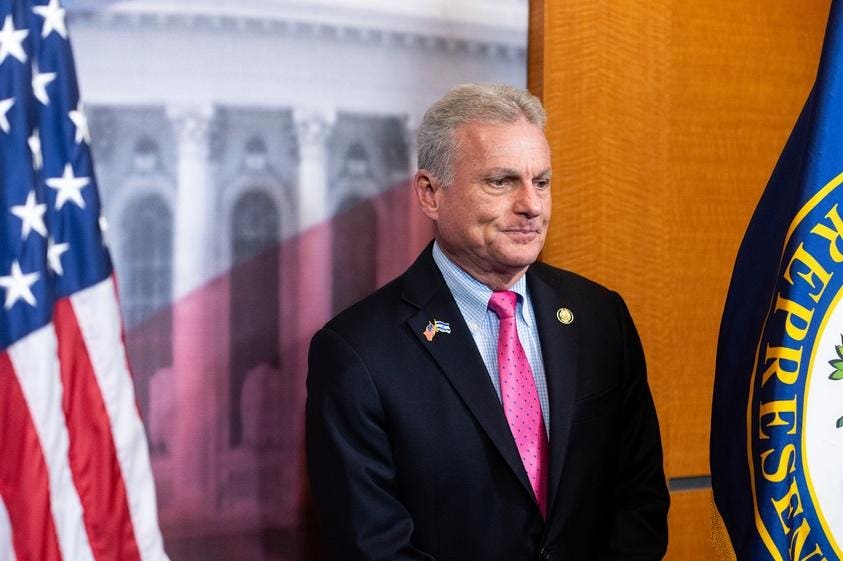
FEB. 4, 2026: Rep. Buddy Carter, R-Ga., participates in a news conference in the U.S. Capitol on pharmacy benefit manager reforms included in the Consolidated Appropriations Act. (Bill Clark/CQ-Roll Call, Inc via Getty Images)
CQ-Roll Call, Inc via Getty Images
A bipartisan group of legislators reintroduced a proposal last month — the Patients Before Monopolies Act — that would prohibit healthcare companies that own pharmacy benefit managers from owning retail pharmacies. If the bill passes, companies will have one year to sell their pharmacies. This proposed legislation constitutes a much greater threat to profitability in the health insurance industry than the set of PBM reforms that have moved forward thus far.
Vertically integrated conglomerates such as Cigna, CVS Health and UnitedHealth, control multiple parts of the prescription drug supply chain, from pharmacies and health insurers to the “Big Three” pharmacy benefit managers — Express Scripts, CVS Caremark and OptumRx, respectively.
Over the years PBMs have invariably found ways to offset diminished sources of revenue and generate new ones. They will likely continue to do so, particularly since the entities they’re part of have been left intact by the latest reform measures. But the proposed bill would break apart the vertically integrated organizations and target retail pharmacies, including specialty units, one of the industry’s major profit engines. Specialty pharmacies focus on dispensing and managing high-cost, high-complexity medications for patients with serious, chronic or rare health conditions. As a source of considerable revenue streams, this could be much more impactful than the slate of PBM reforms currently being implemented.
PBM Reforms Thus Far
The media’s attention has focused on PBM reforms being brought about by passage of the Consolidated Appropriations Act, a Federal Trade Commission settlement and a proposed rule issued by the Department of Labor, all three which occurred last winter. PBMs serve as middlemen between health insurers, drug makers and pharmacies. They manage prescription drug benefits, negotiate prices of pharmaceuticals, including rebates and discounts, process claims and maintain lists of covered medications (formularies).
Federal regulations targeting PBMs are designed to increase their transparency, eliminate hidden fees and mandate the pass-through of drug manufacturer rebates to employers and health plans in the public and private sectors who contract with the intermediaries.
The CAA seeks to give employers and others greater visibility into prescription drug pricing by standardizing PBM reporting on items such as rebates, fees and spread pricing or the difference between what PBMs reimburse pharmacies and what they obtain from fully insured and self-funded sponsors.
A focal point of policy discussions has been the role of rebates in presumably driving up list prices and therefore patient cost-sharing which is calculated on the basis of percentages of list prices. Rebates are payments from drug manufacturers to PBMs in exchange for moving market share toward products with preferred positioning on formularies or lists of covered medications. When a patient fills a prescription for a drug that carries a rebate, the pharmaceutical manufacturer remits an amount to the PBM, according to terms laid out in the contract. Subsequently, the PBM passes through part of the rebate to the patient’s plan sponsor, while keeping a portion as profit. PBMs can pass through up to 100% of these payments to those with whom they contract. The percentage of pass-through depends on the parameters of the signed agreements between PBMs and contractors.
The CAA requires PBMs to pass through 100% of “rebates, fees, alternative discounts, and other remuneration” received from pharmaceutical manufacturers. This applies in both the commercial and Medicare markets, where PBM compensation must be delinked from drugs’ list prices, removing the PBMs’ incentive to sometimes favor drugs with high list prices and high rebates. PBMs are to be paid in flat-dollar bona fide service fees rather than portions of rebates.
The legislation won’t be implemented until 2029, with the DOL’s proposed rule serving as a bridge of sorts that requires self-funded plan sponsors to disclose PBM compensation arrangements as early as at some point this year.
The third set of regulations included in the FTC settlement stipulates that starting next year PBMs have to offer plan sponsors a standard option that passes manufacturer rebates and discounts directly to patients at the pharmacy counter. in other words, not simply a pass-through to plan sponsors as provided in the CAA. Additionally, PBMs must provide standard offerings that eliminate spread pricing. Notably, the FTC settlement contains a provision allowing employer plan sponsors to opt out of the standard offering and continue prior arrangements that include no rebate pass-through to end-users or spread pricing.
Even though enactment of the law as well as other provisions contained in the FTC settlement haven’t happened yet, I’ve been observing shifts in the market from rebate-oriented contracts to ones focused on net pricing for quite some time across all markets.
Possible Break-Up
Independent of legislation and other actions by the federal government, there’s been a rather dramatic shift in primary sources of revenues and profits for PBMs since 2012, from rebates and spread pricing to specialty pharmacy and a variety of fees imposed on drug manufacturers, pharmacies and employer-sponsored plans. While rebates and related cash streams made up nearly 50% of revenue in 2012, by 2023, the percentage had dropped to under 15%. Meanwhile, administrative fees comprised just 5% in 2012, jumping to 22% by 2023 and specialty pharmacy went from 16% to 35%. Though publicly available data hasn’t been released yet this year, it’s probable this change in the mix of sources of revenues has increased since 2023.
And so, while the regulations on tap will further disrupt the rebate system, they’re following an already existing process rather than instigating a transformation. But given the comprehensive moves at the federal level, it’s expected that the new rules will broaden the reach of change.
PBMs, however, have historically found ways to add or offset revenue sources. And since the conglomerates they’re part of have been left intact by the current set of reforms, PBMs can continue to diversify where they make money in the system.
But potentially splitting off retail (specialty) pharmacies, one of the industry’s major profit engines, from healthcare companies may be especially challenging to profitability.
There have been several efforts at the state level to prohibit PBMs from owning specialty pharmacies. Though legislation at the federal level would have substantially more impact given its universal nature.
There’s no guarantee that such a law will pass despite there being bipartisan sponsors. Nonetheless, a mandated sale of specialty pharmacies, in particular, would cut into PBMs’ profitability. They’ve been able to generate increasingly large revenue streams and high profit margins through specialty pharmacies by way of steering patients toward their own captive, vertically integrated mail-order and specialty pharmacies, and even manufacturer subsidiaries in the case of biosimilars (biologic medical products that are almost identical versions of originator biologics).
By controlling the pharmacy that dispenses expensive specialty medications, such as biologic oncology drugs, a vertically integrated PBM can inflate dispensing margins, force patients to use restrictive provider networks and discriminate against independent pharmacies by under-reimbursing them.
Taken together, the federal actions reflect a clear shift toward greater scrutiny of PBMs and specifically the extraordinary opacity of the system in which these intermediaries operate. While the PBM reforms that passed earlier this year will spur further changes in the way business is carried out, it’s the anti-trust legislation that could have the most impact.