

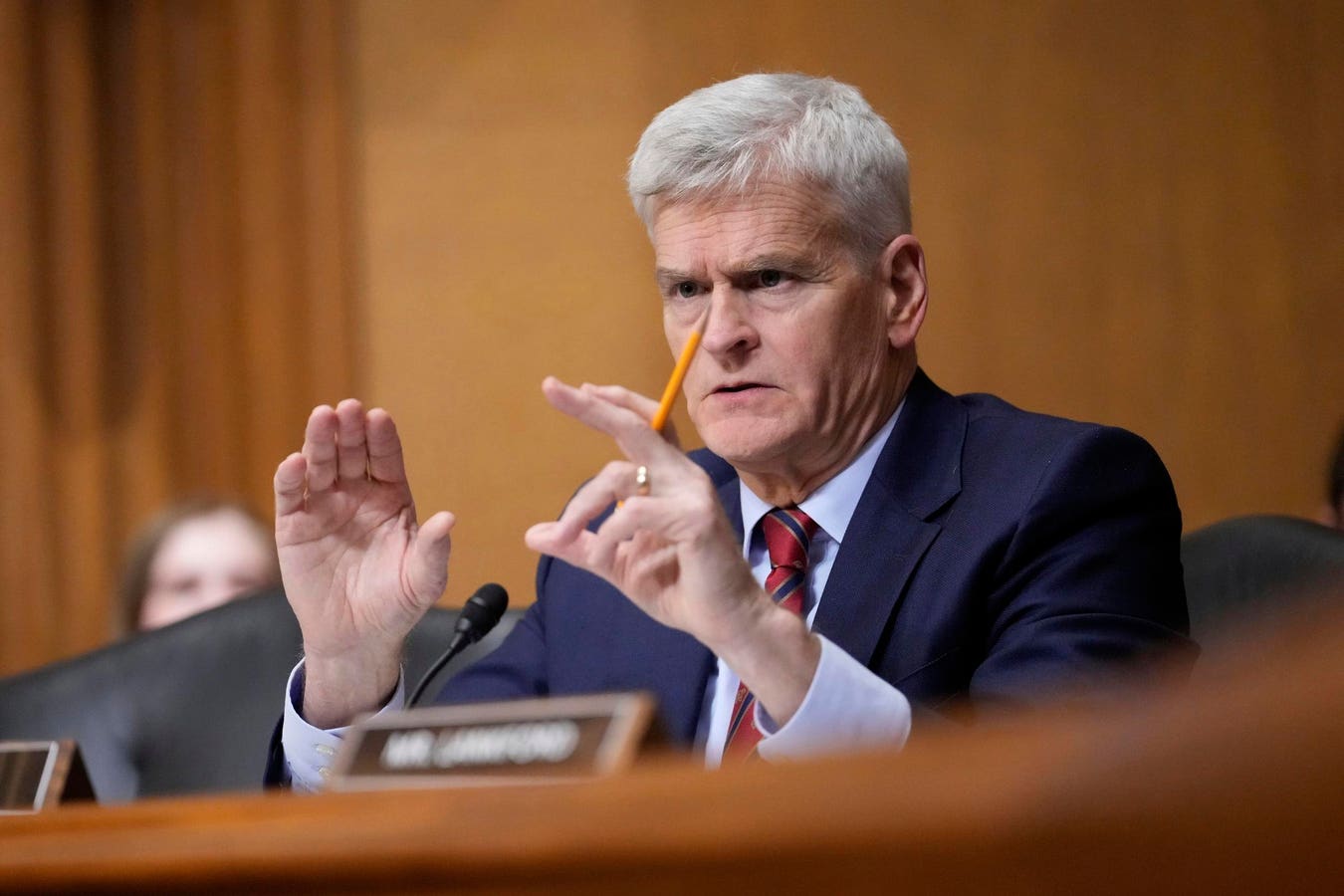
Sen. Bill Cassidy, R-La., questions Dr. Mehmet Oz, President Donald Trump’s pick to lead the Centers for Medicare and Medicaid Services, at Oz’s confirmation hearing before the Senate Finance Committee on Capitol Hill in Washington, Friday, March 14, 2025. (AP Photo/Ben Curtis)
Copyright 2025 The Associated Press. All rights reserved
A few weeks ago, I wrote that Senator Bill Cassidy’s support for Robert F. Kennedy Jr.’s confirmation to head the U.S. Department of Health and Human Services was a case study in political risk and public health leadership. Looking forward, he has a rare second chance to lead and stand up for science and health.
Cassidy entered that confirmation process carrying a unique burden. In February 2021, he was one of only seven Republican senators who voted to convict Donald Trump of inciting the attack on the Capitol the previous month. That vote earned him admiration from some quarters and hostility from others. By the time Kennedy’s nomination reached the Senate in January 2025, Cassidy’s political standing was precarious within certain portions of the Republican base.
As a physician, Cassidy publicly expressed concerns about Kennedy’s long record of vaccine skepticism and public health misinformation. He understood both the scientific and political stakes.
Cassidy the physician worried about what Kennedy’s confirmation might mean for public health. Cassidy the politician worried about how opposing Kennedy would impact his own political future. In the end, despite his public concerns, Cassidy voted to advance Kennedy’s nomination.
It was difficult to not view the vote as an attempt at reconciliation — an effort to make peace with a Republican electorate increasingly aligned with Trump and the Make America Healthy Again movement that had rallied behind Kennedy.
If that was the goal, it did not work. Cassidy’s vote to confirm Kennedy was not enough to overcome the voters who never forgave Cassidy for his vote in Trump’s impeachment trial — or to overcome the president’s support for one of his primary opponents. On May 16, Cassidy came in third in the Louisiana Senate primary — ending his bid for a third term.
Ordinarily, that would be the end of the story.
But Cassidy now has a second chance.
Politics is not known for redemption arcs. Elections are blunt instruments. They do not pause to consider nuance. They do not ask whether a public official deserves another opportunity to explain himself. They render judgment and move on. The winners govern. The losers wonder what could have been. History records the outcome and turns the page.
But every so often, history pauses and presents an unusual opportunity. Not another campaign, not another election, but something far more valuable: another chance to lead — this time without the threat of repercussion.
Despite his primary loss, Cassidy remains chairman of the Senate Health, Education, Labor and Pensions Committee, and in the months ahead, he will oversee confirmation hearings for nominees who could lead some of the most important health institutions in the federal government, including the Centers for Disease Control and Prevention, the Food and Drug Administration and the Office of the Surgeon General.
These are not ceremonial appointments. The leaders selected for these positions will influence how America responds to future disease outbreaks, how scientific uncertainty is communicated to the public and how vaccines and medicines are evaluated. Their decisions will affect the health of millions of Americans long after Cassidy leaves office.
Political survival is not incidental to public office; it is often a prerequisite for continuing to serve. Leaders who lose elections lose the opportunity to advance the causes they care about. As a result, political calculations inevitably become intertwined with policy decisions.
But there is a cost.
The constant pressure of political survival can blur the distinction between what a leader believes and what a leader believes can survive politically. The compromises are rarely dramatic. More often they are incremental — a concern softened, a question left unasked, a calculation made in service of a larger objective. Over time, the distance between conviction and convenience becomes difficult to measure.
What makes Cassidy particularly influential is that before he was Senator Cassidy, he was Dr. Cassidy. Long before cable news appearances, campaign rallies and committee hearings, he spent decades practicing medicine. He treated patients. He diagnosed disease. He relied upon evidence. He understood the difference between scientific uncertainty and scientific denial.
That identity never disappeared. It merely became crowded by another one.
For years, those identities coexisted. The physician informed the politician, and the politician amplified the physician. But there are moments when the obligations of those identities diverge. The confirmation of RFK Jr. as HHS secretary appeared to present one of those moments.
The coming months may present another.
Some will view the upcoming confirmation hearings as an opportunity for Cassidy to distance himself from President Trump or challenge the administration. That would be the wrong instinct.
This moment is not about standing against Trump or anyone else. It is about standing for science. There is an important difference.
In modern politics, we have become accustomed to viewing nearly every disagreement through a partisan lens. Questions about public health quickly become questions about political allegiance. Scientific debates become proxies for ideological conflict. Oversight is often interpreted as opposition, while support is mistaken for loyalty.
But the constitutional purpose of a confirmation hearing is not resistance. Nor is it loyalty. It is scrutiny.
The Senate’s responsibility is to determine whether individuals entrusted with immense authority possess the expertise, judgment, integrity and commitment necessary to exercise that authority responsibly.
That responsibility is especially important when the positions in question affect the health of millions of Americans.
The leaders of the CDC, FDA and Office of the Surgeon General will help shape how scientific evidence is translated into policy, how uncertainty is communicated during crises and how public trust is maintained when the stakes are highest. The country deserves leaders who can explain not only what they believe, but why they believe it.
Cassidy does not need to become a political rebel. He does not need to become an anti-Trump symbol. He does not need to relitigate the battles of the last election. He simply needs to become what he was before politics complicated the equation: a scientist.
A scientist asks questions, follows evidence and interrogates claims. A scientist understands that lives depend upon getting the science right.
The upcoming hearings present an opportunity to ask fundamental questions about science, evidence and public health leadership.
- How should scientific evidence guide public policy?
- What standards should determine whether a recommendation is evidence-based?
- How should agency leaders respond when political pressure conflicts with scientific consensus?
- How can public trust be rebuilt after years of polarization?
These are not Democratic or Republican questions. They are questions confirmation hearings were designed to answer and precisely the kinds of questions that someone with Cassidy’s training and experience is uniquely positioned to ask.
The most valuable contribution Cassidy can make is not opposing nominees for the sake of opposition. Nor is it supporting nominees for the sake of party unity. His responsibility is something far more important.
It is to insist that every nominee demonstrate a commitment to scientific integrity, evidence-based decision-making and transparency. If the administration’s nominees meet that standard, they should be confirmed. If they fail to meet it, they should not. Years from now, Americans are unlikely to remember the details of Louisiana’s 2026 Republican Senate primary. But they may remember what happened next. They may remember how one physician-senator used the final chapter of his public career to elevate science, defend evidence and ask difficult questions when it mattered most.
The hearings will determine whether Cassidy leaves Washington remembered primarily as a politician who once practiced medicine — or as a physician who, in the final act of his public life, did what the profession required.
One senator cannot restore public trust in science. One confirmation hearing cannot repair every institution. But Cassidy has an opportunity to demonstrate that evidence still matters, that expertise still deserves scrutiny rather than dismissal and that democratic institutions still function best when individuals have the courage to do the jobs they were elected to do.
History is giving Bill Cassidy an opportunity to shape his legacy as a senator and a physician — and perhaps, in doing so, improve people’s health. Cassidy’s political future has already been decided, but the future of science, public trust and the institutions that depend upon them has not.