

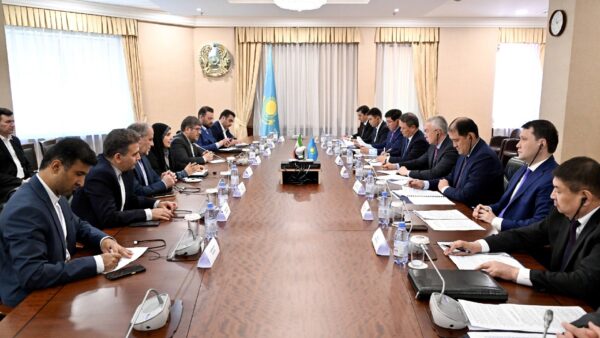
On June 16, 2026, Kazakhstan’s Deputy Prime Minister and Minister of National Economy Serik Zhumangarin and Iran’s Minister of Roads and Urban Development Farzaneh Sadegh met in Astana to discuss expanding transport cooperation.
The meeting produced specific outcomes: Iran allocated a plot at Shahid Rajaee Port in Bandar Abbas for a Kazakh logistics terminal, and Kazakhstan offered Iran port space, berths, and terminals at its Caspian ports of Aktau and Kuryk. Both sides reaffirmed a joint target of 20 million tonnes per year on the International North-South Transport Corridor (INSTC).
The meeting took place three and a half months into the Israeli-U.S. military campaign against Iran, with the Strait of Hormuz closed since March, which gave it a different character than a routine bilateral exchange. It also took place before the signing of a memorandum and talks, which may have paved an exit ramp for the United States from the conflict.
Yet the relationship the Iran-Kazakhstan talks reflected had been developing for years before the war began. Understanding that relationship requires looking at what Kazakhstan built, why it built it, and how a series of overlapping corridor frameworks gradually turned into a transit network connecting it to Iran.
Kazakhstan, the world’s largest landlocked country, inherited from the Soviet Union a railway network that was relatively well developed but poorly balanced: oriented north-south toward Russia, with little east-west connectivity. Post-independence construction, accelerating in the 2000s as the country’s fiscal position stabilized, addressed these gaps. New domestic connections filled the east-west voids; new international lines opened southward to Turkmenistan and Iran and eastward to a second rail crossing with China at Khorgos. Aktau port was modernized and a new port built at Kuryk on the Caspian Sea. A network of overseas logistics terminals – at Lianyungang, Xi’an, Poti, the Moscow region and Alat – extended the country’s reach further. The June 2026 port arrangements with Iran fit into this longer pattern of infrastructure development beyond Kazakhstan’s borders.
The infrastructure Kazakhstan built connects it to Iran through several overlapping international frameworks. Perhaps the most institutionally established is the INSTC, conceived in St. Petersburg in 2000 by Russia, India, and Iran, and joined by Kazakhstan in September 2003. The INSTC has three branches, all of which pass through Iran. The western branch, running through Azerbaijan, carries the largest volumes but is not fully connected by railway – the missing 162-km Rasht-Astara link means most freight crosses the Iran-Azerbaijan border by road. Construction of the missing link was formally agreed between Russia and Iran in mid-February 2026, with a 48-month construction timeline, though its implementation may be affected by the war. The trans-Caspian branch uses Caspian Sea shipping between Russian and Kazakh ports in the north and Iran’s northern ports of Anzali, Amirabad, and Nowshahr in the south. It is constrained by a shortage of vessels and falling sea levels.
The eastern branch is the smallest by volume but the only route with end-to-end railway connectivity. It runs through Kazakh territory via the KTI railway – agreed between Kazakhstan, Turkmenistan, and Iran in 2007 and inaugurated in December 2014 – from Ozen through Bolashak, the border crossing into Turkmenistan, and onward through Bereket to the Iranian border at Incheh Borun and onward to Gorgan. At Bereket, the KTI line connects with Turkmenistan’s Trans-Caspian Railway, extending the corridor’s reach into Uzbekistan and Tajikistan. To operationalize the route, the four countries’ railways agreed on uniform container-kilometer rates in 2022, and Kazakhstan, Turkmenistan and Russia signed a memorandum in 2023 on establishing a joint logistics operator.
A separate but related framework – the Ashgabat Agreement, signed in 2011 and joined by Kazakhstan in 2015 – established a multimodal corridor linking Central Asia to Iran and the Persian Gulf. Institutionally distinct from the INSTC, it shares the same physical backbone and increasingly overlaps with it in practice.
Kazakhstan’s role also extends beyond the north-south axis. China currently has direct railway connections only with Kazakhstan in Central Asia, making it the primary rail gateway between China and the region. In October 2015, Kazakhstan, Turkmenistan, and Iran agreed on uniform tariff rates for container trains from China, an early step in recognizing that transit role. In May 2025, senior railway officials from China, Kazakhstan, Uzbekistan, Turkmenistan, Iran, and Turkiye met in Tehran to advance the China-Kazakhstan-Uzbekistan-Turkmenistan-Iran-Turkiye/Europe corridor, approving competitive tariffs and agreed delivery times. A second meeting followed in Beijing in August 2025, and a multilateral agreement was signed in Istanbul in November 2025. In each of these frameworks, Kazakhstan currently serves as the primary rail transit link between China and Iran.
Kazakhstan and Iran have developed a direct trading relationship that has proved sensitive to the wider geopolitical environment. Bilateral trade turnover exceeded $600 million in the mid-2010s, before declining in subsequent years. It stood at $440.1 million in 2021 and $521.4 million in 2022, before falling sharply to $165.2 million in 2023 under intensified sanctions pressure, with wheat supplies decreasing more than eightfold and barley exports halving. The composition of bilateral trade also shifted, with Kazakhstan running a negative trade balance with Iran in 2023 and 2024 before returning to surplus in 2025. Recovery in overall turnover followed: trade reached $340.3 million in 2024 and grew further to $430.2 million in 2025, up 26.4 percent.
Agricultural goods dominate the export structure: during the marketing year September 2024-August 2025, Kazakhstan exported over 1 million tonnes of grain to Iran, compared to 86,000 tonnes the previous year. In January-March 2026, barley alone accounted for more than half of all Kazakh exports to Iran, amounting to $33 million. Notably, cargo transportation along the North-South corridor grew 12 percent in 2025, reaching 3.5 million tonnes, while railway freight between Kazakhstan and Iran rose 69 percent. The war has disrupted these flows in 2026: bilateral trade in January-March fell to $90.8 million from $129.5 million in the same period the previous year, a decline of 29.9 percent.
Russia began using the INSTC’s eastern branch commercially in July 2022, eight years after the KTI railway opened. The timing followed Western sanctions imposed following Russia’s full-scale invasion of Ukraine in February 2022, though the eastern branch carries only a fraction of total Russia-Iran trade, the bulk of which moves via the western branch through Azerbaijan. In 2024, cargo volumes along the INSTC as a whole reached 26.9 million tonnes, a 19 percent increase on the previous year. The eastern branch carried between 1.8 and 2 million tonnes in 2024, roughly 7-8 percent of total INSTC cargo, compared to only 0.53 million tonnes in its first full year of operation.
Russian Railways (RZD) has nevertheless shown a clear preference for the eastern branch over the other INSTC routes: the eastern branch accounted for 66.8 percent of RZD’s total INSTC freight in 2022, 99.1 percent in 2023, and 78.3 percent in 2024. According to RZD Logistics, in 2024 a total of 2,400 TEUs were transported along the INSTC as a whole, of which 1,900 TEUs moved via the eastern route. The cargo base is dominated by bulk commodities – grain, coal, metals, fertilizers – with a pronounced directional imbalance: 98.9 percent of shipments move southward, as exports from Russia to Iran, while return flows remain thin. In the first four months of 2026, Russian exports toward Iran grew by more than 56 percent, while the North-South corridor as a whole recorded growth of 87 percent, although the latter figure covers the corridor broadly rather than the eastern branch specifically.
China-Iran freight via Kazakhstan developed gradually and unevenly. In January 2019, the first cargo from eastern China arrived in Iran via Kazakhstan’s rail network and Aktau port, shipped by Caspian ferry to Anzali. Yet developing a regular service took time. The institutional groundwork was being laid in parallel: an October 2015 tariff agreement between Kazakhstan, Turkmenistan, and Iran had already established uniform rates for container trains from China, and the six-party talks in 2025 formalized the framework further. Container traffic on the China-Iran route via Kazakhstan grew 2.6 times in January-April 2025 compared to the same period the previous year.
In May 2025, the first direct freight service from China’s Xi’an to Tehran’s Aprin dry port was formally launched, travelling via Kazakhstan and Turkmenistan in approximately 15 days. By the end of 2025, the volume of train services had grown substantially: whereas only seven freight trains had made the China-Iran journey via Kazakhstan in the seven years prior, 40 were dispatched that year alone. Following the U.S. naval blockade of Iranian ports from April 2026, frequency rose from approximately once a week to once every three to four days, according to Bloomberg, with freight rates rising roughly 40 percent. The trade remains predominantly one-directional: containers moving from China to Iran carry industrial and consumer goods, while return flows from Iran to China remain limited, although Iranian officials have indicated they are considering using the route to export petrochemicals and fuel.
The picture that emerges is one of real but uneven momentum. Traffic on the eastern branch remains heavily directional, with return flows thin in both the Russia-Iran and China-Iran cargo. Container volumes are modest: RZD Logistics transported just 1,900 TEU via the eastern route in all of 2024. The Bolashak crossing in Kazakhstan, through which all eastern branch and China-Iran rail freight must pass, remains a single-point bottleneck. Iran’s internal railway network has its own constraints, including gauge differences at the Turkmenistan border that require cargo handling and add time to transit.
Beyond the physical infrastructure, customs procedures and documentation standards across Kazakhstan, Turkmenistan and Iran are not yet fully harmonized, and work on reducing bureaucratic barriers and advancing digital documentation on the corridor is still ongoing. Kazakhstan-Iran bilateral trade, despite its 2025 recovery, was already declining again in early 2026, disrupted by the same war that accelerated freight on other flows. Secondary sanctions risk, already affecting insurance and banking compliance before the war, has not disappeared.
The June 2026 meeting in Astana is best understood as one step in a sequence that began well before the conflict. Kazakhstan built its infrastructure for a combination of domestic integration needs and regional connectivity objectives. The institutional frameworks connecting that infrastructure to Iran developed over two decades through INSTC membership, the Ashgabat Agreement, the six-party talks, tariff harmonization, and corridor roadmaps. Freight flows were growing before the war, and the war has accelerated some of them while disrupting others.
What the conflict has done is concentrate attention on the transport relationship between Kazakhstan and Iran, which was already developing, and bring into sharper focus the question of whether the infrastructure, the institutions, and the commercial conditions are sufficient to sustain that momentum.