

NEW YORK — A couple of years ago, a reporter approached the Boys’ Club of New York looking to interview some of its middle-schoolers for a story about the mental health crisis in boys.
It’s easy to see why. Many of the about 2,500 boys who participate in the 150-year-old organization’s after-school and weekend activities come from disadvantaged socioeconomic backgrounds, often living in single-parent households or facing the threat of immigration enforcement. With limited access to academic and developmental support, the risk factors are plentiful.
“I said, ‘I’m not sure that you’ll find what you’re looking for’, but she insisted,” Avita Bansee, the managing director of communications at BCNY, said about her interaction with the reporter. “She came and interviewed a few of our middle-schoolers. Then she kind of gave up, because it wasn’t echoing what she had thought she would find.”
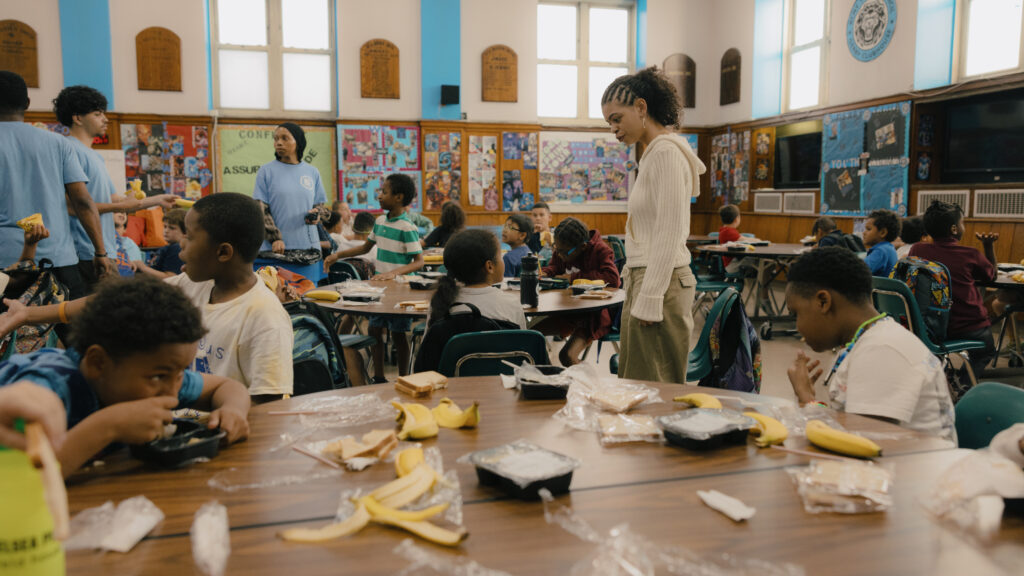
What visitors do find at the three clubhouses the organization runs is a vibe distinctly like a cross between a well-funded public school and a YMCA: wholesome, optimistic, earnest — the opposite of a crisis. It’s just a lot of boys and young men doing homework, swimming, playing sports, learning music, hanging out, teasing one another, getting annoyed, getting bored, having fun. Being kids, together.
It’s rather ordinary. But that’s the story. At a time when so much attention is deservedly being turned to the crisis of boys — who struggle at higher rates than before with mental health challenges, academic performance, and their sense of identity — BCNY is a shelter from the storm for many of its members. There’s nothing especially innovative about what it does; with the necessary updates, it has been doing essentially the same thing since the 19th century, generation in and generation out.
But its approach is emblematic as a model for helping boys and young men thrive against the odds. Researchers are increasingly recognizing one secret to mental health that can be found inside the club’s doors.
“Some of the solutions are really simple,” said Bansee. “You give boys and young men the opportunity to bond in a deeper way. The real magic of Boys’ Club is the sense of belonging and the friendships.”
Niobe Way, a professor of developmental psychology at New York University, who has been studying social and emotional development among teenagers and young adults for almost 40 years, is not surprised that a search for boys in crisis would come out empty at BCNY. Her work led her to develop a theory: “Mental health is not the problem. It’s a symptom of a social health problem,” she said.
Her studies have followed kids over time, observing the evolution of their narratives about friendship. “There’s no gender differences in the desire for close intimate friendships,” said Way, who wrote about her findings in the book “Rebels with a Cause.” “[Boys] are incredibly relationally intelligent. Boys are just like all humans because it’s a human skill, it’s not a gendered skill.”


Yet as boys reach 16, they begin experiencing what she calls a “crisis of connection” and start to be less likely to discuss their feelings and connect to their friends. “They started to give up on their own what they wanted the most, which is friendships,” she said, noting this is exactly the age when the incidence of suicide and violence increases drastically.
She blames “boy” culture: the pursuit of stereotypical manliness, which prioritizes hard traits — “thinking over feeling, autonomy over connection, money over people” — versus soft ones, and defines masculinity by negating vulnerability. This is such an obvious challenge to mental well-being that a group of fifth graders recently diagnosed it, Way said: “When I said, ‘What’s the predictor of mental health?’ they said, ‘When your friends don’t treat you well’. “I started to laugh, and I said, ‘I’ve gotten millions of dollars in research grants to have that research finding.’”
The Boys’ Club, to which she has been an adviser for years, is effective because it addresses the root cause, she said. “At some level what the Boys’ Club does is simple … everything that they offer, every curriculum they have is infused with a desire to help young men bond with other young men across generations, and create opportunities to share hard and soft skills,” she explained. “And it’s run with a lot of love. … When you walk in that space — it’s a place of love.”
A place of love
The club was founded by railroad tycoon E. H. Harriman in 1876, in the basement of a Lower East Side school in Manhattan. It offered reading materials and boxing lessons to keep kids off the streets; today, there are recording studios, swimming pools, robotics classes. The locations have changed as they city has: As once underprivileged neighborhoods turned into some of the most expensive real estate in the world, clubhouses closed in the Lower and Upper East Sides, and opened in Queens and the Bronx.
At its core, however, the main ingredients of BCNY appear to have stayed mostly the same: space, care, structure, and a sense of belonging.

That’s evident on a visit to the Abbe Clubhouse in Flushing, Queens, located in a big brick building belted by a mosaic depicting basketballs and waves. On the entrance door, a laminated sign dispenses rules — no Crocs or sandals (prone to making one fall); headwear needs to be off; and in all caps: NO EATING IN THE LOBBY. Beyond, the small front desk is covered with trinkets that boys have brought the receptionist: Minecraft figurines next to rubber ducks next to McDonald’s Happy Meal gifts.
To the right is the pool, a steamy echo resonating each time its door opens, and to the left, a staircase leading up to the first floor. Written on the steps are BCNY’s four core values — competence, connection, confidence, character. The stairs lead to a gym, a changing room, a game room, a large outdoor terrace, and classrooms with computers. And there is a quiet room where the boys can meditate, relax, or read. Throughout the building, walls are decorated with colorful portraits and quotes of inspiring figures.
Hanging out in the clubhouse on a recent day was a 9-year-old who was skeptical of the pool (“because I was afraid, like if there was a drill and we’re still changing,” he said) and uses the meditation class to catch up on sleep, as he often wakes up by 5 a.m. to see his mother off to work; two impossibly cool teenagers discussing the resurgence of Air Jordans; and a little boy who could not believe he almost forgot his eighth birthday was the following week.
“This is their club,” said Stephen Tosh, BCNY’s CEO of the boys, who are referred to as members. In its early days, the status came with a joining fee: one penny as of 1893, the equivalent of 37 cents today.
“You’re not just a recipient, you’re not just a charity case, you are a member. Membership has its privileges,” said Ashanti Branch, a youth development expert and the founder and executive director of Ever Forward, an organization supporting African American and Latino students in the Bay Area. “Those small little things play a big role in building the connection.”
Abbe Clubhouse Director Orlando Nazario and other workers greet boys by name, and the halls are a riot of high-fives, bro hugs, back pats. Most of the staff dotting the building in red T-shirts are young men, and many are alumni of BCNY clubhouses: when they talk about it, they say they “grew up” there — as if those weren’t institutions but rather the foundational landscape of their childhood and adolescence.
The clubhouses provide boys a safe space and, crucially, some structure and programming, said Dominick Shattuck, a Johns Hopkins University researcher and a men’s health fellow at the American Institute for Boys and Men. “It’s easier to have a personal conversation or even to get to know somebody better when you’re doing something else, whether it’s football or shooting hoops or playing Dungeons & Dragons — whatever your thing is,” he said.
He points to the success of Men’s Sheds, a program that provides men with access to workshops where they can work on projects together, with a belief that “men talk shoulders to shoulders, not face to face.” The idea originated in Australia in the 1980s, as a response to a growing mental health crisis among men in rural parts of the country, and has been credited with reducing loneliness and suicide risk. “There’s plenty of research around this, and these men’s sheds are basically like a Boys’ Club for adult men,” Shattuck said.
The club’s leadership talks about its approach as “collective care”: referring to an approach that borrows from traditions and ideas including Indigenous heritage, mutual aid, and the African concept of ubuntu, which means “I am because we are.” It’s also built on a feminist framework that values interdependence over individualism, and though it originally aimed to improve the well-being of women and gender minorities, the leadership has found it can work just as well for boys and young men.


Where ‘you can be a kid’
For members — especially the many who lack male role models in their lives — being around staff members who “grew up” in the club and lived their same experiences provides a form of organic mentorship, and an opportunity to open up about their feelings with someone who not long ago was in their very same place.
A boy who interacts with that kind of role model sees someone who experienced similar socialization pressure — in particular, the masculinity policing that, since an early age, mandates boys not be too sensitive or emotional, and deprives them of the opportunity of emotional expression — and yet is still able to express himself vulnerably, said Christopher Reigeluth, a professor at Oregon Health & Science University and the author of “The Masculinity Workbook for Teens: Discover What Being a Guy Means to You.”
Branch added that such informal, caring relationships allow a freedom that a boy may not feel when relating to someone who is a relative, or an authority figure such as a teacher. “It allows a soft landing place,” he said.
Over and over in conversations with former members and caregivers of current members, they talked about an “opening up” nurtured by the club. “In school, they would say, ‘Oh, he’s quiet, he don’t say too much of nothing’,” said the single mother of a 17-year-old who joined the club as a first grader. At the time, the two of them had moved to a new neighborhood where they had no family support or connections, and she found BCNY to be a “godsend”: He overcame his fear of swimming to become a member of the swimming team, joined sleepaway camps, and found educational support for his learning disabilities. “When he gets to the Boys’ Club he talks, he doesn’t close out, he’s open, the Boys’ Club was able to give him that,” she said, asking her name not be published.
Another mother, Isabel, signed up her first grader to the club five years ago, following the footsteps of her brother — “I used to be jealous that he went to the club and I had to stay home because it’s for boys only,” she remembered. Her now-10-year-old has gone from shy to social and is able to speak up for himself, and others. “The other day he told me that he helped a friend at school, because the friend was so upset and crying, and he helped the friend to calm down,” she said.
Relationships that are formed with peers and mentors in an environment such as the club can strengthen resilience, said Roselinde Kaiser, director for the Center for Healthy Mind and Mood at the University of Colorado, citing research showing that people who had one trusted person in their life to whom they could go — such as a teacher or a near peer who is a couple of years older — “were much more likely to expand into a broader network.” In turn, she said, this network has the power to mitigate even the impact of stress-induced depression and anxiety. “Fostering those early connections can pay dividends in ways that are exponential,” she said.
For the former members, going back to work at the club has benefits, too: an opportunity to give back and continue developing skills, and potentially a career. Layton McKenzie, who joined as a sixth grader in 2006 and at 31 is now a teen program director, describes joining BCNY as life-changing. It led him to attend boarding school on a scholarship, build lifelong friendships, and attend college.

A young man of strikingly polite and gentle manners, he recalled how the club coaxed him out of his shell as he negotiated an environment very different from Southside Jamaica, Queens, where he grew up. “Coming to the boys club, it was very diverse and there were some [boys] that I never really interacted with before, and I didn’t really know how. But our [mentors] gave us some prompts and they encouraged us to get out of our comfort zone … and encouraged us to just get along,” he said. He realized “there’s no need to be rigid or there’s no need to feel like I’m not protected. There’s no need to feel unsafe.”
So now, as a director, he said he stresses that members can let go of any outside grittiness and toughness. “This is not a place that you have to feel like you need to put up that persona,” he said. “This is a place that you can come and you can be a kid. You can come and be yourself. When you come to the Boys’ Club, it’s a brotherhood.”
Still, this doesn’t work for everyone. “My best friend actually was one of those that came and we started the boarding school process together and he unfortunately just took the completely wrong route. And I’m here and he’s in another completely different place,” said McKenzie. “So, you know, that does happen.”
Members may not paint a picture of youth in crisis, but they still often face serious challenges: learning disabilities, ADHD, lack of financial resources, even homelessness. Recently, fear of Immigration and Customs Enforcement raids has escalated anxiety for members from immigrant families.
The club’s policy is that membership is forever, but some boys stop coming. While in many cases the reason is moving, or going to a boarding school, there are boys for whom the club is not a good fit, said Tosh, the CEO. “The biggest issue we have sometimes with some of the younger boys is it’s a lot after a long day at school … and some of the boys need a quieter environment after school,” he said.

Measures of success
It’s hard to quantify the difference the Boys’ Club makes in its members’ lives, their well-being, their ability to form friendships, the processing of their emotions. These are benefits not measured in high school graduation rates, scholarships awarded, or swimming championships won.
“In most schools, you are measured by attendance, behavior, and core class success; no one’s caring about your wellness, no one cares about your feelings, your emotions,” said Branch.
The club tries to capture some data, if qualitative. Recently, staff surveyed and interviewed more than 500 kids, third grade and up, who had been at BCNY for at least a year. What they found was that 95% of members felt safe at BCNY, 88% felt included, and 85% felt welcome from the very beginning. For about a third of the members, “meeting new people” was the best part of attending.
Kelvin Jarama-Nivicela, a 20-year-old from Corona, Queens, who attended BCNY starting when he was 7, said the friendships he built there continue to be foundational in his life: “We’re a very close knit group, we do a lot of the stuff together,” he said. So are the relationships he formed with his mentors. “I always go to them when I have personal or professional problems,” he said. “Even recently I had a very difficult relationship with one of my supervisors, and I went to them for advice.”
Now working as an assistant project manager for a plumbing company, he said his ability to talk with people and network was a lot better than most of his peers. “I feel like I’ve avoided a lot of problems that come with feeling alone,” he added. “I feel like being in the clubhouse, really just literally physically being in the clubhouse, kept me away from that.”
There’s scientific evidence to support that idea. “Loneliness increases anxiety but also it increases sensitivity to rewards, which means it can have all kinds of behavioral consequences,” said Livia Tomova, a researcher at Cardiff University in Wales who researches the role of social connection in adolescents. This can include risk-seeking behaviors, in which the reward is attention or thrill. Further, socialization is an important part of cognitive development and during adolescence, as it facilitates the development of skills such as strategic decision-making or understanding the sense of self.
“Interactions with others are really crucial in order to develop these,” she said. “So they’re not just beneficial, they’re really kind of essential.”
Dionys Jimenez, a joyful 33-year-old former member who is now the club’s education director, chose his career precisely because he saw firsthand the benefits the club had on him. “The Boys’ Club was that space for us to be able to fail, to be able to learn, and then ultimately try to come out on the other side, a better version of ourselves,” he said.
His generous smile flashed as he remembered being with his peers at the club day in and day out. “I’ve never really had any issues with sense of belonging or isolation or any of the things that young men unfortunately are facing today,” he said. “We were facing the same battles together.”
STAT’s coverage of health challenges facing men and boys is supported by Rise Together, a donor advised fund sponsored and administered by National Philanthropic Trust and established by Richard Reeves, founding president of the American Institute for Boys and Men; and by the Boston Foundation. Our financial supporters are not involved in any decisions about our journalism.