

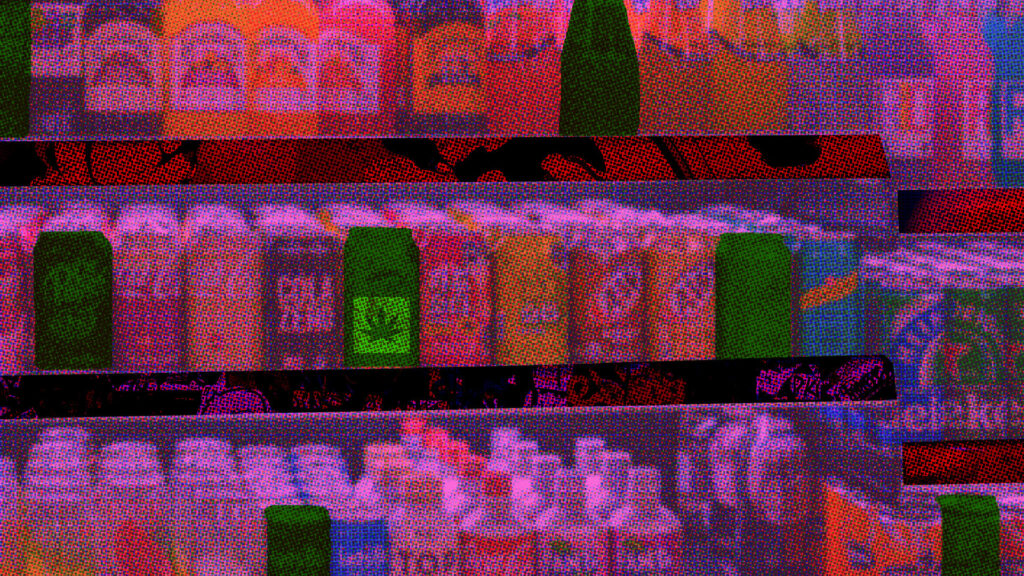
NEW YORK — It’s easy to miss the cannabis beverages that line the refrigerated sections of grocery stores, bodegas, and delis throughout New York City. The rainbow-like array of cans — bearing names such as Oasis, Cann, Milonga, Cycling Frog, Tempter’s, Gigli, and Mighty Kind — often look indistinguishable from iced tea, probiotic sodas, and other wellness-coded “functional beverages” that share their shelf space.
In font sizes that range from prominent to squint-worthy, the cans’ labels note that they contain THC, the psychoactive compound found in cannabis. But most of the 10 stores visited on a recent scouting trip through South Brooklyn, some within a couple blocks of schools, displayed no signs indicating that these were intoxicating beverages, nor did they ask for identification when the drinks were brought to the register.
According to New York state law, none of these drinks should be available in regular retail stores. Regulations adopted in 2023 limit them to no more than 1 milligram of THC per serving. Yet beverages with up to 100 times that much were being sold — in a gourmet deli on a tony Brooklyn Heights street lined with an Instagram-famous bakery and pilates studios; at a large grocery store across from an entrance to Prospect Park. Most doses were in the 5- to 10-mg range, a standard dose for casual marijuana users, though high-potency brands with 50, 60, and even 100 mg of THC — intense amounts likely to overwhelm all but heavy users — were also easy to find.
“It’s not allowed,” said Christopher Lackner, head of the trade group Hemp Beverage Alliance, “but it’s still happening.”
THC drinks like these have exploded in popularity across the U.S. in recent years in tandem with Americans’ declining alcohol consumption, with between 500 and 750 brands competing for expected sales of $1.4 billion in 2026. Their widespread availability is thanks to a loophole created by the 2018 Farm Bill that legalized products derived from hemp — a type of cannabis plant used in agricultural products like textiles and oils.
That opened the door for companies to start selling products with THC derived from hemp at retail stores, too. The loophole is now set to close in November. But the THC beverage industry is confident that some solution will be worked out sooner or later, and recent moves by major chains like Target, Circle K, and Sprouts to roll out or expand sales of the drinks suggest retailers share that optimism. Doctors, researchers, and advocacy groups, however, warn that these easily accessible and indistinctly labeled drinks raise the chances of people accidentally ingesting THC, and put the health of young people and other vulnerable groups at risk.
“We’ve been seeing a huge increase in the number of kids ingesting the THC drinks as well as other THC products now that they’re easily accessible,” said Rudy Kink, a pediatric emergency physician at Le Bonheur Children’s Hospital in Memphis, Tenn.
Kink estimates the hospital sees four to five cases a week — a mix of curious toddlers drawn to colorful packaging and teenagers who are intentionally experimenting with cannabis, though occasionally there’ll be a teen who mistook a cannabis drink for soda, too. They come to the hospital lethargic, confused, sometimes nauseous and vomiting, sometimes nearly comatose. Their mystified parents often have no idea what the problem might be until blood and urine testing turns up the THC.
“I don’t think that teenagers quite understand the effects of THC and how it can cause some of the other problems medically, like vomiting and altered mental status,” said Kink. “Me personally, I’d like to see that these are plainly, clearly marked as THC drinks, so there’s no confusion.”
A 2025 survey of high-school seniors found that 8% of females and 10% of males said they’d had cannabis products made from hemp in the last 12 months. A survey of U.S. adults the same year from the market research firm Brightfield Group found that 14% of U.S. adults said they’d consumed hemp-derived THC, and that THC drink users tend to be younger, more highly educated, and have higher income compared to people who use other kinds of products.
The cans themselves could use more clarity as well, said Jessica Kruger, a health educator at the University of Buffalo who researches cannabis use. “People don’t know nutrition labels,” she said. “They do not understand cannabis labels or milligrams.”
Another public safety concern, Kruger said, is that THC drinks not sold through state-licensed dispensaries aren’t subject to the same testing and scrutiny. “You don’t know if there’s contaminants, you don’t know what the ratio is” of THC to CBD, the nonpsychoactive compound in cannabis that can balance or soften THC’s effects. “They can claim whatever the heck they want.”


The health risks of accidentally consuming a THC drink
Since the availability of hemp-derived cannabis products like THC drinks, gummies, and vapes spiked over the last five or so years, there’s been a notable increase in pediatric poisonings, said Matthew Rossheim, an associate professor of health administration and policy at UNT Health Fort Worth who studies retail cannabis products.
One recent study published in the Journal of Addiction Medicine found that calls to U.S. poison centers concerning cannabis exposure in kids under age 6 exploded by more than 6,000% between 2009 and 2024, and by more than 13,000% for kids between the ages of 6 and 12 during the same period. Another small study of 27 children ages 14 and under with suspected exposures to hemp-derived delta-8 products found that 30% required admission to the intensive care unit. Most had abnormally low blood pressure, while 22% were having trouble breathing and 59% required IV fluids.
Rossheim also pointed to a rise in ER visits from patients with cannabis-induced psychosis. A large cohort study of Northern California teens found that cannabis use was linked with a significantly higher risk of psychotic and bipolar disorders.
“We had parents that thought that their child was buying CBD, and their child thought they were buying CBD, until they developed psychosis,” said Diane Carlson, co-founder and national policy director for the advocacy group One Chance to Grow Up, which is focused on protecting kids and teens from the harmful effects of THC.
In Ohio, the director of outpatient psychiatric services at Licking Memorial Hospital told the local news outlet Newark Advocate that the THC drink boom had led to an increase of ER visits from patients who were “actively psychotic.” And on Reddit, users seek help for all kinds of mistakes. One asks about mixing their medication with a THC-infused drink: “mistook it for some bougie soda,” they write. Others mistakenly take larger doses than they can handle or fret that they’ll fail to scrutinize a label closely enough and fail a mandatory drug screening test for their job.
People less familiar with the world of marijuana may not even know what THC means. “They might just think it’s a wellness drink or some other thing that isn’t going to produce intoxication,” said Tory Spindle, an associate professor at Johns Hopkins Medicine who studies the pharmacological and behavioral effects of cannabis.
The worst-case scenario, he said, “is that someone would buy one and not know that it has THC in it at all, and then you get intoxicated and drive while under the influence.”
THC drinks may also carry particular types of risks compared to other types of cannabis products, according to Spindle.
He’s conducting a study where he gives participants THC beverages and different kinds of edibles. So far, the results show that people can start feeling the effects of drinks within 15 to 20 minutes, peaking around 30-45 minutes. Conventional formulations like brownies or gummies, by comparison, often take about an hour to kick in and peak around two or three hours later. A 10-mg beverage also seems to be more potent compared to a 10-mg gummy.
All of this has critical implications, Spindle said. Even people aware that they’re drinking a THC beverage might not realize how quickly it can start impairing their response times and judgment.
Spindle’s research also shows that cannabis products are often inaccurately labeled, both under- and over-estimating the actual concentration of THC.
Hemp-derived products are more likely to be incorrectly labeled and possibly contain contaminants than cannabis sold in state-licensed dispensaries because there is no regulatory oversight of them, he said. While he hasn’t studied the accuracy of THC drink labels in particular, he said, “I would be surprised if the results were that different from what we’ve shown in the past.”
How groceries and delis market THC drinks
Lackner, the head of the Hemp Beverage Alliance, said his organization thinks THC beverages should be marketed, labeled, and shelved just like other adult beverages, and customers should have to provide IDs showing they’re at least 21 years old.
In the meantime, if the drinks are shelved with nonalcoholic beverages, Lackner said, there should be signage alerting customers to the fact that they contain THC. But the reality is that in many states, there’s essentially “a self-regulatory scheme for the reputable retailers in the industry,” he said.
State laws on hemp-derived THC vary greatly and are often in flux. Ohio, for example, banned most such products this spring with the goal of specifically targeting THC beverages, but some drinks were back in stores starting in July after a federal judge temporarily blocked the law. Alaska and Washington have been fairly successful in pushing back against the availability of THC products outside of state-licensed dispensaries, said Rossheim, noting that bans alone are not enough. Overall, he said, “enforcement for these types of laws is very low.”
Target currently sells THC drinks in Florida, Illinois, Minnesota, and Texas. A Target spokesperson told STAT that the retailer requires IDs for customers to purchase THC beverages, displays the beverages next to other adult drinks, and has “dedicated signage up in stores that carry THC products (even when it’s not required by state law).”
On a recent trip to a Target store in Austin, Texas, THC drinks were displayed on an end cap — the premium space that faces outward at the end of aisles. Manufacturers often pay extra charges, known as “slotting fees,” to stores in order to get those prominent spots.
A large sign, above eye level for many customers, marked them as THC-infused beverages. Lower down was a much smaller sign, stamped with a warning label, that said “these products contain THC,” noting that customers had to be 21 to purchase them and that it was illegal to drive under the influence of THC. Thin green strips saying “these drinks contain THC” also lined the shelves.
The grocery stores and bodegas of Brooklyn, N.Y., took a less intentional approach. At a Brooklyn Heights deli, the THC drinks were directly below Nesquik and bled seamlessly into probiotic sodas, with no signs of any kind indicating that they were intoxicating.
A few stores had labels showing the brand names and prices of the cans, which might or might not mention that they contained THC. In all but one case, they were stocked not with alcoholic beverages but with lemonade, energy drinks, and coconut water.
At a co-op in Minnesota, the drinks were stocked, unmarked, beside cold brews.
A spokesperson for the National Grocers Association noted that regulations on hemp-derived beverages can vary from state to state. “We encourage retailers to follow all applicable federal, state, and local laws and to work closely with regulators and suppliers to ensure products are marketed and labeled in accordance with those requirements,” the spokesperson said.
New York’s Office of Cannabis Management did not respond to a request for comment about the presence of THC drinks in retail stores.

Will THC beverages actually get banned?
Some people may benefit from responsible use of cannabis beverages. University of Buffalo’s Kruger said she sees potential for them as a harm reduction alternative to alcohol. In one study she co-authored, people who drank an average of one THC drink per day drank less alcohol and were less likely to binge drink. “What we found is most people aren’t drinking back-to-back cannabis beverages” the way they may be tempted to with alcohol, she said.
That said, there isn’t yet long-term data to assess the potential health impacts of having, say, one THC drink a day for 20 years. Because of federal restrictions, “we can’t study cannabis like we study alcohol,” she said.
The alcohol industry, for its part, is torn on the matter of THC drinks. Manufacturers have been weighing whether to tap into the lucrative cannabis drinks market or root for the Farm Bill loophole’s closure, while many liquor stores and breweries want to continue selling THC drinks as a way to offset losses from Americans’ declining appetite for alcohol.
Looking ahead, Lackner of the Hemp Beverage Alliance is philosophical about the looming threat of the ban on hemp-derived beverages in November. He said that several pieces of legislation have been introduced in Congress in recent months proposing potential fixes and more proposals are on the way, from delays, to creating new regulatory pathways for THC drinks, to giving states an opt-out option.
Congressional staffers have told the industry, he said, that “the one thing Congress is good at is acting at the very last minute and kicking cans down the road. So while we are in a very awkward position right now of having five months before this ban happens, we still remain very confident that cooler heads will prevail.”
While they await news from Congress, some industry players, including Cann and the founders of Cantrip, are rolling out non-THC beverages to hedge their bets. But many are continuing to produce their THC drinks at high volumes. “Demand is through the roof,” Lackner said. “If you’re a manufacturer of these, you’re gonna manufacture up until the very point that you can’t.”
Also keeping the faith were the more than 100 distributors signed up for the recent hemp beverage expo in Austin, Texas. “I don’t think people go to an expo for a category that’s demise is imminent,” he said. “Certainly you don’t go to Texas in June for one.”
STAT’s coverage of chronic health issues is supported by a grant from Bloomberg Philanthropies. Our financial supporters are not involved in any decisions about our journalism.