

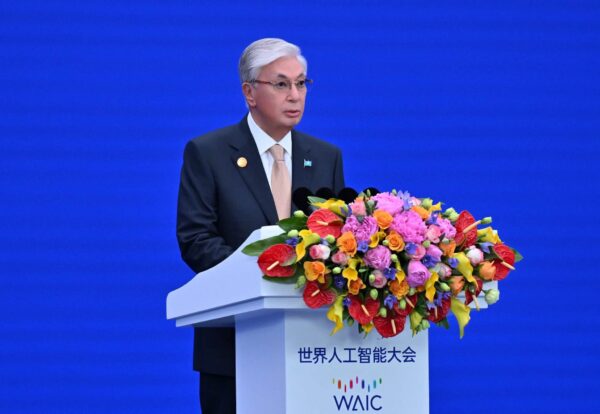
On July 17, Kazakh President Kassym-Jomart Tokayev concluded a trip to Shanghai, China, by speaking at the opening of the 2026 World Artificial Intelligence Conference. While restating Kazakhstan’s efforts to become a regional hub for digital trade and international cooperation, Tokayev also praised China for its advancements in the field during his 16-minute speech.
The day before, the Kazakh president had already expressed his desire to deepen cooperation between the two countries in the field of technology. This was underscored by the signing of deals worth more than $15 billion covering digital infrastructure, transport, and the security sector.
Tokayev’s trip comes amid what the Kazakh government has coined the Year of Digitalization and AI, with energy and resources being directed toward the development of a digital state. His talks with industry-leading companies in Shanghai on July 16 also made it clear that China played a defining role in Kazakhstan’s development.
Even before the conference, China played a visible part in Kazakhstan’s digital strategy, both by sharing relevant knowledge and by integrating Chinese hardware to propel Kazakhstan’s hypermodern ambitions. For example, the Chinese firm Huawei is the provider of several parts of Kazakhstan’s critical infrastructure.
Tokayev’s Shanghai visit was preceded by a trip by Kazakh Foreign Minister Yermek Kosherbayev to Beijing on July 13, where he met with his Chinese counterpart, Wang Yi. There, Wang expressed optimism about the upcoming meeting.
“The two heads of state will conduct in-depth strategic communication, injecting new impetus into the development of bilateral relations,” the Chinese foreign minister stated.
Simultaneously, Kosherbayev showed great interest in maintaining close relations between the two countries, asserting that Kazakhstan always prioritizes cooperation with China.
In his Shanghai speech, Tokayev further emphasized the scale of Sino-Kazakh economic relations: “Last year, bilateral trade volume reached $49 billion. This is a record high. China has invested over $30 billion in Kazakhstan’s economy,” the president said during the roundtable with heads of several Chinese high-tech companies.
The speech was followed by another step toward closer cooperation, with the two countries signing more than 70 agreements and memorandums worth over $15 billion. Besides deals in the logistics sector, some of the largest agreements concerned the digital development of, or deployment of, artificial intelligence in Kazakhstan. Astana became one of 29 governments to sign on to the Shanghai-based World Artificial Intelligence Cooperation Organization.
Huawei emerged as the biggest beneficiary, agreeing to a strategic partnership with the Kazakh Ministry of Artificial Intelligence and Digital Development while also signing a deal on the delivery of equipment for Kazakhstan’s sovereign wealth fund. Alongside this, Kazakhtelecom also agreed on the basic principles for future cooperation in the construction of the Data Center Valley, a 1 GW data center in northeastern Kazakhstan that, when built, is set to become the biggest of its kind in Central Asia.
Despite the fact that a full list of the more than 70 agreements and memorandums has not been published, the publicly available data suggests that most of the deals center around the delivery of Chinese products to Kazakhstan, and not the other way around. While Kazakhstan exports critical minerals to China, such as copper used in the manufacturing of electric vehicles, Chinese companies have been key to Kazakhstan’s digitalization over the past several years.
China’s focus on Kazakhstan shifted noticeably in 2022. That year, Huawei decided to relocate several of its operations from Russia to Central Asia, following Moscow’s full-scale invasion of Ukraine. Huawei was later also selected to build Kazakhstan’s 5G infrastructure, thereby giving the company leverage over critical infrastructure.
Moreover, the telecommunications company also signed agreements related to future data centers in Kazakhstan just last year, including a memorandum under which Huawei will assist with cybersecurity efforts in the Kazakh energy sector going forward.
On a broader level, China has already influenced Kazakhstan’s approach to security. According to Radio Azattyk, this can be seen not only in the technology used, which comes from China, but also in the methods of nationwide surveillance.
As Tokayev returns home, Kazakhstan’s technological dependence on China appears set to deepen. With this, a successful hyper-digitalization of Kazakhstan will benefit both the Central Asian nation and the Chinese economy.