

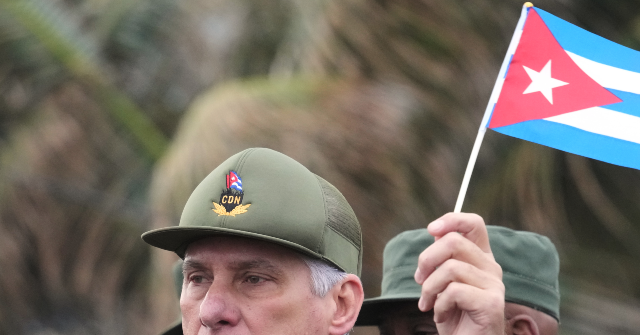
Cuba’s ceremonial “president” Miguel Díaz-Canel, who is subordinate to 95-year-old dictator Raúl Castro, published a diatribe on social media on Monday condemning the U.S. State Department for detailing the Communist Party’s decades of violent and destabilizing activities around the world.
In a six-part post on Twitter, Díaz-Canel claimed that the United States was guilty of “genocidal” behavior against the Cuban Communist Party, had propagated “plagues” on the island, and was reviving “fascist” “neo-McCarthyism.” The leader claimed that the Cuban Communist Party, a U.S.-designated state sponsor of terrorism with ties to a host of jihadist and anti-American groups around the world, had never sought to damage the fabric of American society and had only “defended” itself against Washington.
Díaz-Canel’s outcry followed declarations by Cuban Foreign Minister Bruno Rodríguez and preceded propaganda in Cuban state media outlets condemning the State Department for accurately detailing the history of espionage and subversion the Castro regime has written for itself in the past half century. The regime is responding to the publication on Monday of a 100-page report by the State Department titled “Cuba: The Capital of 21st Century Communism” offering a detailed history of nefarious and often terrorist activities against the United States by the Castro regime since 1959. While retelling in vivid detail the espionage, guerrilla actions, and terrorist activities organized while late dictator Fidel Castro was still alive, the report also warned that the Castro regime continues to engage in expansive subversion activities, training Marxist Americans in how to disrupt American society and foment civil unrest at home.
In his tirade, Díaz-Canel accused Secretary of State Marco Rubio, a member of the Cuban exile community, of being “one of the most corrupt officials in the current administration” and spuriously claimed Rubio himself had links to “terrorists in Florida.”
He accused the U.S. government for decades of supporting “regime change programs in Cuba, appealing to subversion and terrorism all the same.” In reality, the United States has long supported persecuted dissidents on the island and condemned the extensive list of abuses the regime has committed against them, including assassinations, imprisonment and torture, starvation, and other atrocities.
In addition to complaining about support for pro-democracy dissidents, Díaz-Canel claimed, without evidence, that the United States had subjected the island to “plagues,” listing “psychological warfare” as part of this alleged plague campaign. The only disease he listed in his statement was dengue fever, a mosquito-borne illness prevalent in tropical countries. Cuba has for decades struggled to contain outbreaks of preventable disease due to the deteriorated state of its communist healthcare system, which the Castro regime hollowed out to subsidize its lucrative slave doctor program.
Díaz-Canel went on to accuse the American government of “genocide” through its limitations on trade with Cuba — the so-called “embargo,” with extensive exceptions for food and medical aid — and of being governed by a “clearly fascist” administration.
“What the Cuban Revolution has done throughout its history is defend itself from these successive and interminable aggressions, by legitimate right,” Díaz-Canel claimed. “Cuba has never worked to hurt the American people, nor has it intended to affect the national security of the U.S.”
Díaz-Canel’s statement was more incensed than the comments from various other arms of the Cuban regime to the report. Foreign Minister Bruno Rodríguez accused the State Department of creating “a pretext to sustain the cruel and criminal economic war that punishes every Cuban family” with the report, an often repeated talking point in response to any American action.
Rodríguez’s vice minister, Carlos de Cossio, pronounced himself bored by the document.
“Whoever has the patience to read in its totality the propaganda pamphlet from the State Department about Cuba will find,” he wrote on social media, “1) routine lies; 2) references to genuine solidarity; 3) curious admiration for Cuba; 4) no concrete evidence of subversion in the U.S. or the Western world.”
Contrary to Cuban officials’ claims that the State Department offers no proof of subversive activity, the document meticulously documents Castro regime actions beginning in 1959 to support communist terrorism around the world and Marxist unrest in the United States. Much of this activity is orchestrated through organizations such as the Venceremos Brigades and other “solidarity” groups that invite American leftists to Cuba for training on how to organize social disruptions. The report specifically identifies American college campuses as Castro regime targets, stating, “U.S. intelligence analysis and DI [Dirección de Inteligencia, Cuba’s main foreign intelligence agency] defector testimony have both established that Cuban intelligence treats infiltrating American universities as a top priority.”
“The Cuban regime functions less as a vehicle for the interests of ordinary Cubans… than a one-stop shop political service for the rotating cast of foreign left-wing activists,” the report asserted.
The State Department first revealed that it would soon publish the report on Cuba’s elite position as a destabilizing force internationally in a statement to Breitbart News on July 14.
“The State Department will be issuing a report detailing the Cuban regime’s longstanding campaign to foment left-wing extremism in the United States and internationally,” a State Department official told Breitbart News at the time. “The report finds that for nearly seven decades, the Cuban regime has played an indispensable role in nearly every notable far-left insurgency, revolution, and militant movement across the Western Hemisphere and beyond.