

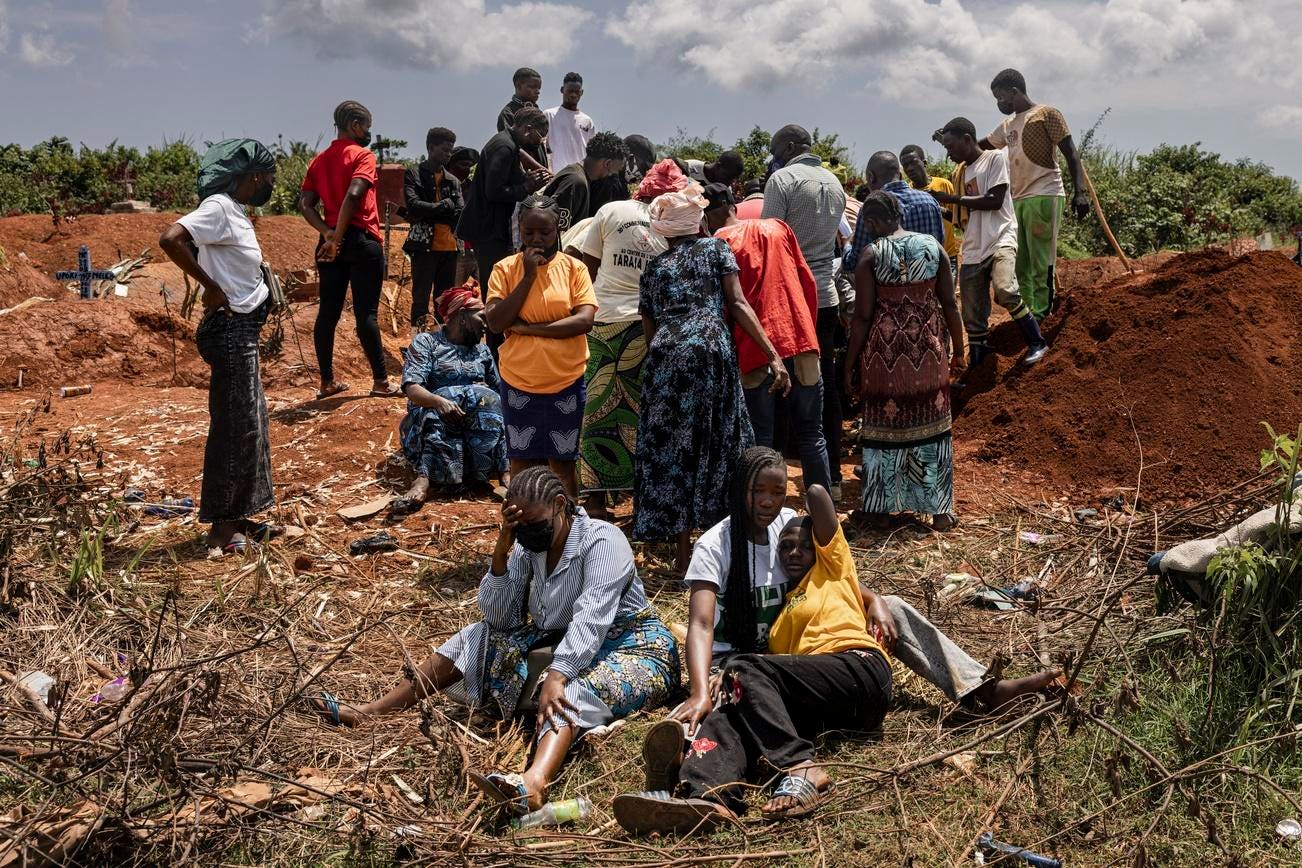
MONGBWALU, DEMOCRATIC REPUBLIC OF CONGO – MAY 20: People attend the burial of an Ebola victim at a cemetery in Mongbwalu, Ituri province, eastern Democratic Republic of Congo, during the Ebola outbreak on May 20, 2026. The World Health Organization (WHO) has declared the Ebola outbreak in the Democratic Republic of Congo (DRC) and Uganda a “public health emergency of international concern,” as the death toll and number of confirmed cases continue to rise. The current epidemic is caused by the Bundibugyo virus, one of several Orthoebolaviruses that can cause Ebola disease, and for which there are no approved vaccines. The highest number of cases have been reported in Congo’s eastern Ituri province, bordering Uganda. Global health officials have expressed grave concern over the capacity to contain the outbreak in a region already facing a humanitarian crisis, with highly mobile populations displaced by conflict and economic factors. (Photo by Michel Lunanga/Getty Images)
Getty Images
The chief medical officer for the Mongbwalu health zone in eastern Congo, Ruben Deja Dhenyo, told Bunia Actualité on May 8 that there was no epidemic in the town, because the recorded cases did not present similar signs. He allowed that there had been unusual events. Drug use among young people. Tramadol and diazepam dissolved into soft drinks.
Seven days later, Congo declared an outbreak of Bundibugyo virus, an Ebola species for which there is no licensed vaccine and no specific treatment. It is now the second-largest on record, with 3,802 confirmed cases and 1,707 deaths as of August 3.
Dhenyo was not being evasive. He was describing what his surveillance system could see, which by then was almost four months behind what was happening.
500 Cases Nobody Counted
Science reported July 30 on an unpublished, WHO-funded field study by the anthropologist Jules Villa, the University of Bunia medical researcher Roger Buju and Alain Alithum Bero, a social scientist working in Ituri. The three spent more than a month in Mongbwalu. They interviewed 97 people, looked for households that had lost two or more members within 21 days to symptoms suggesting Ebola, and read the biographies delivered at funerals.
They counted more than 500 suspected cases between mid-January and the declaration. Thirteen front-line health workers died. The cemetery was managing as many as 20 burials in a day.
The first of those deaths they could date was a fifty-year-old woman on the outskirts of town who died on January 25 after vomiting blood. Her mother died six days later. Her husband fell ill and recovered.
Why The Models Miss January
So far, none of the models of this outbreak has placed its beginning in January. The CDC’s team, writing in MMWR in June, placed the spillover in “mid to late February 2026.” The running nowcast maintained by Sam Abbott, Kath Sherratt, Samuel Brand and Sebastian Funk at the London School of Hygiene and Tropical Medicine puts the start between March 1 and March 27 with 90% probability.
A genomic analysis posted in early July, led by the Institut National de Recherche Biomédicale in Kinshasa with Placide Mbala-Kingebeni and Jean-Jacques Muyembe-Tamfum among its authors, dated the epidemic from the family tree of sequenced viruses. It put the earliest cases in mid-March, though its intervals ran back into the first week of February.
A veteran of Ebola research, Muyembe-Tamfum collected the blood sample that led to the identification of Ebola in 1976, and he directed Congo’s response to the epidemic that began in 2018 in the east. This is a team that knows what its sequences can and cannot show. “I think January is plausible … because we don’t have many sequences from Mongbwalu,” Andrew Rambaut, an evolutionary biologist at the University of Edinburgh and a collaborator on the analysis, told Science.
MONGBWALU, DEMOCRATIC REPUBLIC OF CONGO – MAY 21: Health workers wearing protective equipment walk outside the General Referral Hospital during the Ebola outbreak response on May 21, 2026 in Mongbwalu, Democratic Republic of Congo. The World Health Organization (WHO) has declared the Ebola outbreak in the Democratic Republic of Congo (DRC) and Uganda a “public health emergency of international concern,” as the death toll and number of confirmed cases continue to rise. The current epidemic is caused by the Bundibugyo virus, one of several Orthoebolaviruses that can cause Ebola disease, and for which there are no approved vaccines. The highest number of cases have been reported in Congo’s eastern Ituri province, bordering Uganda. Global health officials have expressed grave concern over the capacity to contain the outbreak in a region already facing a humanitarian crisis, with highly mobile populations displaced by conflict and economic factors. (Photo by Michel Lunanga/Getty Images)
Getty Images
The Lived Experience And Modeling Of An Epidemic
We have watched this number move before. On May 16 I wrote here that the virus had circulated undetected for at least three weeks, which is what the diagnostic record supported at the time. Then the modeled estimates said February or March. Now the field evidence says January.
Each revision came from a different kind of evidence, and each kind reaches further back than the last. Diagnostics see the first positive test. Models see the first recorded case. Only fieldwork sees the funerals.
Models of this kind are fit to case notification data. Surveillance data are produced by surveillance. Before the system exists there is nothing to fit to, so the epidemic’s starting point is set by an assumption placed near the beginning of the data window rather than estimated from the epidemiology. The date a model calls the start of an outbreak is usually the date somebody started writing things down.
The models are working correctly. They describe the epidemic that was recorded, and they describe it well. But the epidemic that people lived through likely began earlier.
Dhenyo was right that the cases in front of him did not present similar signs. Ebola in a gold-mining town looks like malaria, like typhoid, like a bad month. In Mongbwalu, that month was January.