

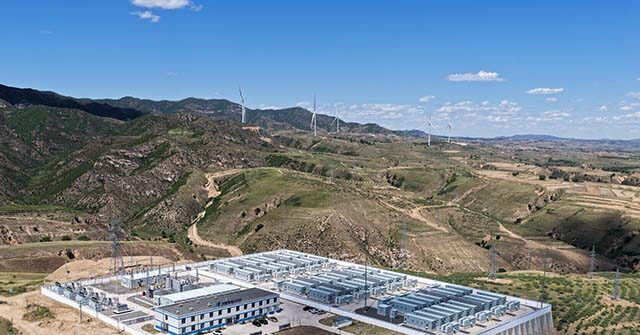
The city of Ulanqab in the Inner Mongolia Autonomous Region, a pastoral region that has become a haven for data centers over the past few years, debuted China’s largest industrial park for artificial intelligence (AI) last week.
The new park has already caught the attention of DeepSeek, one of China’s highest-profile AI startups.
China’s state-run Global Times on Saturday explained that Inner Mongolia features cheap land, cheap electricity, and cool temperatures, making it ideal for data centers. Major corporations such as Huawei, Alibaba, and even Apple have built data centers there.
Ulanqab features a lot of wide-open spaces that proved useful to wind and solar power development, and with an average annual climate of about 40 degrees, keeping massive data centers cool is not too difficult.
The new AI industrial park is anchored by Envision Group, whose AI Data Center (AIDC) is known as the Envision Galaxy Campus. The company said that when the new 120,000 square meter campus opened for business last Thursday, it became the AIDC with the largest token throughput in the entire world.
The Global Times quoted Envision boasting that its two-gigawatt Ulanqab facility “integrates renewable energy, intelligent power management and high-density computing at unprecedented scale.”
Another advantage of Ulanqab is its proximity to cities that consume a great deal of computing power, including the national capital of Beijing, which is a little over 200 miles away. Envision noted that high-capacity AI computing is so speed-intensive that even the speed of light is a factor. Data centers must be built fairly close to their heaviest users, or the time it takes for data to travel through fiber-optic networks from the center to the users can become a performance issue.
China has long touted a strategy called “East Data, West Computing” that called for putting data centers in rural areas, where land and electricity are cheap. The problem is that China’s land area is so vast that feeding all that processing power to its over-developed cities turned out to be inefficient. The distance between data centers and end users was simply too great, given the limits of today’s data transmission lines.
Critics, mostly from outside China, have noted that East Data, West Computing is mostly a public-relations illusion, and the data centers in China are actually springing up close to the big data-consuming cities. Still, Ulanqab serves as the photogenic marquee example of a rural area bristling with solar panels and windmills that can host plenty of massive data centers without getting a lot of “not in my backyard!” complaints from local residents.
The Chinese government also loves to tout Ulanqab as an example of a centrally planned power and industrial hub that shows off the “institutional strengths” of the Communist system, as the Global Times did by quoting technology analyst Ma Jihua on Friday.
“The government drew up a plan, laid down the backbone of a national computing power network, and private-sectors companies followed up with their own investment, forming a self-reinforcing positive loop,” said Ma.
The current iteration of the East Data, West Computing strategy relies on Ulanqab and seven other rural hubs that feature affordable electricity for massive data center construction. The overall goal is to make China a top regional provider of computing power – possibly outpacing Western countries that are having a much more difficult time finding good locations for big data centers.