

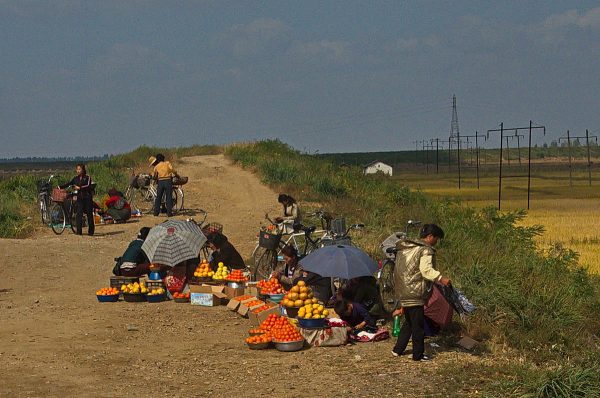
Recently there have been reports from inside North Korea that a ban on the sale of rice and corn has been implemented in some parts of the country. News of the ban, which took effect in January, emerged as the North Korean government has moved to monopolize the country’s food supply, most prominently through the establishment of state-run food shops to distribute food at lower-than-market prices. While it is unclear whether a ban on the sale of rice and corn is in place throughout the country, there is little doubt that the government is intensifying its efforts to crack down on illegally obtained grains circulating in markets.
A Complicated Relationship With Markets
It makes some sense contextually for the North Korean government to have slapped a ban on food sales in markets. Over the past several years, particularly in the midst of the COVID-19 pandemic, the North Korean state has made an effort to tighten control over various aspects of its economy, with clear moves, for example, to tighten control over trade-related organizations with a view to squash unsanctioned smuggling, along with efforts to centralize control of the economy in the Cabinet.
We also have seen reports that the government is actively trying to push wholesalers in parts of the country out of business, while the establishment of state-run food shops in itself presents a potential – although as of yet unclear – danger to the country’s network of markets, particularly to the sellers of rice and corn.
North Korea has always had a complicated relationship with markets. In the Kim Il Sung era, farmers’ markets did exist, but it was not until the collapse of the country’s public distribution system (PDS) in the 1990s that black markets sprouted throughout the country to distribute food in place of the state. In 2003, Kim Jong Il abandoned the PDS and began tacitly acknowledging the existence of markets, even constructing “general markets” that allowed sellers to purchase stall space to display their wares. As of 2018, there were at least 436 officially sanctioned markets in existence, according to satellite imagery.
In allowing markets to spread, the regime has been aware of the possibilities markets provide for social interactions to take place out of state control. Indeed, markets have become a driver for improving the lives of ordinary citizens by allowing them to buy and sell everyday items. But it is important to point out that government efforts to suppress markets over the years have led to negative reactions from the public, for example, when the North Korean government tried to roll back market reforms from 2004 to 2009.
Moreover, marketization in North Korea has not exclusively benefited ordinary people. The markets have provided a source of revenue for the government. In fact, one of the reasons why street sellers of food, commonly called “grasshopper merchants,” face crackdowns by the state is due to the fact they do not provide a source of revenue to the government, despite their contribution to the economy as a source of jobs and distribution of goods.
A Ban, or Just Crackdowns on Illegally Obtained Food?
Given this context, an outright ban on market sales – even if it is just focused on certain foods like rice or corn (rice being the more important grain given its preference among general consumers) – would represent a grave shift away from North Korea’s complicated yet relatively tolerant attitude toward markets. What, then, could be going on in North Korea that would even suggest that a ban on certain market sales has been implemented?
Broadly speaking, North Korea’s government has trouble acquiring enough food to distribute not just to ordinary people but also for important institutions such as the military. While the country’s poor agricultural situation, including its dire lack of chemical fertilizer, is much to blame, a considerable amount of harvested crops appears to be siphoned off for sale in markets and other places. In fact, a large portion of one of the country’s key foods, rice, circulates in markets through illegal transactions between wholesalers and collective farms.
These illegal transactions, which undermine the government’s ability to tax grain deals, are so prevalent that the authorities routinely make efforts to prevent the loss of harvested crops, including rice. Reports surfaced during the harvest season last year, for example, stating that the government had deployed soldiers to prevent illegal distribution of crops from collective farms. Given that rice produced at collective farms is considered state property, it is only natural for the authorities to heavily monitor rice sellers for illegal activity and crack down on illegal transactions.
In fact, it appears that the authorities have strengthened their efforts this year to crack down on these illegal transactions, even forcing sellers to submit special documentation confirming the source of the rice they are selling. These restrictions seem to have forced some market retailers, who receive rice from wholesalers, to avoid the markets altogether, selling their goods at home or on the streets. While it is not completely clear whether a nationwide ban on the sale of rice and corn is in place, there is no question that different localities in North Korea are cracking down on the circulation of illegally obtained rice and other grains.
Moving Toward a State Monopoly on Food?
In fact, the North Korean government’s efforts to crack down on illegal food transactions can be linked to a broader situation that news outlets with sources inside North Korea have reported on for some time now: The North Korean state’s keen efforts to monopolize its food supply. In short, the regime aims to place state-led distribution of rice and other key commodities such as corn at the forefront, with the markets playing a secondary role in food distribution. The government’s move to expand state-run food shops appears to be an important part of implementing a state-led monopoly on the supply of food to its people.
That being said, as North Korea economy expert Benjamin Silberstein has noted, while the expansion of state-run food shops can be considered a heavy government intervention in its own right, there is still no firm evidence that the government is actually enforcing a complete monopoly on the food supply. Markets still operate and people are still selling food in them. Indeed, with trade over the border growing and smuggling increasing, markets look set to remain a key distribution point for various goods, including food.
As Silberstein pointed out, for the government to firmly implement a monopoly on the food supply, it would have to force people to exclusively purchase from the shops and demand that farmers sell all crops to the government at state-set prices. As of yet, this phenomenon does not seem to have taken hold in North Korea. Moreover, given the benefits the government reaps from markets and the negative reactions caused by efforts to diminish them, there is every reason to think that it never will.