

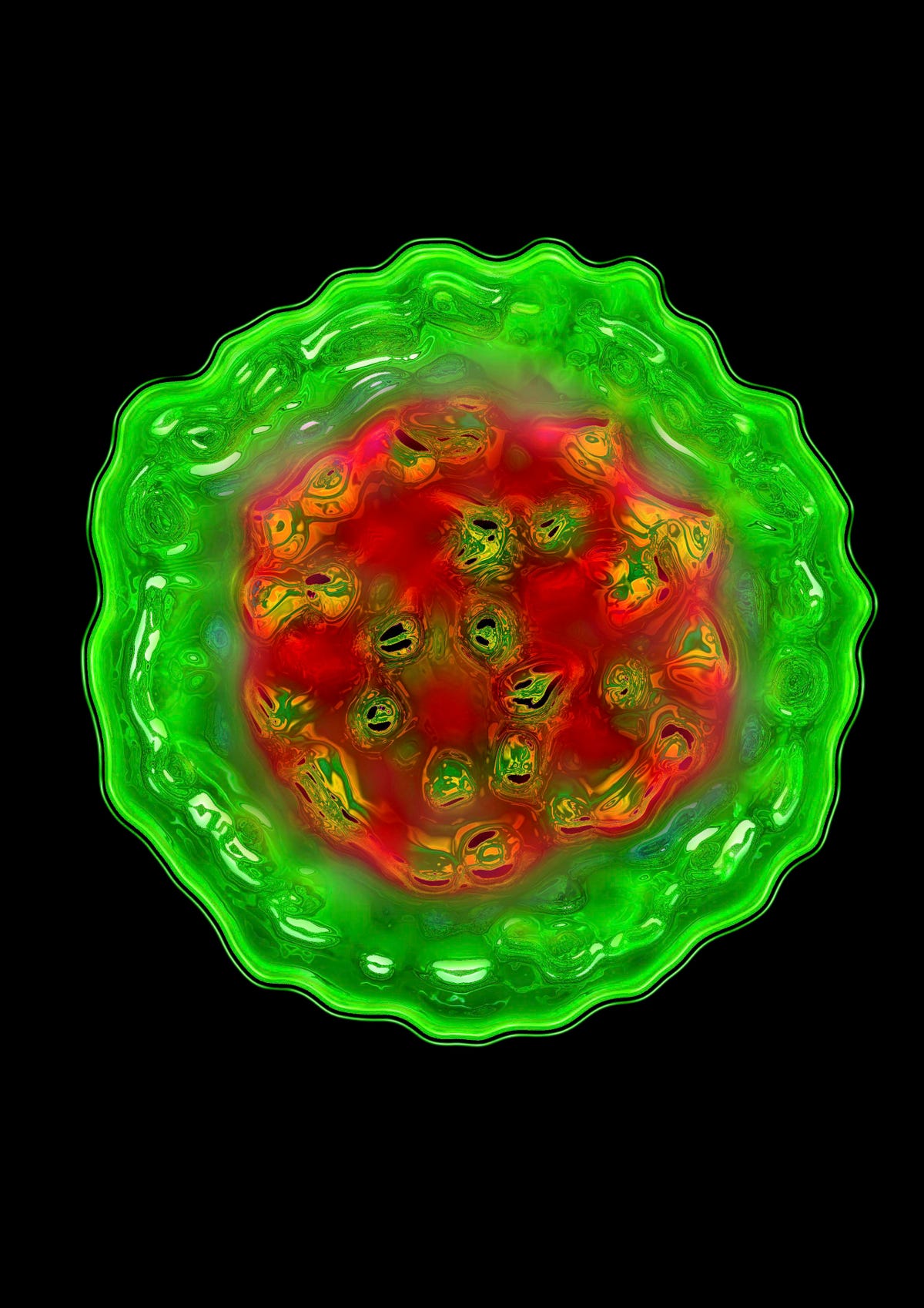
Hepatitis D Virus (HDV) Particle. Image Made According To A View Under Transmission Electron … [+]
This is the first part of a series on hepatitis D virus, a virusoid-like pathogen that causes serious human disease. What follows is a description of the epidemiology and of the disease itself. Upcoming articles will delve into molecular biology, replication, and other issues.
History
In 1977, a gastroenterologist by the name of Mario Rizzeto, working out of the University of Turin, Italy, discovered the first evidence of hepatitis Delta virus. While caring for chronically ill hepatitis B patients, Rizzetto and his colleagues noticed something unusual during routine liver biopsies: in some samples, antibodies against the hepatitis B core antigen (HBcAg) were reacting even when there was no hepatitis B core antigen present. Clearly something was triggering an immune reaction. The antibodies would only react in samples which contained the hepatitis B surface antigen (HBsAg); samples containing the core antigen but no surface antigen did not bring about any response. Further experiments revealed that the mystery antigen was also distinct from the hepatitis B e antigen (HBeAg) — samples containing the surface antigen and the mystery antigen did not react when anti-e antibodies were added to the mix. Having discounted all known antigens, the culprit was given the name of δ (delta). It is now referred to as hepatitis delta antigen (HDAg).
Two years later, in 1980, Mario Rizzetto and his team returned with new findings. By studying blood samples of chimpanzees positive for the delta antigen, they noticed that, along with the hepatitis B surface antigen, delta was also associated with a small, low-weight RNA. Although they could not yet confirm it at the time, they had succeeded in identifying the genetic material of the hepatitis Delta virus.
That same year, in a follow-up study, the delta agent was proven to be transmissible, albeit only in the presence of hepatitis B virus. By 1986, the RNA associated with the delta antigen had been cloned and fully sequenced, giving researchers an in-depth look at the genome. There was no overlap in the genetic sequence of the hepatitis Delta virus RNA (HDV RNA) and that of hepatitis B virus, on which it relied for transmission. This suggested that the delta agent was not simply a defective interfering particle (DIP) —a mutant snippet of a parent virus that forms as a result of defective replication— but instead its very own entity. Nor was it a classic example of a virus, given its small and circular RNA. Despite this, it was given the name hepatitis D virus (HDV).
Structure
Hepatitis D virus more closely resembles viroids and virusoids than traditional RNA viruses: it is a small single-stranded circular RNA, it has a double-stranded rod-like secondary structure, and it encodes ribozymes (Figures 1 & 2). Like virusoids, it also depends on a helper virus for transmission and infection — at least in humans.
FIGURE 1. A microscope view of hepatitis D particles.
FIGURE 2. HDV RNA is a circular single-stranded RNA made up of roughly 1700 nucleotides. 74% … [+]
Hepatitis D virus also contains an open reading frame, which is a section of RNA that can encode a protein. Although virusoids are not usually thought to produce any proteins of their own, there are exceptions to the rule. In fact, hepatitis D uses this open reading frame to produce three different versions of its antigen protein: a large one, a medium one, and a small one. Each of these versions has slightly different functions in the hepatitis D lifecycle.
The large and the small hepatitis D antigens bind to the genome to form a ribonucleoprotein (RNP) complex; the final result resembles beads (the antigens) on a string (the RNA). This ribonucleoprotein complex is then encapsulated in the envelope protein of hepatitis B virus, offering it protection and enabling entry into host cells (Figure 3).
FIGURE 3. Schematic representation of an hepatitis D virus (HDV) particle: a ribonucleoprotein (RNP) … [+]
Hepatitis D: Pathogenicity & Epidemiology
Viral hepatitis is a potentially life-threatening disease characterized by inflammation of the liver. It is caused by the hepatitis viruses, of which there are five main strains: A, B, C, D, and E. Hepatitis A and E are primarily spread through the gut, when food or water contaminated by an infected person’s stool is ingested. Even the tiniest, trace amounts can cause illness. A and E also mainly tend to cause acute disease, which usually resolves after four to eight weeks.
The remaining three strains —B, C, and D— are most commonly transmitted through contact with the blood of an infected person. This can happen in a number of ways: sharing needles or other items (razors, toothbrushes, etc.) with an infected individual, contact with open wounds from an infected person, unprotected sex with an infected person, and, albeit rarely, birth from an infected mother. Hepatitis B, C, and D are also more likely to cause chronic infection, leading to severe liver cirrhosis and liver cancer. Despite the severity of the disease, many chronic hepatitis infections remain asymptomatic for extended periods; by the time you realize something is amiss, the disease has already put down deep roots. When symptoms do appear, it is usually in the form of fever, tiredness, nausea, abdominal pain, vomiting, and occasionally jaundice (yellowing of the skin and eyes) and confusion.
A 2021 report by the World Health Organization (WHO) estimates that 350 million people globally are living with either chronic hepatitis B or C infections (296 million with hepatitis B; 58 million with hepatitis C). As mentioned above, in humans hepatitis D virus takes advantage of hepatitis B as a helper virus, using it to transmit between hosts and to infect cells. This means cases of hepatitis D are either co-infections, which happens when the two viruses infect an individual simultaneously, or super-infections, which happens when someone already infected with hepatitis B contracts hepatitis D (Figure 4). Because of these very particular conditions, hepatitis D infections are rarer. Still, they are generally thought to affect around 15-30 million people, or nearly 5% to 10% all people with chronic hepatitis B infections. A recent meta-analysis suggests the actual number may be far higher, somewhere in the range of 67-72 million people.
FIGURE 4. DV-HBV co-infection or HDV super-infection of a chronically infected HBV patient can … [+]
Although less common than its helper virus, hepatitis D infection is much more severe. Superinfection accelerates disease progression in up to 90% of people, leading to liver cirrhosis onset almost a decade earlier than in cases of hepatitis B infection alone. In general, those suffering from chronic hepatitis D infection experience liver failure within five to ten years, and 15% of people will experience liver failure as quickly as one or two years after initial infection. People who acquire hepatitis B in childhood, in contrast, usually do not have issues with cirrhosis until roughly 40 years after infection. In fact, around 18% of the cirrhosis and 20% of the liver cancer associated with chronic hepatitis B are likely to be caused directly by hepatitis D virus.
Since hepatitis D virus usually depends on hepatitis B virus for transmission, their geographic distribution overlaps significantly. And although they can both be found worldwide, there are some clear hotspots, including Western and Middle Africa, Eastern Europe, the Mediterranean Basin, and Central Asia (Figure 5). The Republic of Moldova and Mongolia, in particular, have the highest rates of hepatitis D — up to 60% of chronic hepatitis B patients in Mongolia are also positive for hepatitis D.
FIGURE 5. Geographic distribution of chronic hepatitis D infection.
Mechanisms of Damage?
We know that hepatitis D virus is responsible for the most severe form of hepatitis, but we still don’t know exactly how it causes such damage. Currently, there are two dominant theories. The first posits that damage to the liver is caused directly by the hepatitis D virus antigen (HDVAg). The second posits that, as is the case with other viral hepatitis infections, liver damage is primarily a result of our own immune response to the virus. Note that these two views needn’t be mutually exclusive; it could be that both play a role. Indeed, it may be that the former is the primary mechanism of action during acute hepatitis D infections, whereas the latter occurs during chronic infections.
Evidence for direct damage comes primarily from studies performed in test tubes, known as in vitro. When exposed to the hepatitis D virus antigen, human liver cells suffer a serious reduction in the rate of RNA synthesis. Over time, this leads to cell death — cells depend on RNA for the production of proteins, which perform vital functions required for the well being and longevity of the cells. Under the microscope, the antigen-exposed liver cells look exactly like the liver cells of individuals suffering from a hepatitis D infection. And the amount of antigen in the dead cells matches the amount of antigen seen in the liver cells of chimpanzees suffering from acute hepatitis D infections. Research in chimpanzees and some human case studies have yielded similar findings. However, a long-term study of transgenic mice found no evidence of direct liver damage from exposure to the hepatitis D virus antigen.
If not from direct injury via the viral antigen, it is likely that liver damage seen in hepatitis D infections is instead a byproduct of immune responses intended to clear the pathogen. Once hepatitis D virus enters our cells, it triggers an inflammatory response, rallying various immune cells and signaling proteins together to combat the infection. These immune cells destroy infected cells in an attempt to stop the spread of hepatitis D virus. Think of inflammation as a necessary evil: immune cells damage their own host tissue in the short run so that they can eliminate a pathogen in the long run. If the pathogen is successfully eliminated, inflammation subsides and the damaged areas can recover. The problem with chronic hepatitis D virus is that our immune system fails to fully clear the infection, leading to a continuous state of inflammation. Since hepatitis D exclusively infects liver cells, the extended inflammatory response slowly wears down the liver as a whole. The large hepatitis D virus antigen (L-HDVAg), in particular, has been associated with the activation of transforming growth factor-β (TGF-β) cascades. Transforming growth factor beta is a well-known signaling protein involved in the regulation of various important cellular processes. But dysregulation or overexpression can lead to serious issues, including fibrosis and cirrhosis, especially in the liver.
Other Potential Helper Viruses & Tropism
It was generally understood that hepatitis D virus depends entirely on hepatitis B virus for initial infection. It was also understood that, like the other hepatitis viruses, delta exclusively infects liver cells. Novel research indicates this may not be so. Published in Nature Communications, the work revealed that hepatitis D virus can be packaged by vesicular stomatitis virus and hepatitis C virus. Hepatitis D ribonucleoproteins encapsulated in the envelope proteins of these viruses could successfully leave host liver cells and, using the appropriate surface receptors, bind and enter new liver cells, effectively spreading infection. Crucially, hepatitis D virus particles packaged in the stomatitis virus envelope were able to infect not only liver cells but also kidney cells.
This opens the possibility that the hepatitis D virus may actually be the cause of a number of diseases other than just hepatitis and hepatic cancer, including across different organ systems. Future studies might do well to search for hepatitis D genomes in a broader range of disease tissues, expanding beyond only the liver.