

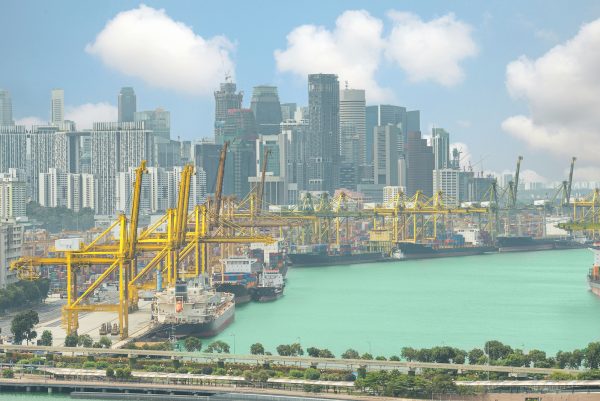
Oil storage firms and traders operating in the Singapore Strait are reporting a rise in fuel suppliers blending and re-exporting Russian fuel, despite the European Union and Group of Seven nations’ designation of sanctions on fuel to economically pressure Moscow into ceasing its military aggression against Ukraine. Current sanctions include a ban on the use of Western-supplied maritime insurance, finance, and brokering for Russian crude oil priced above a cap of $60 per barrel. The reported rise in the re-export of oil with concealed origins was signaled by an increased demand for oil storage within Singapore, with the cost of a six-month lease for Singapore fuel oil or crude oil storage rising by as much as 17 to 20 percent over the previous year.
Ship-tracking data from Vortexa showed that Singaporean oil-receiving terminals took in over double the volume of Russian naphtha – a light crude oil used to break down heavier crude oils – and fuel oil in December 2022 than they did in December 2021. Traders can reportedly enjoy a profit margin of close to 20 percent, compared to a typical 10 to 12 percent margin, from mixing Russian fuel components purchased under the price cap with other sourced fuel and selling a blended fuel oil product at market price.
In response to queries from news agency Bloomberg about their possible response to a rise in the re-export of blended fuels, Singaporean government officials in January referred to past statements on the ban and price cap policy without additional comment on whether they intended to more strictly enforce compliance with widespread multinational sanctions restricting access to Russian oil. Multiple factors may have contributed to Singapore’s muted response to a lapse in sanction compliance by ships passing through its ports, but failures in compliance have significant consequences for overall sanctions effectiveness.
Obstacles to Sanctions Enforcement
Determining the origin of marketed crude oil is a complicated task due to long supply chains that involve fuel being sold multiple times before usage, as well as shipping vessels’ ability to conduct unsupervised re-mixing operations in international waters. Areas within and adjacent to the Singapore Strait, where oil-carrying ships frequently pass and may conduct illicit fuel “swapping” maneuvers, are inconsistently surveilled and governed by loosely enforced agreements like the United Nations Convention on the Law of the Sea. Ships may also falsely document where oil shipments are arriving from and manipulate their Automatic Identification Systems transceiver location to support false documentation.
Determining which sanctions are relevant to the situation can be equally complex. After Russia invaded Ukraine in February 2022, Singapore imposed its own limited set of targeted sanctions and export controls focused on preventing Russia’s acquisition of weapons. However, Minister of State for Trade and Industry Low Yen Ling has stated that companies “have been informed of the ban imposed by the EU and other countries.” Experts claim that the increased amounts of Russian oil being stored in Singapore are likely to be re-exported to markets in Northeast Asia.
Unlike the EU, which has adopted a total ban on the import of crude and refined oil from Russian sources into the region, these areas in Northeast Asia are not covered under direct sanctions. However, the excess may flow into bunker fuel used by marine vessels based in Singapore, Indonesia, and Vietnam, placing greater responsibility on the city-state’s officials to ensure fuel used by locally headquartered companies is not obtained illicitly. Furthermore, according to a report from the Center for Research on Energy and Clean Air, price cap coalition countries such as the EU and the United States increased imports of refined oil products from Singapore by 33 percent after Russia invaded Ukraine.
Singapore’s muted response to a possible violation of sanctions may also arise from a lack of political will, as reflected in an official’s comments following its compliance with a costly international anti-tax avoidance policy. Singapore recently raised its effective tax rate on large Singapore multinational enterprises (MNEs) to 15 percent in order to bring it in line with the standards articulated in the OECD’s Base Erosion and Profit Shifting Initiative. The move is expected to cause budget tightening, with the possible relocation of MNEs such as DBS Group Holdings Ltd. and Oversea-Chinese Banking Corp. In a speech on February 14, Deputy Prime Minister Lawrence Wong suggested that multinational corporations “seek to relocate to places where they are less likely to get caught in geostrategic crossfires,” implying that Singapore will preclude itself from establishing policies that would limit business operations based on international politics.
Options for the Future
Some Singaporean government officials have suggested that the responsibility to comply with international sanction regimes should fall on individual private companies. Minister Low Yen Ling has stated that “companies in Singapore will have to [personally] consider and manage any potential impact on their business activities, transactions, and customer relationships when dealing with Russian crude oil and refined products.” Oil storage firm Advario Asia Pacific Pte, one of the companies that have provided data demonstrating the rise in demand for short/spot-term oil storage, states they independently “verify the source of products to ensure compliance with Russian sanctions before accepting them.”
However, without monetary incentives from the government, companies are less likely to devote additional resources to sanctions compliance. Advario is only one of multiple companies providing commercial oil storage in Singapore, including Jurong Port, Horizon, and Royal Vopak, that have provided responses of varying strength regarding their intentions to survey incoming oil exports for clarity of origin.
Another option is the imposition of secondary sanctions by the U.S., which the Treasury has pursued as a way of dissuading neutral countries from overt sanctions-busting in the past. Earlier this year, the U.S. Treasury announced it was imposing sanctions on Unicious Energy Pte. and Asia Fuel Pte., two small oil trading firms based in Singapore and Malaysia, respectively, due to their relationship with the sanctioned Malaysian firm Triliance, which was found in 2020 to be facilitating shipments of oil on behalf of the National Iranian Oil Company. This brings the total number of Singaporean oil companies penalized by the U.S. for sanction noncompliance to three.
In the case of Unicious and Asia Fuel Pte, the U.S. Treasury was able to impose secondary sanctions based on comprehensive sanctions on the Iranian and Iranian subsidiary companies they partnered with, without having to consider whether or not the regions they exported to maintain direct sanctions on the import of Iranian oil. However, coercing direct sanctions through the threat of secondary sanctions is antithetical to sanctioning countries’ primary motives in pursuing sanctions.
Declining cooperation from previously active partners such as Singapore, the only ASEAN member that has imposed direct sanctions on Russia, plays into Russia’s narrative that sanctions are a one-sided Western-led operation, undermining sanctioning countries’ intended message that Russia’s invasion of Ukraine is universally unacceptable. Singapore’s oversight of sanctions noncompliance also reduces the effectiveness of sanctions in materially restricting Russia’s ability to profit from oil sales. In April of this year, Russian seaborne exports rose to their highest level since the beginning of 2022, with the majority of the increase attributable to a rise in shipments to Asia. Oil exports to Asia currently account for around three-fourths of what used to be shipped to Europe, undermining the 17 percent decline in Russia’s earnings from fossil fuel exports achieved in the first month after imposing sanctions.
Without the imposition of penalties for sanction-noncompliant ships and companies from Singapore’s government, Russia will likely continue to export oil with impunity, diminishing the value of the significant costs faced by countries that have attempted to signal their disapproval of the Ukrainian invasion through sanctions.
This article was originally published in New Perspectives on Asia by the Center for Strategic and International Studies and is reprinted with permission