

Overcapacity, particularly prevalent in technologically advanced sectors such as electric vehicles (EVs), now occupies a central place in the economic discourse between the United States and China. Overcapacity occurs when the production capacity of certain industries vastly exceeds demand, leading to a surplus of goods and reduced global prices.
In the United States, this issue is perceived as a deliberate strategic tactic on China’s part that disrupts global market equilibriums. American critics argue that China’s prodigious production capabilities not only skew global pricing mechanisms but also compromise the sustainability of industries globally by precipitating a downward spiral in prices.
Moreover, the United States considers the strategic ramifications of overcapacity within its broader narrative on economic security. It views with apprehension China’s accelerated expansion of capacities in sectors critical for future technological hegemony, such as semiconductors, clean energy, and telecommunications.
Conversely, China views overcapacity not merely as a byproduct of government policy but as an integral part of its broader economic strategy to transition from traditional manufacturing to a more innovation-driven economy. This strategic pivot entails a redistribution of resources toward dynamic, high-value industries, thus augmenting China’s global stature and resilience.
China contends that its developmental trajectory necessitates phases of overcapacity as it ascends the value chain. Chinese officials emphasize their efforts to mitigate these issues, such as implementing capacity reductions in traditional sectors like steel and coal and promoting high-tech sectors through innovation policies.
Moreover, the Chinese government perceives accusations of overcapacity as partly hypocritical, stemming from Western anxieties about losing global economic supremacy. Chinese leaders suggest that the United States and other Western nations employ the overcapacity narrative as a tool to curb China’s rise as a global economic power.
From Beijing’s perspective, Western critiques often fail to consider the context of China’s developmental needs and contradict global environmental commitments, resulting in a distorted portrayal of China’s strategic intentions.
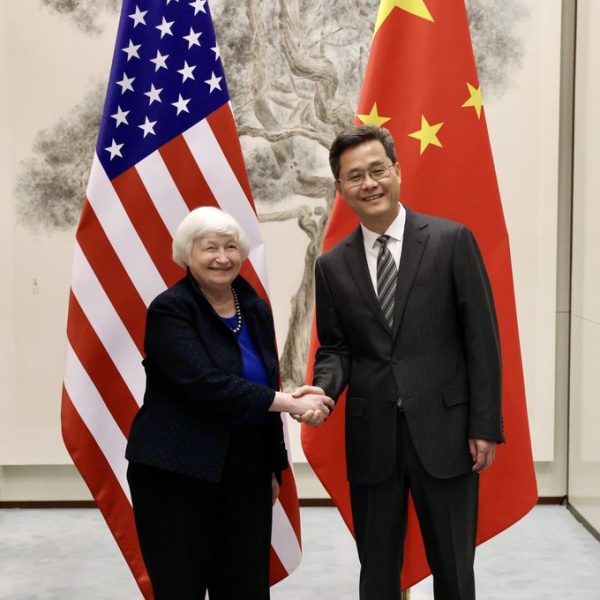
The discourse on overcapacity transcends mere economic concerns, evolving into a geopolitical lever. The respective stances and responses of each nation to overcapacity are deeply ingrained in their broader economic strategies, national priorities, and global aspirations. This was highlighted in recent comments by Treasury Secretary Janet Yellen during her visit to China, where she voiced concerns about a potential “China Shock 2.0” – a reference to possible market upheavals similar to those witnessed during China’s earlier rapid industrial rise, potentially flooding global markets with low-cost, high-tech products.
It is vital to acknowledge that Chinese policymakers are aware of the adverse aspects of overcapacity. Chinese economists recognize that the core of the overcapacity issue lies in the nation’s high national savings rate, which comprises 45 percent of GDP. Ideally, this capital should be directed toward burgeoning industries to spur innovation. However, the Chinese banking system, dominated by state-owned enterprises, disproportionately favors traditional sectors, resulting in suboptimal capital allocation.
Domestically, the government is engaging with economists and industry specialists to reform sectors plagued by overcapacity through market-driven solutions rather than heavy-handed state interventions. This includes curtailing subsidies in saturated markets, enforcing stringent environmental and production standards, and promoting consumption-led growth.
Internationally, however, China defends its industrial policies by emphasizing its alignment with global economic shifts toward sustainability and high-tech development. Beijing asserts that its expansion in sectors like renewable energy and electric vehicles aligns with global environmental sustainability needs and should be regarded as a contribution to global technological advancement rather than a threat.
Constructive engagement between China and the United States to address overcapacity necessitates a paradigm shift in policy thinking. This could entail the establishment of bilateral or multilateral frameworks that encourage sustainable trade practices and foster technological exchanges. Such frameworks would not only address immediate concerns related to overcapacity but also set the groundwork for future international collaborations.
China-U.S. joint innovation initiatives could serve as a foundation for this new era of cooperation, leveraging American technological expertise and Chinese manufacturing prowess in non-sensitive sectors, thereby cultivating a milieu of reciprocal technological advancement while respecting each nation’s security concerns.
Paradoxically, the United States might benefit from adopting China’s model of Special Economic Zones (SEZs). These zones, which provide tax incentives and streamlined bureaucratic processes, could be particularly valuable in areas primed for industrial revitalization. Chinese economists suggest a strategy wherein China could extend its industrial capacity internationally through strategic Overseas Direct Investments (ODI), targeting economies such as the United States. Such investments could bolster local industries and contribute to economic growth. To ensure these arrangements align with U.S. interests, clear regulatory frameworks would need to be established, ensuring adherence to American laws and addressing any national security concerns with utmost transparency.
Moreover, addressing the complexities of overcapacity demands a sophisticated approach to economic diplomacy from both nations. Traditional methods, such as tariffs and trade restrictions, may prove inadequate. A more comprehensive strategy would involve robust capacity management, augmented technological collaboration, and the establishment of common standards for environmental and labor practices.
Both nations must conscientiously evaluate the global repercussions of their policies. As preeminent economic forces, the United States and China bear a profound obligation to the international community to ensure that their domestic agendas neither destabilize global markets nor intensify delicate trade relations, particularly in an increasingly tumultuous political climate.