

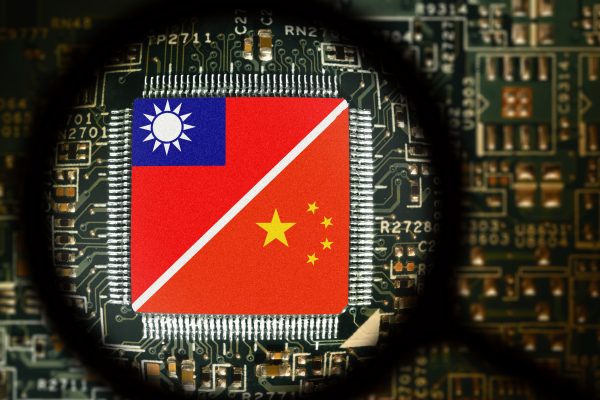
In the recent U.S. presidential election, the semiconductor trade issue catapulted Taiwan into the spotlight. During the September 10 debate, Vice President Kamala Harris criticized former President Donald Trump for enabling China’s military by allowing the sale of U.S. chips during his tenure. “Under Donald Trump’s presidency, he ended up selling American chips to China to help them improve and modernize their military – basically sold us out,” Harris asserted.
Trump retorted, “First of all, they bought their chips from Taiwan. We hardly make chips anymore because of philosophies like they have and policies like they have.”
Despite their heated exchange, both sides concurred on the need to restrict China’s access to crucial technologies that could fuel its military modernization. But Trump’s comments about the semiconductor trade between Taiwan and China brought to light a lingering concern: Taiwan’s equivocal stance on semiconductor export controls and the degree of its collaboration with the United States to limit advanced technology transfers to China.
With the U.S. and China locked in ongoing contention, the strategic importance of this issue cannot be overstated. Taiwan’s role is crucial in ensuring the effectiveness of U.S. restrictions against China, given its market-leading share in the global advanced semiconductor industry. The issue has also taken on diplomatic urgency as Japan and the Netherlands – both vital suppliers of manufacturing equipment, materials, and components for advanced chip production – have now toed the line with U.S. policy.
Yet Taiwan’s position on such a critical matter is puzzlingly ambiguous. While China – the main focus of U.S. export controls – aggressively asserts its claims over Taiwan through increased military and political pressure, Taiwan continues to ship semiconductors to Chinese entities. This ongoing trade with China paradoxically feeds into the very threats to Taiwan’s existence. Why, then, does Taiwan persist with these exports?
Taiwan’s Faustian Tragedy
The obvious unbalanced tradeoff between economic interests and national security is, in itself, a moral quandary that could leave Taiwan vulnerable to criticism for its mercantilist short-sightedness. Nevertheless, the tragic nature of this self-inflicted vulnerability can hardly be ignored, particularly the structural politico-economic constraints that Taiwan has been compelled to confront in its longstanding struggle with China.
The irony of Taiwan’s export of advanced semiconductors to China – used by the latter to bolster the prowess of its military, which poses a constant threat to Taiwan – echoes a familiar historical parallel. Beginning in the 1980s, as China opened its economy to the world, Taiwanese firms – seeking new markets and lower production costs – invested heavily across the strait. Taiwanese firms played a key role in sectors such as electronics, textiles, and machinery, spurring China’s industrial development. In return, they reaped the benefits of reduced costs and access to a burgeoning market of over 1.3 billion people, solidifying their global competitiveness.
But what began as an economic partnership soon morphed into a strategic risk. These investments helped transform China from a developing nation into a global superpower, with vast economic and technological resources. Back home in Taiwan, this expansion came with its own challenges – job losses and growing economic dependence on China. By the 2010s, China had leveraged its wealth and industrial growth to foster domestic industries that began to compete with Taiwanese firms, ultimately driving many, such as Foxconn, to withdraw their production from the Chinese market.
Today, this Faustian bargain continues. Taiwan, as the world’s premier producer of advanced chips – holding over 90 percent of the global market share – still supplies essential components to Chinese industries. While these semiconductors are vital for Taiwan’s economic growth, they also enhance China’s military capabilities, including missile guidance systems, thus jeopardizing Taiwan’s own security.
The Entrenched Dilemmas
These are all highly palpable strategic risks that require Taiwan to adopt decisive action. This urgency is further amplified by Japan and the Netherlands recently following the United States to implement export controls on semiconductor manufacturing technologies. As Taiwan approaches a critical decision point in the China-U.S. technological competition, its reluctance to take firm action could be seen as a strategic misjudgment, potentially placing it in a disadvantageous position.
However, such a view might oversimplify the complex decision-making dilemmas that have deeply ensnared Taiwan in this difficult situation, in both strategic and diplomatic terms.
In Taiwan, concerns remain about the potential domestic repercussions of export controls. While these measures can prevent adversaries from accessing critical semiconductor technologies, they may also harm the very businesses that have propelled Taiwan to its prominent position in the chip industry, potentially stifling both domestic innovation alongside foreign capabilities.
Chinese customers might seek alternative suppliers in countries that do not enforce similar export controls. This shift, currently termed as “de-Americanization” in the Chinese chip industry, could also precipitate a “de-Taiwanization.” And it may not be long before Taiwanese companies begin relocating their operations overseas to circumvent local regulatory constraints.
However, a deeper concern arises from the cautionary precedent set by U.S. export controls since the trade war began in 2019. These restrictions have driven China to invest at least $150 billion in its domestic semiconductor industry, form new public-private partnerships, and encourage local sourcing among companies. Such initiatives have greatly enhanced China’s research capabilities and innovation agenda. As a result, China is developing internal commercial relationships and technological capacities that might not have emerged had access to U.S. technologies remained unrestricted. Taiwan could face a similar scenario.
On the strategic level, Taiwan is trapped between its economic interests in China and its security ties with the United States. Despite the deteriorating cross-strait relations, China remains Taiwan’s largest export market. According to Taiwan’s Ministry of Economic Affairs, in 2023, China accounted for 35.2 percent of its total exports – and this was the lowest proportion in nearly 21 years, an 18.1 percent reduction from 2022.
The semiconductor sector underscores the depth of these ties even more. The Ministry of Finance reported that in 2023, Taiwan exported $166.6 billion worth of integrated circuits, which represented 38.5 percent of its total export value. Of these semiconductor exports, 54.2 percent, or $90.4 billion, were directed toward China. Given the substantial scale of semiconductor trade, it would be inconceivable for Taiwan to abruptly sever these economic ties with China.
However, with China’s persistent military intimidation in recent years, Taiwan’s economic prosperity has become increasingly dependent on the security commitments provided by the United States as its strategic partner. This interdependence introduces a profound dilemma: As the U.S. works to harmonize global policies on chip exports, Taiwan stands at a crucial juncture. Taiwanese policymakers are now faced with a challenging decision – whether to align more closely with U.S. policy directives, potentially at the expense of its significant economic interests with China.
To further complicate matters, the U.S. security commitment to Taiwan has long been characterized by “strategic ambiguity” – a policy that deliberately leaves uncertain the extent of U.S. intervention in the event of a cross-strait conflict. Initiated as a diplomatic strategy following the termination of formal relations with Taiwan in 1979, this policy aims to deter both Taiwanese moves toward independence and Chinese military aggression. But it does so at the cost of leaving Taiwan in a perpetual state of uncertainty about the reliability of its most critical alliance. An aggressive China casts long shadows, under which the steadfastness of U.S. support remains an unanswered question.
With China’s military drills targeting Taiwan becoming a daily occurrence, the U.S. approach that once appeared effective now faces mounting criticism. Gone are the days when ambiguity could easily balance competing interests, as regional tensions demand clearer policy signals.
Under the Biden administration, the policy of strategic ambiguity toward Taiwan has indeed begun to relax. In 2022, President Joe Biden himself made a clear departure from previous ambiguities by unequivocally stating that the United States would use military force to defend Taiwan if it were attacked by China. However, a more fundamental variable affecting U.S. policy toward Taiwan is the U.S. electoral cycle, which tends to exacerbate policy inconsistencies during presidential transitions and shifts in party control. Contrasting Biden’s supportive stance, for instance, Trump recently criticized Taiwan, accusing it of exploiting the U.S. semiconductor industry and saying it should pay for its own defense.
Complications From Taiwan’s Lack of International Standing
Perhaps the most immediate challenge facing Taiwan is its exclusion from multilateral coordination in global semiconductor policy decision-making. Despite calls for Taiwan to have a more active role in shaping global supply chain policies, progress has been limited.
For instance, the recent assembly of the G-7 Semiconductors Point of Contact Group in September 2024 marked a concerted effort by major global powers to coordinate semiconductor-related R&D and crisis management. The relevance of these matters to Taiwan goes without saying. Yet Taiwan lacks a formal channel to participate in these crucial discussions.
This kind of exclusion not only appears strategically misguided but also fuels domestic skepticism in Taiwan about Western intentions to undermine its competitive edge in semiconductors. Such anxiety had already been heightened by earlier U.S. pressure on TSMC to diversify its manufacturing, with the company investing heavily in the United States while also expanding its operations in Japan and Germany. The potential partition of TSMC’s operations is increasingly seen not merely as conjecture but as an imminent reality.
The reason for the half-hearted response to Taiwan’s push for more proactive engagement in global semiconductor policy is not difficult to grasp. Western diplomatic reticence toward Taiwan often rests on the assumption that Taiwanese policymakers, regardless of the West’s actions, will never gravitate toward China, resulting in a one-sided expectation of allegiance.
Nonetheless, the power of Taiwan’s anti-China nationalist rhetoric must be treated with caution, nor should Taiwanese policymakers let the current global momentum cloud their judgment. The stark fact is that Hsinchu, known as Taiwan’s Silicon Valley, has never been a stronghold for the Democratic Progressive Party, the current ruling party that advocates for independence.
One must not forget that Taiwan’s success in the semiconductor industry is one of globalization’s finest achievements. It has developed alongside, but never fully intertwined with, the island’s bumpy transition to democracy. While critical to Taiwan’s economic future, the semiconductor industry does not inherently carry the ideological weight often projected onto it.