

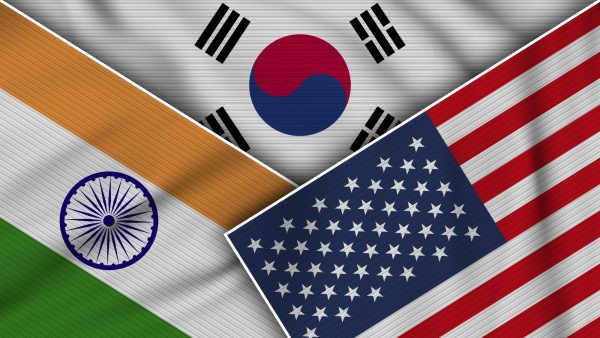
The United States and India inaugurated the U.S.-India Initiative on Critical and Emerging Technology (iCET) in January 2023. That was followed by the U.S.-South Korea Next Generation Critical and Emerging Technology Dialogue in December 2023. As a follow-up initiative, all three nations held their first inaugural trilateral technology dialogue in Seoul in March 2024. India, South Korea, and the United States were able to solidify their trilateral cooperation in various areas, including economic security, supply chain resiliency, and emerging technologies in the broader Indo-Pacific region.
There are various opportunities for this triangular dynamic that can foster innovation, enhance strategic alliances and partnerships, and benefit each of the three nations, even as certain challenges exist.
Military Cooperation
Trilateral defense cooperation between India, South Korea, and the U.S. aligns with strategic objectives in the Indo-Pacific to enhance collaboration among like-minded regional actors. In February 2022, the United States released its Indo-Pacific Strategy, highlighting the importance of strengthening security and upholding a free and open Indo-Pacific region. To achieve this, the U.S. supports a “strong India” and South Korea as key partners and allies in realizing this regional vision. Similarly, India advocates for a free, open, and rules-based Indo-Pacific through its vision of Security and Growth for All in the Region (SAGAR), and South Korea reiterates a free, peaceful, and prosperous Indo-Pacific through its Indo-Pacific Strategy.
At the same time, India’s rise as a significant importer of military equipment (accounting for 9.8 percent of total global arms imports) allows major exporters like South Korea and the United States to reap economic benefits and further develop their defense industries, fostering a sense of growth and prosperity. This increases interoperability among their armed forces and diversifies India’s arms supply away from Russia, which continues to play a dominant role.
Recent developments already exemplify the accelerated collaboration in defense industrial and technological development. After the United States and India launched their U.S.-India Defense Technology and Trade Initiative (DTTI) in 2012, Washington recognized India as a Major Defense Partner (MDP) in 2016. This was followed by initiating the India-U.S. Defense Acceleration Ecosystem (INDUS-X) and signing the Security of Supply Arrangement (SOSA) in 2024. With South Korea also having signed a SOSA agreement with the U.S. in 2023, there are more trilateral opportunities to come in terms of military cooperation.
The United States has become a significant defense supplier to India, providing advanced weapon systems such as Apache attack helicopters, C-17 Globemaster transport aircraft, P-8I maritime patrol aircraft, and MH-60R Seahawk helicopters. Similarly, South Korea has emerged as a primary defense partner for India, as seen in India’s acquisition of 100 K9 Vajra-T self-propelled howitzers, a variant of South Korea’s K9 Thunder. This successful export led to a Roadmap for Defense Industries Cooperation in 2019 for the joint development of land and naval defense systems, creating a foundation for more robust military cooperation and reaping economic benefits for all parties involved.
With the India-South Korea-U.S. trilateral, military and security cooperation is not just significant, it’s strategically crucial. However, the triad’s synergy extends into other areas as well.
Green Energy Partnerships
The inaugural trilateral technology dialogue between the United States, India, and South Korea, held in Seoul, represents a significant milestone in strengthening cooperation on critical and emerging technologies for green transition. The dialogue emphasized areas of cooperation that are integral to economic growth and security, with clean energy and critical minerals at the forefront. This partnership is aligned with the global push toward green energy solutions, particularly focusing on building resilient technology supply chains.
In the clean energy sector, the United States, India, and South Korea identified several key areas for collaboration, including the development of advanced materials for renewable energy technologies and the exploration of critical mineral supply chains, essential for manufacturing batteries, solar panels, and wind turbines.
South Korea has been ramping up its investments in green technologies through its Green New Deal, which focuses on transitioning to renewable energy, building eco-friendly infrastructure, and developing electric vehicles (EVs). In collaboration with the U.S. and India, Seoul has sought to expand joint investments in clean hydrogen production and decarbonization technologies.
As part of the broader Indo-Pacific strategy, the Quad nations – India, the United States, Japan, and Australia – have engaged in discussions to boost clean energy partnerships. This group has facilitated cross-national investments in solar energy projects and supply chains for critical minerals essential for renewable energy. South Korea and India have also partnered on solar energy initiatives, with Korean firms investing in solar power plants across India. This cooperation is expected to expand, particularly with the trilateral dialogue placing green energy at the center of its discussions.
This collaboration also aligns with the growing global focus on decarbonization and climate action, as all three nations aim to capitalize on clean energy technologies and critical minerals to advance their renewable energy capacities. By fostering partnerships in areas like solar energy, hydrogen production, and critical mineral supply chains, the trilateral dialogue addresses both environmental challenges and the need for secure technology ecosystems. It further highlights the increasing importance of multilateral cooperation in the Indo-Pacific region, especially as these countries seek to counterbalance dependencies on dominant supply chains, such as those tied to China. This initiative not only supports innovation but also positions these nations as key players in driving the global green energy transition.
Emerging Tech and Innovation
The trilateral cooperation can shed light not only on military cooperation and the green transition but also on emerging technologies and innovation. The semiconductor industry is one of the critical areas for collaboration among the United States, South Korea, and India, aiming to enhance supply chain resiliency and strengthen research and development for advanced chips. This potential is phenomenal because of the fragmentation of expertise in the whole value chain of the semiconductor industry.
The United States is known for its expertise in chip design and advanced semiconductor research. Companies like Intel, AMD, and Qualcomm are all at the forefront of developing new chip architectures and AI processors, leading in semiconductor intellectual property. On the other hand, South Korea is a semiconductor fab hub with two integrated device manufacturers, Samsung and SK Hynix, dominating the production of cutting-edge chips.
With its vast pool of highly skilled and educated engineers, India can play a vital role in this value chain. While the U.S. and South Korea lack chip talents due to workforce shortages, India can become a hub of the semiconductor industry’s R&D. Numerous multinational companies, including Texas Instruments and Qualcomm, have established design and R&D centers in India. Thus, the three countries’ synergy will allow them to collaborate across the semiconductor value chain – from R&D and design (the U.S. and India) to manufacturing (South Korea), with India’s role being particularly significant and promising.
Private South Korean and U.S. chipmakers’ efforts to collaborate with India as part of a broader trilateral effort are already underway. The Indian government, through its “Semicon India” program and numerous incentives, is attracting investments from both South Korea’s Samsung and SK Hynix, as well as U.S. firms like Intel and Micron. Meanwhile, South Korean firms are investing heavily in U.S. states like Texas and Indiana after the United States passed the CHIPS and Science Act. This trilateral dynamic has the potential to expand simply from chipmaking to other sophisticated emerging technologies, including space, artificial intelligence, 6G, biotech, and quantum computing.
Challenges Ahead
However, trilateral cooperation still has its limitations. The differing approaches to China among the three nations present a challenge to trilateral cooperation.
Considering the United States’ emphasis on strategic competition and its view of China as a primary challenger to the international order, it might consider the India-South Korea-U.S. triad as another minilateral within Washington’s latticework strategy. Its views on China can be exemplified in the Biden administration’s Inflation Reduction Act (IRA) and the recent notice of proposed rulemaking (NPRM) prohibiting selling and importing connected cars that utilized technologies from China and Russia.
However, South Korea is reluctant to join blocs that appear to target China, given its substantial economic ties and the precedent of China’s economic retaliation following the 2016 THAAD deployment. Meanwhile, India is “hedging,” avoiding full alignment with any one power bloc. While India does face border disputes and strategic rivalry, it tries to continue its economic ties with China, as exemplified by their trade volume surpassing that between the United States and India.
That said, Washington may act as a catalyst in pulling India and South Korea together for its own economic statecraft in the Indo-Pacific by taking advantage of both Seoul’s and New Delhi’s strained ties with Beijing.
Another major challenge that will also affect this trilateral is the possibility of Donald Trump winning the U.S. presidential election in November 2024. Formerly, Trump referred to India as a “very big abuser” of trade connections with the United States, suggesting that he could slap heavy tariffs on Indian products. If Trump wins the election, the trilateral relationship will experience significant changes due to the uncertainty created by the messaging, let alone if the Trump administration ultimately implements some of the more concerning pledges, recommendations, and possible actions that the former president has hinted at.
Policy Recommendations
For more effective trilateral cooperation, institutionalization is essential. Consistency is key in diplomacy, as regular interactions ensure that cooperative efforts are sustained over time beyond the changes in political landscapes. Thus, creating formal mechanisms by initiating ministerial-level trilateral dialogues, consultative groups, and communication hotlines can provide a more structured platform for collaboration and coordination of policies.
It is also crucial to communicate actively with China, stating that these efforts are not aimed at creating a new bloc or containing China. By emphasizing that the India-South Korea-U.S. partnership is focused on common goals such as economic security, transnational threats, and emerging technology standards, the three nations can reduce misunderstandings and convey their actions as contributory to regional stability.
Though currently underexplored, the India-South Korea-U.S. trilateral presents a unique opportunity to enhance maritime security cooperation in the Indian Ocean, a region critical to global trade and strategic stability. As the geopolitical and economic significance of the Indo-Pacific grows, securing vital sea lines of communication (SLOCs) and addressing threats such as piracy, illegal fishing, and other illicit activities has become a priority for these three nations. India, positioned at the heart of the Indian Ocean, plays a pivotal role in ensuring maritime safety and stability, while the United States and South Korea bring advanced naval capabilities and strategic expertise to the table. By working together, these countries can strengthen coordinated patrols, share intelligence, and improve capacity-building efforts for maritime domain awareness (MDA), ensuring that the Indian Ocean remains a free, open, and secure space for international commerce.
Conclusion
The India-South Korea-U.S. trilateral partnership holds the potential to influence the Indo-Pacific region’s future via military cooperation, green energy transitions, maritime security, and strategic cooperation on vital technologies. Even if the early efforts, such as the iCET and technology discussions, represent important turning points, this trilateral agreement has complex issues. These include differing perspectives on China, with the United States’ strategic competition posture contrasted with South Korea’s economic reliance on China and India’s non-alignment strategy. The course of trilateral cooperation may also be further complicated by prospective changes in U.S. policy in sectors like defense and trade cooperation, especially if the Trump administration returns.
But these difficulties are outweighed by the opportunities. The trilateral partnership can promote innovation, strengthen supply chain resilience, and uphold an Indo-Pacific rules-based order by formalizing regular dialogues, establishing formal mechanisms for cooperation, and highlighting common objectives like economic security, technological leadership, and maritime stability. By working together to handle transnational issues like illicit fishing, piracy, clean energy, and technological advancement, India, South Korea, and the United States can create a strong framework for regional peace and prosperity and pave the way for future collaboration.