

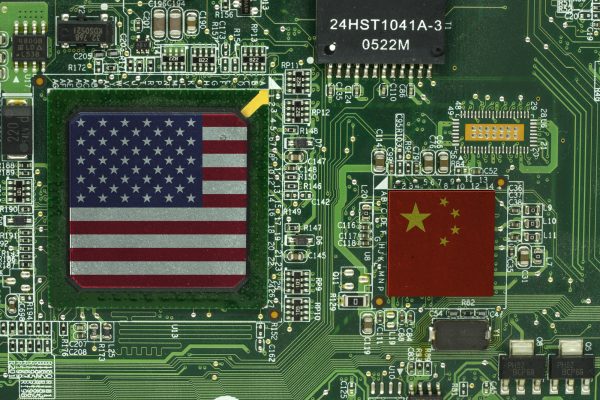
President-elect Donald Trump has criticized the CHIPS and Science Act, describing it as providing billions of dollars to wealthy companies. He argued that a better strategy would be to impose a series of tariff to force companies to produce chips domestically. In addition, he proposed imposing a 60 percent tariff on Chinese products specifically and 20 percent tariff on all imported goods to help domestic manufacturers become more competitive in the global supply chain.
In fact, since Trump’s first term, the U.S. government has already implemented various restrictive measures on China – including high tariffs, export controls, and investment screening – aiming to limit Chinese entities’ access to advanced chips and their manufacturing equipment, as well as restricting the entry of China’s competitive products such as electric vehicles and lithium batteries into the U.S. market.
However, these restrictive measures may not effectively slow down China’s progress to dominate the global supply chains of emerging technology. On the contrary, among the 13 key technologies tracked by Bloomberg researchers, China has gained a global leadership in five thus far: drones, solar panels, graphene, lithium batteries, and high-speed rail. The U.S. restrictions haven’t succeeded in containing China’s technological development, but they have increased product costs for U.S. companies, shifted the U.S. trade deficit to other countries, and encouraged Chinese firms to focus more on domestic supply chains, potentially causing U.S. businesses to lose their operations in China permanently.
First, if Trump administration follows through on his pledge to place tariffs on all Chinese products, it will increase the cost of goods for U.S. companies, which could, in turn, reduce their investment in innovation. For example, more than 95 percent of iPhones, AirPods, Macs and iPads are made in China. The comprehensive tariff would undoubtedly lead to a significant rise in Apple’s product costs in the short term and could even expose the company to severe supply chain risks.
Trump plans to review and potentially repeal the Biden administration’s executive orders regulating artificial intelligence (AI) in an effort to maintain the competitiveness of U.S. firms in the AI race with China. However, such regulatory easing is unlikely to fully compensate for the losses that U.S. companies face in the Chinese market. Even though the current Biden administration has provided substantial subsidies to these companies, they are unlikely to match the profits generated from their business in China, which consumes nearly 50 percent of the world’s semiconductors. U.S. semiconductor giants like Qualcomm and Nvidia are unwilling to forgo the significant market benefits.
According to a report from the New York Federal Reserve in April 2024, following the semiconductor export control announcement on October 7, 2022, the affected U.S. semiconductor companies saw a 2.5 percent drop in their stock market valuations, which lasted for 20 days, resulting in a market value loss of $130 billion. The Semiconductor Industry Association noted that tariffs on chip imports have effectively resulted in U.S. chipmakers paying tariffs on their own goods.
Actually, these tariffs impact not only the semiconductor industry, but many other related sectors. The tariffs in the Trump’s first term failed to boost jobs in protected industries and harmed jobs in other sectors affected by the trade war, according to the National Bureau of Economic Research.
Second, the restrictive measures have, to some extent, isolated U.S. businesses and consumers from engaging with the world’s second-largest economy. However, instead of fundamentally resolving the United States’ problem of “deindustrialization” and the over-reliance on external supply chains, current measures have simply shifted some of the U.S. trade deficit to other countries, such as Vietnam.
Tariffs have helped reduce the U.S. trade deficit with China on paper. The share of Chinese goods in U.S. imports, which peaked at 22 percent in 2017, fell to around 17 percent by 2022. This decrease was mainly due to reduced imports of Chinese products in categories like machinery, footwear, and telephones. However, much of the reduction in imports from China has simply resulted in increased trade deficits with countries in Southeast Asia and Latin America.
In 2023, the U.S. trade deficit with Vietnam reached $109.13 billion, more than double the amount in 2017. This surge coincided with a nearly $110 billion decrease in imports from China. Hung Nguyen, a supply chain expert at RMIT University Vietnam, noted that in key industries such as clothing and electronics, “Vietnam captured more than 60 percent of China’s loss.”
Furthermore, the tariff measures targeting China may, in fact, encourage Chinese companies to actively establish factories abroad, to mitigate the impact of U.S. tariffs on their products. The increasing number of Chinese-built or owned factories outside China only further strengthens the leading position of China in global supply chains. Take Vietnam as an example. In the first three months of 2024, U.S. imports from Vietnam totaled $29 billion, while Vietnam’s imports from China amounted to $30.5 billion. The majority of Vietnam’s exports to the U.S. involve Chinese-made components.
Many Chinese companies have set up new factories in Southeast Asian countries like Vietnam. For instance, Chinese electric vehicle manufacturer BYD, which faces tariffs of over 100 percent in the U.S., has already established a plant in Thailand and plans to build similar facilities in Hungary, Brazil, and Turkiye. Battery maker CATL has set up production bases in Germany and Hungary, with plans to establish joint ventures for battery cell manufacturing in Thailand and Indonesia.
In fact, the deindustrialization of U.S. manufacturing has made it difficult for the country to break free from its reliance on external supply chains in the short term, and this reliance is not solely confined to China. However, Trump’s tariff plan – imposing a 60 percent tariff on Chinese products and a 20 percent tariff on all imports – may not only trigger a new round of trade wars but also further isolate U.S. businesses and consumers from external supply chains.
Finally, the restrictive measures like tariffs and export controls could force Chinese companies to focus more on self-reliance and prioritize excluding U.S. firms from their supply chains, potentially causing U.S. companies to permanently lose market share. The April 2024 report by the New York Federal Reserve noted that current export controls have accelerated Chinese companies’ shift toward independent research, development, and innovation, resulting in a “permanent loss” of business for some U.S. firms in China.
Take Huawei as an example: since being targeted by the U.S. market in 2018, Huawei has actively pushed forward the localization of its supply chain, continually increasing the domestic substitution rate of phone components. According to Japanese media, in 2019, the Mate 30 had a domestic substitution rate of 30 percent, and the Mate 30 5G version had a rate of 42 percent. By 2023, the Mate 60 series achieved a domestic substitution rate of 90 percent. Huawei founder Ren Zhengfei mentioned that the company had replaced 13,000 components and redesigned 4,000 circuit boards to overcome the U.S. restrictions. If Huawei succeeds in localizing its supply chain, other Chinese smartphone manufacturers may follow suit, adopting more components from Chinese companies or manufacturers, leading to the permanent replacement of U.S. firms in the Chinese market.
The American Chamber of Commerce in China predicted that the U.S. semiconductor export controls to China could result in annual sales losses of up to $83 billion for U.S. semiconductor companies, along with a reduction of 124,000 jobs. The Huawei example and sale statistic explains why U.S. semiconductor giants like Intel and Qualcomm oppose the Biden administration’s tightening of chip export controls, and why Nvidia continues to design chips for the Chinese market while adhering to export control standards.
Therefore, the cost of the U.S. attempting to curb China’s development of key technologies is extremely high. Existing measures like tariffs and export controls are unlikely to prevent Chinese companies from gaining an edge in some fields such as electric vehicles and mature node chip manufacturing. It would be more effective for the Trump administration to focus on addressing the issue of deindustrialization and consolidating its remaining technological leadership.
As Adam Posen, president of the Peterson Institute for International Economics, pointed out, “China’s technological rise will not be stymied, and might not even be slowed, by U.S. restrictions, except those draconian ones that simultaneously slow the pace of innovation in the U.S. and globally.”