

Southeast Asian nations are scrambling to respond to the sweeping tariffs announced by U.S. President Donald Trump, expressing hopes for bilateral negotiations but also a desire reduce their reliance on the U.S. market.
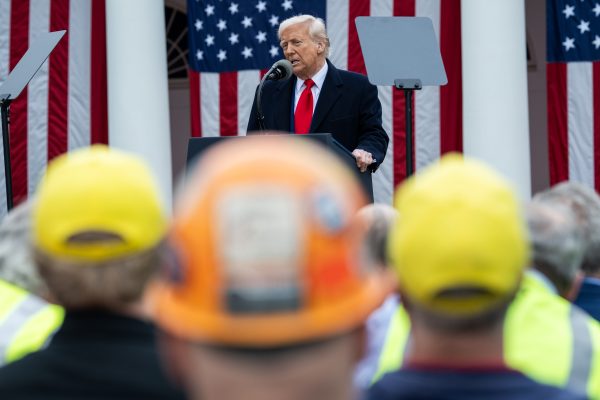
Yesterday, Asia woke to the spectacle of Trump, sitting in the Rose Garden of the White House against a backdrop of American flags, announcing a range of punitive tariffs on a long list of nations. These involve a baseline 10 percent tariff on every U.S. trade partner, and a range of reciprocal tariffs on nations that enjoy a trade surplus with the United States.
Among the Southeast Asian economies, Cambodia was hit with the highest rate – 49 percent – followed by Laos (47 percent) and Vietnam (46 percent). This was followed by Thailand (36 percent), Indonesia (32 percent), Malaysia (24 percent), and the Philippines (17). Singapore and Timor-Leste, the only two Southeast Asian nations that run a trade deficit with the U.S., were spared the reciprocal tariffs and hit with just the 10 percent baseline rate.
Overall, while Southeast Asia survived the first Trump administration’s trade wars relatively unscathed – indeed, nations like Vietnam benefited considerably from the relocation of Western businesses from China – it is firmly in the crosshairs under Trump 2.0. As Roland Rajah wrote for The Interpreter yesterday, “Instead of getting a boost, the entire export-driven development model of the region is now at serious risk.”
Indeed, if implemented in their current form, the tariffs could have severe impacts on the region. The U.S. is the largest export market for Vietnam, Cambodia, Thailand, and the Philippines, the second largest for Indonesia, and the third largest for Malaysia.
The exact goal of the tariffs remains unclear. Southeast Asian countries are effectively being punished for running trade deficits with the U.S. (Indeed, far from being “reciprocal,” the tariffs were calculated simply by halving countries’ trade balance ratio with the U.S.)
At the same time, nations like Cambodia have been accused of acting as backdoors for Chinese exports to the U.S. As one White House official told reporters, “China has turned Cambodia into the most important transshipment hub that Communist China uses to evade our tariffs.” Vietnam has also been accused of being a major source of indirect Chinese exports to the United States, either by outright tariff evasion or through the inclusion of Chinese components in Vietnam’s exports to the United States, although some argue that this is overstated.
Responses From Hanoi and Bangkok
Nonetheless, the region’s two hardest hit major economies – Vietnam and Thailand – responded in ways that reflected both the importance of Southeast Asia’s trade relations with the U.S. and the frustration that many in the region feel about the brusque and coercive turn in U.S. trade policy.
In Vietnam, the general reaction to the tariffs has been “a mix of shock, frustration, anger – and fear for the economy if a reprieve can’t be negotiated by the 9th,” as Mike Tatarski noted in his Vietnam Weekly newsletter.
After the tariff announcement, Prime Minister Pham Minh Chinh called an emergency cabinet meeting in which he said that the 46 percent tariff “did not reflect the strong bilateral relations between the two nations,” Reuters reported, citing state media. He nonetheless said that Vietnam’s ambitious 8 percent GDP growth target remained unchanged.
Ministry of Foreign Affairs spokesperson Pham Thu Hang said that the tariff decision was “not in line with the reality of mutually beneficial economic and trade cooperation between the two countries” and “fails to reflect the spirit” of the Comprehensive Strategic Partnership that the two nations established in 2023. Meanwhile, the Ministry of Trade asked the Trump administration to put the tariff on hold and engage in further negotiations about Vietnam’s lopsided trade surplus with the United States. Hanoi has already announced that Deputy Prime Minister Ho Duc Phoc, a former finance minister, will fly to the United States on April 6 to try and broker a deal.
At the same time, in a subsequent government statement quoted by Reuters, Chinh pledged to diversify Vietnam’s export markets. He described the tariff announcement as “an opportunity to restructure the economy towards swift yet sustainable development… to expand markets, diversify product markets and supply chains, and boost localization.”
Vietnam has ample reasons to be aggrieved. Since Trump’s election in November, Vietnamese officials have done a lot to engage with the U.S. government in order to address its concerns about its lopsided trade balance, in the hope that any U.S. tariff would be moderate. It unilaterally lowered tariffs on a range of U.S. imports, including ethanol, cars, and liquefied natural gas, with further reductions flagged on a range of other imports. It also gave Elon Musk’s Starlink permission to begin operating in Vietnam and, for good measure, greenlit a Trump-affiliated golf course and resort project outside Hanoi. As Tatarski wrote, Vietnam “took a decidedly nonconfrontational approach and nonetheless got hit much harder than countries Trump routinely inveighs against.”
Similarly, in Thailand, a longstanding U.S. security ally, Prime Minister Paetongtarn Shinawatra said in a statement that her government had “signaled its readiness to discuss with the U.S. government at the earliest opportunity to adjust the trade balance in a fair manner for both parties, minimizing the impact on the relevant sectors.” Thailand is also exploring the possibility of increasing imports of U.S. agricultural products, in a bid to narrow the $45.6 billion trade deficit with the U.S. In February, it announced plans to import 1 million tonnes of American ethane in the second quarter of this year.
Paetongtarn added that Thai exporters “were encouraged to seek new potential markets to reduce reliance on a single market” and that the Thai government had “prepared mitigation measures to support affected Thai exports who rely mainly on the United States’ market.”
Officials in Cambodia, meanwhile, seemed relatively blasé about the mammoth 49 percent tariff announced by Trump, which, if implemented in full, could wreak havoc on the country’s export-dependent garment and footwear manufacturing industry.
Pan Sovicheat, a Commerce Ministry spokesperson, said that the tariffs were “not reasonable” but also told the Phnom Penh Post that “the government and the commerce ministry are not alarmed by this issue.” He added, “We will make every effort to protect the interests of the export industry, as well as the interests of workers in Cambodia.” Ly Kunthai, president of the Cambodia Footwear Association, told the newspaper that he believed the matter would be resolved through negotiations between Phnom Penh and Washington.
Going Forward
Whether Southeast Asian governments will succeed in negotiating lower tariffs hinges in large part on the Trump administration’s ultimate goals, which remain hard to pin down. As Roland Rajah argued in The Interpreter, if the Trump administration is truly focused on reducing trade deficits, “there may also be limited room for these countries to negotiate their way out,” given the small size of their economies. However, if the Trump team has in mind a more holistic view of regional geopolitics – in particular, its heated attempts to hamstring China’s growing power and ambition – it may be more willing to be more flexible, at least for nations that it views as potential partners in this project.
Over the longer term, the shock of the tariffs, to say nothing of the capricious and almost insultingly slapdash way in which they were determined, will tarnish, perhaps permanently, Washington’s reputation as a steadfast and reliable economic partner. As the reactions of the Thai and Vietnamese governments suggest, major Southeast Asian economies now have a strong incentive to reduce their heavy reliance on the U.S. market. While this is easier said than done – replacing the U.S. market could well take years, if not decades – the indiscriminate nature of the Trump tariffs could create new economic convergences between Southeast Asia and many other economies, among them the European Union, Japan, South Korea, India, Australia, the United Kingdom, and Russia. It is also very likely to tighten China’s already considerable economic linkages with the region, as Beijing presents itself as a proponent of mutually beneficial economic exchange.
Should this happen, the logical outcome will be a reduced U.S. economic presence in the region. There is a lot of water still to pass under the bridge, but as Nikkei Asia concluded in an article yesterday, “Even if Trump’s tariffs help reduce the U.S. trade deficit with Southeast Asia, the benefits will be harder to see for U.S. companies as ties with Southeast Asia’s vast market weaken.”