

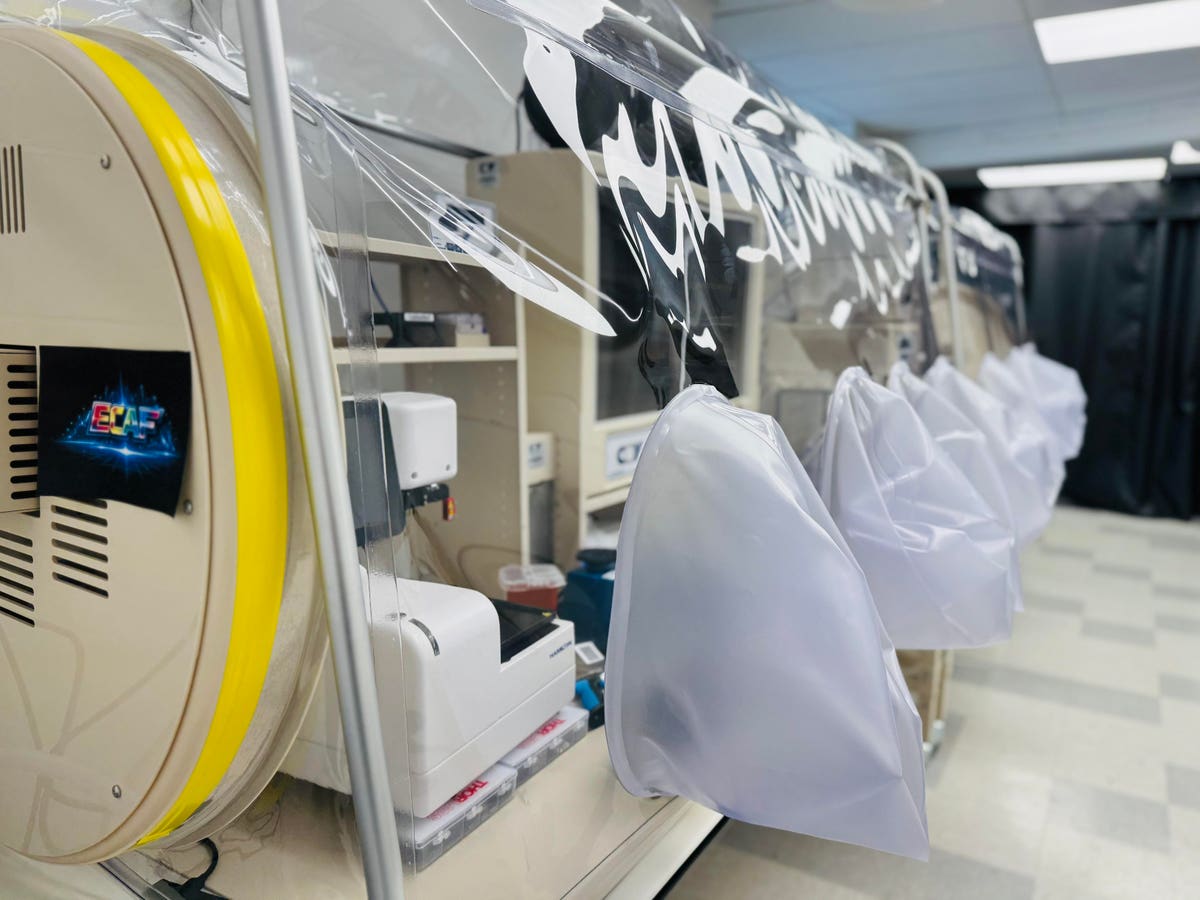
Anaerobic chamber where Kanvas strains are characterized and banked.
Kanvas Biosciences
Synthetic microbiomes to treat disease. Sea levels may rise faster than we thought. AI for scientific researchers. All that and more in this week’s edition of The Prototype. To get it in your inbox, sign up here.
Around 150 million children worldwide are at risk for a disease called environmental enteric dysfunction (EED), particularly those who live regions with poor sanitation. This causes severe gut inflammation, preventing them from absorbing nutrients from food. There is no approved medicine for the disease, though some interventions can help and others are being researched.
Kanvas Biosciences cofounder and CEO Matthew Cheng is aiming higher. His startup received new funding from the Bill & Melinda Gates Foundation to develop a treatment for EED. How? By developing a synthetic bacterial microbiome that can be delivered to patients in a pill.
Since it was founded in 2020, Kanvas has been building what it calls a “Google Maps” for the microbiome, using machine learning and spatial imagery. With these methods, Cheng told me his team can identify promising strains of gut bacteria that can work in concert in a bioreactor. His company’s technology, he told me, means they can get 145 different bacterial strains into a single pill–compared to other microbiome treatments that contain fewer than a dozen.
Why is this the solution? Because the gut inflammation underlying EED is usually the result of chronic infections from bacteria like E. coli, which damage the gut lining and prevents absorption of nutrients. This microbiome pill would introduce healthy microbes that displace the pathogenic ones, the way fecal transplants are currently used to treat certain bacterial infections. The treatments will be designed with pregnant women in mind, which hopefully will induce healing in mothers and provide a healthy microbiome for their unborn infants.
It won’t be easy, Cheng admitted to me. Not only will the company need to identify the appropriate local bacterial strains to use, but it will also need to design the pill to be stable at warmer temperatures. Dosing will also have to be optimized–one pill alone is unlikely to do the job, but if it requires too many, that could make it hard for patients to adhere to the medication schedule.
Kanvas doesn’t have any FDA-approved microbiome treatments on the market yet, but they do have one currently in clinical trials and another going later this year. And the advances the company has made in the past couple of years make him confident that his company can work with the Gates Foundation to tackle this disease. “We think we have a really high chance of solving this problem,” he told me. “Or at least being part of the solution.”
Discovery of the Week: Global Sea Levels May Rise Faster Than Expected
Increased carbon dioxide levels could cause sea levels to rise faster than expected. That’s suggested by new research published this week by the iC3 Center for Ice, Cryosphere, Carbon and Climate.
The reason for this has to do with Antarctic ice shelves. These are part of the giant glaciers on top of the continent, which have extended out over the ocean and are floating. They help slow down the flow of ice into the sea–where it melts more readily than it does on land–keeping sea level rise in check.
As it turns out, the undersides of these ice shelves are lined with grooves. Those grooves trap water, causing the ice shelves to melt faster, accelerating ice flow into the sea. The upshot of that is sea level rise could end up being much faster than previous predictions. That means coastal cities and regions may have less time to prepare than they thought, putting lives and property at risk.
A Better AI Tool For Scientific Research
Since ChatGPT hit the market, people have been increasingly using AI for research and writing. But that can cause problems when accurate attribution is important, as large language models are prone to hallucinating documents and citations that never existed. For instance, big law firm Sullivan & Cromwell recently apologized for submitting a document to a court that had hallucinated references. Scientists aren’t immune, either. A recent study published in The Lancet found that fake references have been steadily on the rise over the past few years in peer-reviewed papers.
Academic publisher Elsevier has built a new tool using LLMs to improve on this, which it calls LeapSpace. It’s a research chatbot that’s trained on millions of peer-reviewed research papers, book chapters and abstracts from its own family of journals, as well as IOP Publishing, Oxford University Press, Sage Publishing, the NEJM Group and more. The company hopes to sign agreements with other publishers as well to expand the tool’s knowledge base.
Elsevier gave me access to try it out, so let me give you some flavor of how it works. When you query LeapSpace on a scientific topic, it provides nuanced answers and degrees of confidence based on the available studies. It identifies which studies support different aspects of its answer, so you can review them yourself. It also outputs an “evidence classification table,” which cites studies that support its answer, show mixed outcomes and/or contradict its answer.
Even better–it does not have a chummy or sycophantic personality. It is no-nonsense and to the point, like when characters query the computer on Star Trek. I’ve started to use it to support my reporting for stories and found it really helpful in tracking down relevant research and context. I’m very interested to see how the tool evolves in the coming months and years.
The Hot Take: The Era Of Quantum Computing Is Near
Each week, I ask investors for their take on tech trends within their industries. Today the answers come from Jason Pontin, a general partner at DCVC who invests in emerging tech startups focused on health, industrial transformation and sustainability such as Kanvas and ZwitterCo.
Jason Pontin
WINNI WINTERMEYER
What tech is being overhyped right now?
AI (sort-of). The giant large language model companies, the many wrapper businesses they’ve spawned, and the horde of more specialist scientific discovery companies employing transformers are, in aggregate, obviously overvalued by markets. The difficulty is, we don’t know which companies will win. I don’t believe LLMs, absent new approaches (some of them neuro-symbolic), are on the royal road to artificial general intelligence, and I’m skeptical of hyperbolic claims that LLM will displace 50% of entry-level white-collar jobs within one to five years. Fears of technological unemployment accompany every technological revolution, and while AI may be different, new technologies in the long run have always created new, better-paying jobs, serving hitherto unimagined consumer needs. I worship in the church of Amara’s Law: “We tend to overestimate the effect of a technology in the short run and underestimate the effect in the long run.” AI will allow us to solve problems that our poor ape brains can’t solve, such as understanding and treating complex diseases or designing new chemical reactions and materials, which will birth new industries that solve global problems, grow wealth, and expand human possibilities.
What tech should more people be talking about today?
Microbiome medicines. Ever since the genomics revolution revealed how reliant the human organism is on its microscopic microbial cohabitants, the microbiome has been medicine’s elusive frontier, promising better health if we could untangle the trillions of interactions that influence nearly every facet of our bodies. However, effective medicines that harness the microbiome have been rare, despite its importance to functions like immune response. Now, new advances in microscopes that can spatially visualize the entire human microbiome and its host-to-microbe interactions, producing an unprecedented wealth of data to map the microbiome and train AI-drug discovery platforms, in tandem with automated manufacturing technologies that can isolate, optimize, and synthesize microbes in a pill-like format, are making the microbiome druggable. The benefits will be wonderful, extending far beyond gut health, to include treating cancer, multiple sclerosis, and infectious disease in the poor world.
What tech are we all going to be talking about in five years?
Quantum computing. Ever since the early 1980s, when Richard Feynman and Yuri Manin first proposed harnessing quantum systems to build computers that could simulate quantum mechanics and solve problems unsolvable with classical computers, quantum computing has been the technology of the future–and (as the joke goes about fusion power) it seemed as if quantum computing always would be the technology of the future. But quantum computers, at least for specialist applications such as cryptography, won’t be science fiction in five years. What’s changed is that quantum computing is no longer a scientific challenge, but increasingly an industrial activity, amenable to new supply chains and advances in manufacturing. Recent architectural and resource-estimation research demonstrates that cryptographically relevant instances of Shor’s algorithm (a quantum algorithm that factors large integers exponentially faster than classical algorithms) can be executed on a reconfigurable neutral-atom quantum computer with only 50,000 physical qubits, roughly two orders of magnitude below the one-million qubit figure that has anchored planar surface-code estimates.
On My Radar
The state of the Strait, day 69: The Strait of Hormuz is still effectively closed, with only a handful of ships successfully transiting in the past few days. Despite an ostensible ceasefire between the two countries, fighting appears to be ongoing, albeit sporadic. We’ve previously discussed how this impacts technology in a variety of ways, and the overall economic ripple effects are only getting worse. Spiking jet fuel prices have put Spirit Airlines out of business and are putting pressure on other airlines. As the blockade continues (and personally, I don’t see it ending anytime soon), expect more ripples and delays throughout the economy, especially in the tech sector, as the resulting increased costs of doing business get passed on to customers–like the $50 hike in Nintendo Switch 2 consoles announced today.
Blocking Wind Power: Electricity rates have reached new highs in the United States, with no end in sight as data center buildouts increase demand for power and the aforementioned Hormuz blockade spikes prices of natural gas. Meanwhile, regulators in the Trump administration are stalling development of more than 165 wind farms that could generate a total of up to 30 gigawatts. Wind has become an increasingly large source of electricity in the U.S., supplying more than 10% of the total, and in states like Kansas, Iowa and New Mexico it provides more than half. As power demand spikes and supply is stalled, expect prices to keep going up.
Pro Science Tip: You Don’t Need That Much Proteinhat much protein
For the past couple of years, I’ve been on a fat loss journey which means living on a calorie deficit. And to avoid losing muscle mass, I’ve also been strength training while regularly running. So it’s probably not a surprise that my social media algorithm likes to populate my feed with fitness influencers promoting the idea that if you’re trying to build muscle, you optimally want 1 gram of protein per pound of body weight. That’s… not easy if you’re also trying to live on a calorie deficit, even in an era where we’re adding protein to everything from Pop-Tarts to ramen.
So out of curiosity, I used LeapSpace to do a literature review on this (See how I’m maintaining continuous threads in the newsletter today? Pretty cool, right?) and found that the consensus from studies says you really only need about half that–around 0.54 grams per pound–with performance rising as you get to about 0.73g, but plateauing after that for everyone except basically the most elite athletes (a group of people that certainly does not include me). LeapSpace’s confidence in this assessment is high, because “multiple independent systematic reviews and meta-analyses converge on the same plateau.” Clicking through to its references, like this study, seem to back that up, with an added benefit of putting less stress on your kidneys and liver than higher intakes.
What’s Entertaining Me This Week
I’m very much enjoying Look For Your Mind!, the latest album from The Lemon Twigs. The band has an incredibly retro, late 60s/early 70s psychedelic style that nevertheless manages to sound fresh. My favorite tracks: “2 or 3”, “I Just Can’t Get Over Losing You” and “Look For Your Mind.”