

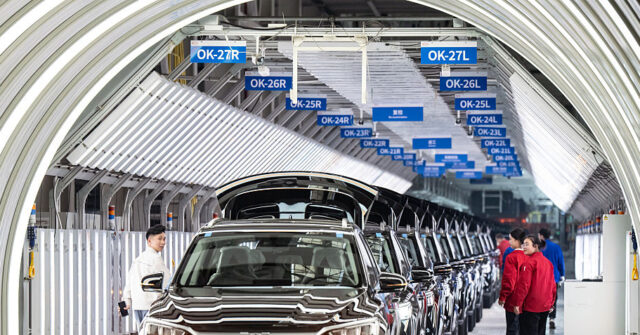
A human rights organization revealed evidence in a recent report, highlighted by the Guardian on Tuesday, that Chinese automobile giant BYD’s first electric vehicle (EV) plant in Europe, a project advanced by former Prime Minister Viktor Orbán in Hungary, is subjecting Chinese migrant workers to abuse and forced labor.
The accusations are far from the first that BYD has faced abroad for importing and then enslaving Chinese migrant workers, most prominently in Brazil.
BYD, China’s top carmaker, is a company widely known to hold deep ties to the Chinese Communist Party. The New York-based human rights organization China Labor Watch (CWL) first accused BYD’s Hungarian plant, located in the town of Szeged, in April of abusing Chinese workers by subjecting them to seven-day work weeks, debt-recruitment, excessive overtime, and visa fraud — all clear violations of EU labour laws.
For years, CWL has dedicated itself to investigating and documenting Chinese factories over their unfair, often slavery-like labour conditions. CWL substantiated its accusations against BYD with testimonies from more than 50 Chinese workers at the Szeged plant. Some of the workers said their lodging is jam-packed, forcing over 450 individuals into one dormitory.
The Guardian reported that locals have reported potential health concerns as a result of the conditions at the site. One unnamed hospital doctor told The Guardian that several migrant workers have been being treated for tuberculosis. The safety of the workers at the plant has been also called into question, particularly after a London-based BYD spokesperson confirmed that a worker died on February 14 in a crane accident.
Additionally, some of the workers claimed they were hired through a contractor who demanded high fees that CWL warned constitutes a form of debt bondage for workers coming from low-income regions in China. Workers claimed to the group that the recruitment fee would be returned if they finished working at the plant for a full uninterrupted year. Workers who try to leave early would allegedly be forced to forfeit the fee and reimburse the recruiter for the costs incurred to bring them into Hungary.
BYD was blacklisted in Brazil for similar reasons, reportedly subjecting its Chinese workforce to conditions akin to modern slavery. In 2024, Brazilian authorities halted construction of BYD’s EV plant in Camaçari, Bahia, after investigators found and rescued 163 Chinese nationals working at the factory under slavery conditions. While a court injunction has prevented the blacklisting in Brazil, the government report on the conditions at its plant remains available.
Brazilian prosecutors levied similar allegations to those now issued against BYD’s Hungary plant. The investigation found that BYD hired the Chinese workers through a contractor, who withheld a significant percentage of each worker’s wages and their passports, forcing them to comply with unfair working conditions under threat of punishment.
A European Commission spokesperson said that the organization is aware of the allegations, but that it had been informed that there is a pending case before Hungarian authorities over the claims. A BYD spokesperson, on the other hand, told The Guardian the company placed the “highest priority on the protection of labour rights and the strict compliance with Hungarian and European laws and regulations.”
The Szeged plant began vehicle production trials this year, aiming to move to production phase throughout the second quarter of 2026, and a complete opening in 2027. The company reportedly invested over $4.5 billion to built the plant. In its original 2023 press release announcing the construction of the plant, BYD affirmed that it planned to turn Hungary into the centre of its European production operations.
Former Hungarian Prime Minister Viktor Orbán prioritized importing Chinese business into Hungary. In May 2025, Orbán proudly announced that BYD was planning to locate its European business headquarters in Budapest, declaring, “We need partners. And we can only enter this new era if there is Chinese-Hungarian strategic cooperation, because China leads in this industry’s technology.” The Orbán government referred to calls for distancing itself from China as a “red line” that it refused to cross.