

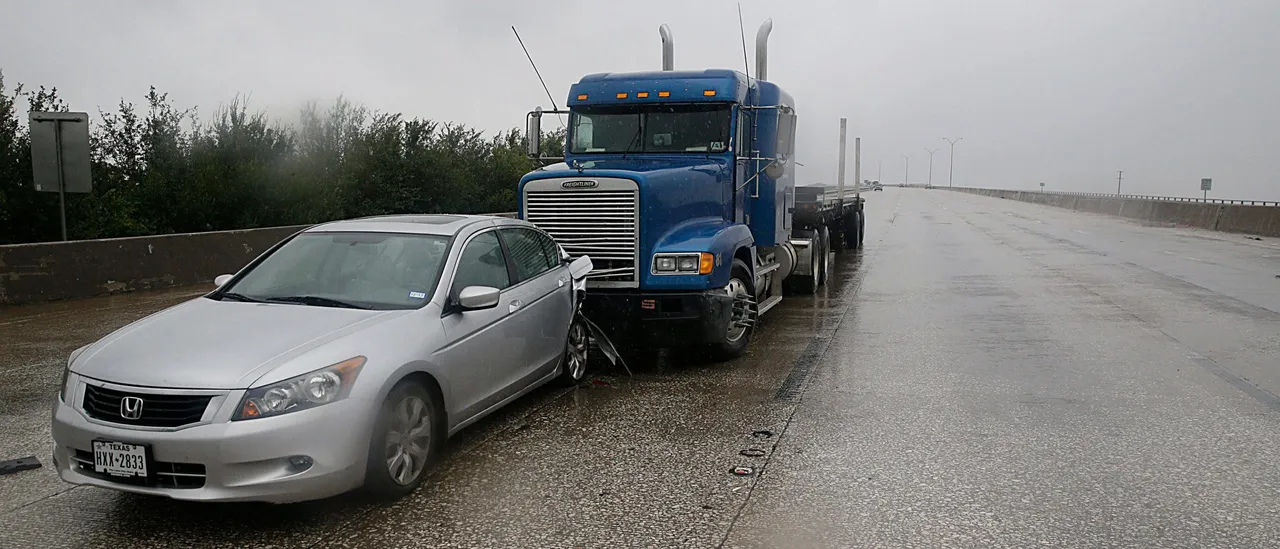
Americans may be paying a hidden “lawsuit tax” through higher insurance premiums and higher prices for everyday goods, as trucking companies face rising litigation costs from staged crashes, massive settlements and “nuclear verdicts.”
Industry groups and lawsuit abuse critics told the Daily Caller News Foundation that costs from frivolous lawsuits and rising settlements are being passed down to consumers through elevated insurance premiums, higher transportation costs and inflated prices for everyday goods. They argue those costs are especially hitting the trucking industry, where rising commercial insurance premiums can ripple through freight rates, grocery bills, consumer goods and even personal auto insurance premiums.
“Abusive litigation practices against the trucking industry are driving up costs for consumers, destroying small businesses, and undermining public safety.” Henry Hanscom, American Trucking Association’s (ATA) chief advocacy & public affairs officer, told the DCNF.
Congress Takes Notes
The number of filed cases involving tractor-trailers has increased at an annual rate of 3.7% between 2014 and 2023, according to a study by the American Transportation Research Institute. This comes as the personal injury market size rose 2.5% CAGR between 2020 and 2025, according to IBIS World.
Auto insurance premiums have been rising since February 2020, and insurance premiums have soared by 55%, according to NPR.
The Surface Transportation Reauthorization Act is set to expire in September and is considered must-pass legislation, as it sets federal transportation funding and policy. ATA supports including several lawsuit-abuse measures in the package or another legislative route, though it remains unclear if lawmakers will include those reforms in the final bill.
ATA Chairman Greg Hodgen and a group of trucking industry members met with both the House and Senate Judiciary Committees in April to discuss lawsuit abuse targeting the industry, including staged accidents, forum shopping, third-party litigation funding and frivolous lawsuits, Hanscom told the DCNF. (RELATED: Are We Approaching The End Of The Road For America’s Truckers?)
After hearing about the surge in staged crashes and the roughly $4,200 a year it adds to the average family’s costs, House Judiciary Committee Chairman Jim Jordan said he wants to take a closer look at it.
A spokesperson from Jordan’s office confirmed to the DCNF that the Representative’s office is “looking into it.”
AUSTIN, TEXAS – JULY 26: An aerial view of vehicles travelling along Interstate 35 on July 26, 2024 in Austin, Texas. The Insurance Research Council has released data showing, people driving without auto insurance rose 11% in 2019 to 14% in 2022. The average annual cost of full-coverage auto insurance has spiked 12% according to Bankrate. (Photo by Brandon Bell/Getty Images)
‘Hits Consumers’
In October 2025, Georgia Republican Rep. Mike Collins introduced the Lawsuit Abuse Reduction Act of 2025, which aims to reduce frivolous suits in federal courts by imposing mandatory sanctions on attorneys who file them. It ends the 21-day “safe harbor” rule that allows attorneys to withdraw frivolous filings in that timeframe without consequences.
The bill has gained support from the U.S. Chamber of Commerce and is pending before the House Judiciary Committee.
A similar version of the legislation was introduced in 2017, but it ended up dying in the Senate Judiciary Committee after passing the House.
The bill faced strong opposition from the American Bar Association (ABA) and the American Association for Justice (AAJ), where the two spent over $7 million lobbying in 2017, according to Open Secrets.
In September 2025, Congress introduced the FAIR Trucking Act, legislation that seeks to curb “nuclear verdicts” against the trucking industry. Nuclear verdicts are high jury awards in personal injury cases that can exceed $10 million, and can lead to bankruptcy for freight carriers. Nearly 80% of trucking-related verdicts exceed $1 million, according to an American Transportation Research Institute (ATRI) report.
Since the introduction of the FAIR Trucking Act, the AAJ has lobbied heavily against the measure, according to lobbying reports obtained by the DCNF.
“The insurance industry raked in $169 billion in profits in 2024 while denying Americans’ claims after catastrophic events and jacking up rates for policyholders year after year,” AAJ spokesperson Heather Sager told the DCNF. “So, it’s no surprise they’re trying to point the finger at anyone willing to hold them to account.”
“This is a tale as old as time — for decades, corporations who can’t justify their treatment of American consumers attempt to blame those holding them accountable while pushing legislation that would shield them from accountability,” Sager added.
The risk of litigation is negatively affecting freight industry insurance, where settlements frequently reach millions of dollars. In 2025, some trucking companies experienced premium increases of 20-30% in just one year, according to FreightWaves.
On Thursday, the Supreme Court declined to limit freight broker liability in the Montgomery v. Caribe Transport case, which addressed whether freight brokers can be sued under state law for hiring unsafe motor carriers, leaving business groups warning that shipping companies could face a patchwork of state liability rules.
“Without a uniform standard, every small business who uses a trucking company will be hit with higher costs and reduced availability as the resulting patchwork of rules and risk ricochets through the supply chain,” Beth Milito, vice president and executive director of NFIB’s Small Business Legal Center, said in a press release following the decision.
The ruling leaves freight brokers facing state-by-state liability risks that could drive up insurance and shipping costs across the supply chain.
Hanscom said rising litigation costs have driven up commercial auto insurance premiums across the trucking industry, with liability insurance premiums increasing 18.6% between 2021 and 2024, “outpacing consumer inflation,” even as heavy-duty truck crash rates declined by as much as 3.1%.
“These soaring insurance costs year-over-year are putting enormous financial strain on trucking companies at a time when the industry is grappling with a prolonged freight recession,” he said. “It’s pushing many motor carriers to the brink.”
The trucking industry moves roughly 70% of U.S. goods, meaning higher freight insurance costs can spill over to consumers. Over the next decade, litigation is expected to contribute 15% of the inflation in food costs, according to the U.S. Chamber of Commerce Institute for Legal Reform.

In an aerial view, brand new Volvo trucks are displayed at TEC Equipment on September 26, 2025 in Dixon, California. (Photo by Justin Sullivan/Getty Images)
The proposals include legislation that seeks to target staged highway accidents involving commercial trucks, forum shopping, frivolous lawsuits and third-party litigation funding.
The AAJ, the largest trial bar association, acting as the leading advocacy and lobbying organization for plaintiffs’ attorneys, stated that insurance companies and corporations are attempting to shift the blame for rising premium costs.
“Lawsuit abuse against the trucking industry hits consumers in two ways,” Hanscom told the DCNF. “Since virtually every good travels on the back of a truck at one point in time, increases in freight transportation costs are reflected in the cost of goods.”
Hanscom added that rising premiums in the commercial auto sector also “put upward pressure on the consumer auto insurance market.”
In 2023, Republican Florida Gov. Ron DeSantis signed HB 837 into law, aiming to reduce frivolous lawsuits and insurance litigation by altering negligence standards, all in an attempt to combat high premiums.
The effects of the reform were felt rapidly, as the top five auto insurance groups saw an average rate decrease of 6.5%, according to the Florida Office of Insurance Regulation.
As insurance premiums skyrocket nationwide, states are now signaling similar reforms to tort laws, including New York, where insurance rates rank among the fourth-highest in the nation.
“You can have a situation where someone causes the accident intentionally and gets a huge personal injury payout. So we’re putting the brakes on that fraud. Enough is enough here in the State of New York,” Democratic New York Gov. Kathy Hochul said in a statement released in February.
“We’ll start by reforming our tort laws to protect people who play by the rules and insulate the personal injury system from abuse,” Hochul added.
All content created by the Daily Caller News Foundation, an independent and nonpartisan newswire service, is available without charge to any legitimate news publisher that can provide a large audience. All republished articles must include our logo, our reporter’s byline and their DCNF affiliation. For any questions about our guidelines or partnering with us, please contact licensing@dailycallernewsfoundation.org.