

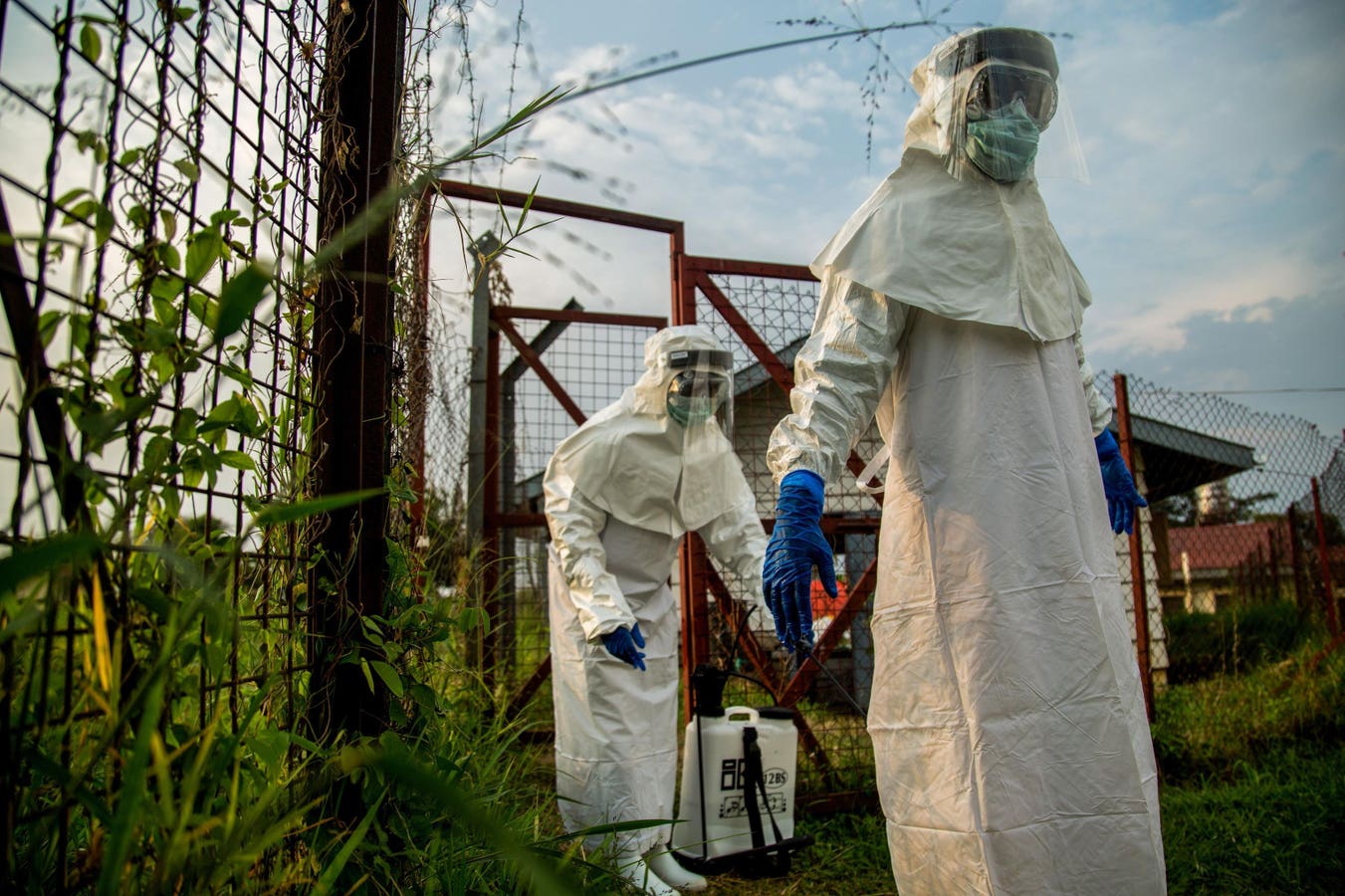
Medical staff are sterilised before entering the isolation unit at a hospital in Bundibugyo, western Uganda, on August 17, 2018, where there was a suspected case of Ebola. On May 16, 2026 an outbreak of Bundibugyo virus was declared a public health emergency of international concern. (Photo by SUMY SADURNI / AFP) (Photo credit should read SUMY SADURNI/AFP via Getty Images)
AFP via Getty Images
The World Health Organization has declared the ongoing outbreak of Bundibugyo ebolavirus in the Democratic Republic of Congo and Uganda a public health emergency of international concern, just two days after the outbreak was confirmed.
The speed of this designation is without precedent. A PHEIC is the highest level of alarm WHO can sound under the International Health Regulations. Since the mechanism was established in 2005, it has been invoked only nine times: for H1N1 influenza, polio, the two prior Ebola outbreaks, Zika, COVID-19, two waves of mpox and now Bundibugyo. Every prior declaration followed weeks or months of deliberation. The 2014 West Africa Ebola epidemic was not designated until August 2014, eight months after the first cases appeared in Guinea, by which point 1,711 people were infected and 932 had died. The 2018–2020 outbreak in eastern DRC was not declared a PHEIC until July 2019, nearly a year in, after the virus reached the city of Goma. Both declarations were widely criticized as too late. This one came in 48 hours.
Why So Fast?
The WHO statement points to several factors. Eight of 13 laboratory samples tested positive for Bundibugyo virus, a high positivity rate suggesting widespread infection. At least four healthcare workers have died. Clusters of epidemiologically unlinked cases have appeared, meaning people are falling ill with no traceable connection to known cases, a signal of community transmission that contact tracing has not yet mapped. Most alarming, the virus has already reached two capital cities: a confirmed case appeared in Kinshasa, the DRC capital of 17 million people, on May 16, and two confirmed cases, one fatal, were identified in Kampala, Uganda on May 15 and 16.
The combination is what drove the decision. Bundibugyo is an Ebola virus for which no vaccines or therapeutics exist. Like other ebolaviruses, it causes severe hemorrhagic fever with high fatality. It is spreading in a conflict-affected province with documented community transmission and is already present in two of the most connected cities in central and east Africa. WHO plans to convene an Emergency Committee to issue formal temporary recommendations.
What Does a PHEIC Actually Do?
A PHEIC declaration is a legal instrument under the International Health Regulations. It signals that an event constitutes a public health risk to other countries through international spread and requires a coordinated international response. It authorizes WHO to issue temporary recommendations on trade, travel and surveillance. It is also, practically speaking, a mechanism for mobilizing funding and political attention.
What it does not do is deploy vaccines that do not exist or resolve the security challenges in Ituri Province. The response to Bundibugyo still depends on the same tools I described yesterday: contact tracing, infection control, Ebola treatment units and safe burial protocols. The PHEIC raises the international profile of the outbreak. Whether it accelerates the actual response on the ground in Mongwalu, Rwampara and Bunia is a different question.
The fact that WHO moved this fast suggests the organization has internalized the lessons of its earlier Ebola failures. The 2014 delay cost thousands of lives. Whether speed at headquarters translates to speed in the field will be the real test.