

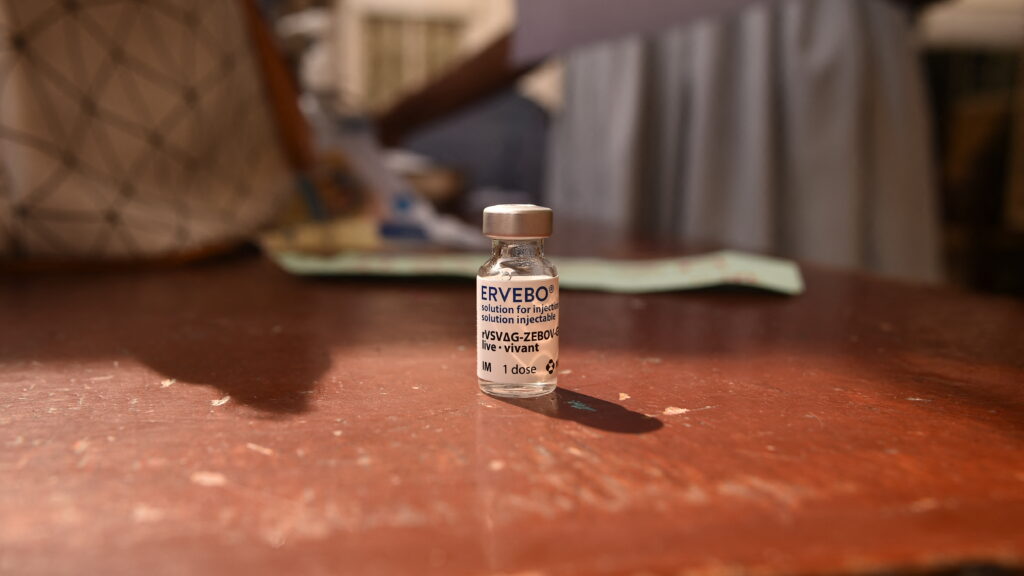
The latest Ebola outbreak in the Democratic Republic of the Congo, which was only confirmed to be underway at the end of last week, is already the fourth largest on record. The deadly virus is spreading in a conflict zone where recent Ebola experience has shown containment will be a challenge. There is no vaccine that targets the species of the virus that is spreading there, Bundibugyo.
But there is a tiny bit of scientific evidence that suggests the existing licensed Ebola vaccine, Merck’s Ervebo, might offer some protection against this virus, even though it is designed to target a different species of Ebola, Zaire ebolavirus.
The World Health Organization and scientists who study these viruses are debating whether Ervebo could help contain this outbreak. A meeting of a group of experts who advise the WHO on development of needed vaccines is scheduled for Tuesday, and the question of whether Ervebo should be put to the test will be on the agenda, Vasee Moorthy, acting lead of WHO’s so-called R&D Blueprint group told STAT.
But at the end of the day, whether the vaccine is used in this outbreak will require a request from the affected countries.
“Any decision as to next steps will be for DRC and Uganda, supported by WHO,” Moorthy said, adding that there are ethical and other considerations to ponder, including whether people in the outbreak zone would be willing to participate in a clinical trial.
The WHO declared the rapidly growing outbreak a public health emergency of international concern on Sunday. As of Monday, there have been a reported 395 suspected cases and 106 deaths in the DRC, according to the African Centres for Disease Control and Prevention. Uganda has detected two cases, both in travelers from the DRC; one of those people died.
The evidence that points to the possibility that Ervebo may be cross-protective against Bundibugyo comes from a small study in primates. Views are mixed about both how likely it is that those results would translate into protection in people and whether it’s worth trying to see if there would be a benefit.
“It’s a damned if you do, damned if you don’t situation,” said virologist Darryl Falzarano, the lead author on the 2011 paper, published in the Journal of Infectious Diseases, that showed some cross protection of the vaccine in macaques.
“You’d be going in almost blind with very little data supporting it and with the thought that it is unlikely to make it worse, but there’s the possibility,” said Falzarano, who is a principal scientist at the Vaccine and Infectious Disease Organization (VIDO) at the University of Saskatchewan.
There are several species of Ebola viruses, four of which have been seen to infect people. Of the four, Bundibugyo is the most recently discovered. Only two previous Bundibugyo outbreaks have been recorded, in 2007 and 2012. Based on data from those two outbreaks, the virus is believed to have a lower case fatality rate than the Zaire and Sudan ebolaviruses, though at an estimated 50%, it’s still a dangerous threat.
Multiple studies over the years have suggested that because the four Ebola species that infect people are sufficiently different from one another genetically, medical countermeasures developed against one will not protect against another. So it was with some surprise that the group responsible for the 2011 paper discovered that macaques that had been vaccinated with a precursor of Ervebo were more likely to survive when exposed to what should have been a lethal dose of the virus than control animals that hadn’t been vaccinated.
In the study, three of four previously vaccinated animals survived exposure to the virus, compared to one of three unvaccinated animals, though all of the vaccinated animals developed symptoms of the disease. (Studies in primates always use as few animals as possible, both for humane reasons and because of the high cost of the animals.)
The fact that one of the control animals survived despite being unvaccinated points to a challenge in interpreting the results, said Tom Geisbert, an Ebola expert at the University of Texas Medical Branch who was an author on the paper.
“When you get three out of four survivors, we’ve got to factor in that some of those survivors may have survived without the [vaccine],” he said, suggesting that fact likely means the protective effect — if there is one — isn’t 75% but more like 50%.
Geisbert said that if the study had been larger, it would be easier to have confidence that there might be a significant benefit from using the vaccine in people.
But other scientists see this as enough evidence to at least study whether the vaccine offers some protection against Bundibugyo, especially given that the alternative is no vaccine at all.
“What’s the old Donald Rumsfeld line? You go into the outbreak with the vaccine you have, not the vaccine you wished you had, or that might someday have,” said Armand Sprecher, an emergency physician with Doctors Without Borders (MSF) who has worked in multiple Ebola outbreak responses.
“The non-human primate study is a reasonable basis for saying let’s use this vaccine, because we’ve got it, and we know that it’s at least safe, and the platform works, and the non-human primate data suggest it will work,” he said. “You use what you got, because the alternative is to do nothing, and I don’t think that that’s acceptable.”
Merck, the maker of Ervebo, didn’t indicate whether it would be willing to see Ervebo used in a clinical trial in this outbreak.
“It is not known whether Ervebo may offer protection against other strains, including Bundibugyo. While some research has been conducted independently from Merck to explore potential cross-protection of other Zaire ebolavirus-containing vaccines against other ebolavirus strains, including Bundibugyo, the data are limited, not from humans and not from evaluation of Ervebo,” a spokesperson said in an email.
Some scientists are reportedly worried about the idea of testing the vaccine against Bundibugyo, concerned that it might backfire in some way.
There is some in vitro evidence that using a vaccine for one type of Ebola virus to protect against a different type might cause what’s known as antibody-induced enhancement — worsened disease. But that effect has not been seen in animal studies.
Falzarano said he’s not so much worried about ADE, as it’s called, but about the fact that giving a vaccine that is meant to arm the immune system to fight off Zaire ebolavirus might distract it from the job of mounting an immune response to Bundibugyo, if the vaccinated person encounters the virus.
He suggested, though, that he could see using Ervebo in a well-run clinical trial in the region, if one can be mounted despite the challenges that would undoubtedly come in an isolated, conflict-ridden area. Otherwise, he would see using the vaccine as “too risky.”
The decision isn’t likely to be an easy one, given the paucity of the data.
“To me, this isn’t a slam dunk,” Geisbert said.