

Get your daily dose of health and medicine every weekday with STAT’s free newsletter Morning Rounds. Sign up here.
Good morning. STAT’s Breakthrough Summit West is today! It’s not too late to attend virtually. We’ve got a packed agenda including speakers like former FDA commissioner David Kessler, OpenEvidence founder Zachary Ziegler, and 23andMe founder Anne Wojcicki. And, of course, a bunch of my talented STAT colleagues.
The latest on Ebola: A travel ban and an old vaccine
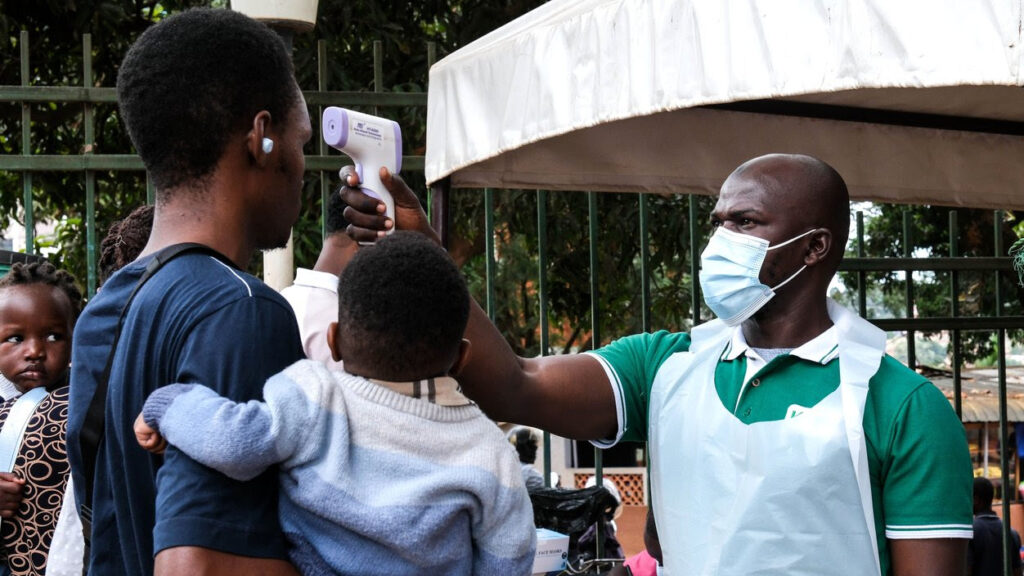
The Trump administration is banning foreign travelers from entering the U.S. if they’ve been in the Democratic Republic of the Congo, Uganda, or South Sudan in the past 21 days, according to a CDC order issued yesterday. The ban — the first ever imposed by the U.S. in response to an Ebola outbreak — is in effect for 30 days. Read more from STAT’s Annalisa Merelli and Helen Branswell on the details, including updates on the American doctor who is confirmed to have been infected.
Meanwhile, experts are looking for potential strategies to contain the outbreak, which has already become the fourth largest on record. The World Health Organization and expert scientists are debating whether an existing vaccine for a different species of Ebola could help. But as Helen reports in her latest, any decision about using the drug will be left to the affected countries. “It’s a damned if you do, damned if you don’t situation,” said virologist Darryl Falzarano, who worked on an animal study that showed the vaccine had some cross-protection potential. Read more from Helen on what might be possible.
Lastly, this morning at the World Health Assembly in Geneva, WHO Director-General Tedros Adhanom Ghebreyesus opened his remarks with an update on the outbreak, with more than 500 suspected cases and 130 suspected deaths. He outlined the numerous reasons for concern — from cases in health care workers to infections in cities — and noted how the conflict in the region has escalated in the last two months. “Over 100,000 people have been newly displaced, and in Ebola outbreaks, you know what displacement means,” Tedros said.
Tedros said the Ebola cases, as well as the recent hantavirus infections on a cruise ship, pointed to “why international threats need an international response,” and why the world “needs WHO.” The agency, however, has been grappling with a shrunken budget, in part because of the withdrawal of the U.S. from WHO under the Trump administration.
Supreme Court rejects challenge on price negotiation
Yesterday the Supreme Court declined to take up lawsuits against the Medicare drug price negotiation program, dealing a major blow to the industry’s legal campaign against the program. The decision was not exactly a surprise, but the justices did not give a reason for their decision. STAT’s John Wilkerson has the details.
$1,000
That’s how much the average Affordable Care Act Marketplace deductible increased from 2025 to 2026, according to a new KFF analysis. That’s about a 37% increase, from $2,759 to $3,786.
After the enhanced tax credits established during the pandemic expired last year, more people opted for plans with lower monthly bills and higher out-of-pocket commitments. These “Bronze” plans saw a jump from 7.3 to 9.2 million enrollees, while “Silver” plans with higher monthly costs and lower deductibles saw a major decrease from 13.7 to 9.8 million people.
By the end of the year, total Marketplace enrollment could drop by 21.5% from last year’s numbers, per the analysis. Initial estimates accounted for only the people who didn’t sign up or get automatically re-enrolled. As we’ve mentioned before in this newsletter, we’ll have to see how many people are disenrolled if they can’t pay the premiums. Revisit this great explainer from Wilkerson for a rundown on the expected impact of the expired subsidies.
Drinking while pregnant more common than believed
The first U.S. public health advisory on drinking during pregnancy was issued in 1977. Since then, rates of alcohol use among pregnant people have dropped steeply — for the most part. In the last decade, those rates have actually started climbing. By 2024, more than 1 in 8 pregnant adults reported drinking in the last month. In the latest installment of The Deadliest Drug, STAT’s Isabella Cueto lays out the findings of an original STAT analysis on drinking and pregnancy data from 2011 to 2024.
“How can something be so common and nobody’s talking about it? It blew my mind,” said Vincent Smith, who helps lead a neonatal intensive care unit in Boston.
While scientists and health experts understand the wide range of harms that can come from exposure to alcohol in the womb, it’s less clear how much alcohol it takes to cause those harms. It’s in that zone of opacity where things seem to get especially complicated. Read more from Cueto on data and attention gaps, the difficulty of getting a diagnosis for fetal alcohol spectrum disorders, and the cultural conversations around “light drinking.”
More kids with autism are getting leucovorin
Since last spring, leucovorin prescriptions among children with autism have skyrocketed, according to a study published yesterday in JAMA Network Open. Federal health officials and President Trump first promoted the generic drug as a potential treatment for autism in September. Prescription rates were already increasing at that point in the wake of a CBS report on the drug, but the government’s spotlight brought even more attention to the drug.
While previous studies found that prescriptions for children generally increased, the new paper used large-scale Epic systems data to look at trends specifically among children with autism diagnoses. In 2023 and 2024, monthly leucovorin prescription rates among kids with autism held steady at 34 orders per 100,000 clinical encounters. That rose to 335 per 100,000 in August 2025, and all the way to 835 in November.
FDA officials have since walked back statements about the drug’s potential and acknowledged the limited evidence around both efficacy and safety. Still, prescription rates in early 2026 remained high.
Haunted by a ‘ghost approval’
Heart transplant recipient Payton Herres has health insurance on paper. But in real life, she’s living in what she calls a “ghost approval.” This means that the medication she needs to make sure her body doesn’t reject the transplant is technically approved or covered, but she still has trouble getting it.
There’s always a reason for the difficulty: The drug needs prior authorization, or has to go through a specialty pharmacy, or, most common for her, it’s not FDA-approved for that exact use.
“That’s why I started using the term ‘ghost approval,’” Herres writes in a new First Opinion essay. “Because that’s what it feels like — something that exists enough to be referenced, but not enough to actually rely on.” Read more about her experience, which includes seeking help from places like Facebook and people like Mark Cuban.
What we’re reading
-
An HIV-free generation is closer than you think, Vox
-
What I can’t forget about the babies who died of Vitamin K deficiency, ProPublica
- Colorado Supreme Court sides with transgender youth in fight against Children’s Hospital Colorado, Colorado Sun
- Abortion bans are restricting miscarriage care, new study finds, 19th News
- Opinion: Britain embraces a Massachusetts experiment on tobacco regulation — just as the state might roll it back, STAT