

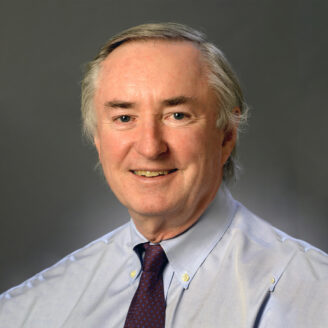
After 40 years at the helm of nonprofit Boston Health Care for the Homeless Program, Jim O’Connell likes to remind himself — and his colleagues — that they’re not saving the world.
Yes, the program has a longtime reputation for building bridges between unhoused people and clinicians at Mass General, building sufficient trust to convince “rough sleepers” to be treated in the streets or visit the hospital. But they’re not even close to ending the crisis.
He and other clinicians at the nonprofit have a “small little mission in the world,” said O’Connell, the founding physician of the program and a member of the second annual STATUS List. ”It’s not solving homelessness, but it’s caring, as best we can, for those who are currently suffering.”
Still, O’Connell says he’s heartened to know that the program he’s built will be sustainable in the long-term, thanks to the efforts of his fellow clinicians. When he was sick during the early days of the Covid-19 pandemic, he recalls, he watched “these amazing younger people take over, and I had to acknowledge at the end of it all that I’m kind of redundant in my own program. So there’s a joy in that that says, ‘Okay, I can walk away. It will be fine.’”
The collective efforts of O’Connell and his colleagues are the subject of journalist Tracy Kidder’s 2023 book “Rough Sleepers,” which recounts the work of the nonprofit’s Street Team in caring for unhoused people in Boston, both medically and emotionally, over the course of five years. STAT spoke with O’Connell about what his work with unhoused people has taught him about the connections between community and health, the diagnostic power of feet, and palliative care.
Excerpts from the conversation are below, lightly edited for clarity.
You told Tracy Kidder, about the time you started to take photos of unhoused people, that you “started to think loneliness is really what drives much of what happens in our world.” What has your work this past year reminded you about the role of loneliness in our Covid-era world?
The isolation that came along with Covid, where everybody had to be distanced, I think gave most of us a glimpse of how lonely the homeless world can be. What is striking about the poverty you see among homeless people is, they have no money, but they also are isolated, and have very little support from family or friends. When they come into the hospital, and we take care of them, they have no visitors. We spend a lot of time in our program trying to make sure we visit people when they’re in the hospital, take care of them when they’re there.
We’re realizing that filling the gaps of that loneliness, giving people a community or helping them find a purpose, just becomes a real, important part of health.
Could you talk about a time you witnessed that link between loneliness or community and overall health in someone you worked with?
One guy [Mikey Henry], he was down at Starbucks in Beacon Hill. He knows everybody, got his own little thing there. But when he got placed in housing, it was away from the folks he knew. He was thrilled to have this housing — he spent the first week or so watching his TV, he got a cat, he was doing well. But when he was starting to get sick of the TV, he was really frightened. He found that he couldn’t sleep at night because it was too quiet. So he came down to where our main offices are. It’s right across the emergency room at Boston Medical Center. He took a tape recorder and he taped the sounds of the ambulances going on. And when he goes home at night he puts on that tape, and he sleeps to the sounds of sirens and everything else around. The quiet only emphasized for him how alone he was, and getting the noise again, gave him a little bit of [his old life].
He had prostate cancer, and we were able to get him over to Mass General — our oncology team just took amazing care of him. Most people are just in the doldrums while getting the infusion — and he was just the only person I’ve ever seen who is radiant during chemotherapy. He couldn’t wait to go to his next session.
About six months ago, he got really sick, and we realized his cancer had spread everywhere. To get him to come to the hospital for care, we had to make sure we would take care of his cat. So one of our physician assistants said, “Well, I’ll take the cat home,” and then he would come to the hospital. If we didn’t do that, he would stay at home and suffer.
And another was this really wonderful guy who just died about a year ago, who was a co-chair of our board of directors. He had been on the streets for about 25 years, and when he got into his apartment, got so excited. And it was so quiet and so lonely. He almost went crazy, and he went into a pretty deep depression.
After we got him through that, he then got some of the other homeless people out to do a video to help other homeless people, about being prepared for loneliness, being prepared for being all by yourself. The video got distributed to all 340 Health Care for the Homeless programs around the country; the government actually distributed it for us.
But it’s a universal experience. Most people find that you don’t have a community when you move into a new neighborhood. If you don’t have the skills to meet everybody around, you’re really isolated.
You’ve said that a lot of the medical help from the Street Team at Health Care for the Homeless has also just been good palliative care, as when you can’t really treat the ailment. Are there any lessons you think our palliative care system can learn from your program or team?
I struggle with this a little bit, because the usual quality measures that we measure health by is, “Did you have your mammogram? Did you have your pap smear? Did you have your colonoscopy on time?” And all of those, if you think about it, are challenging in a homeless population. Where do women go to have a safe pap smear and a safe mammogram? It’s very frightening to people. But, on the other hand, we accept those are parts of good quality care. You gotta try and do it.
When we first started on the street, none of the women we knew had a Pap smear. As we got to know them, and you knew them better and better, they would all of a sudden say, “OK, I’ll do it if you ask me.” We learned that when they come into the hospital for any other reason, saying, “Can we do a quick Pap smear?” becomes not so frightening, especially with our women clinicians. So we went from almost zero to more than a third of the street women being up-to-date in getting their Pap smears.
The reason I say palliative is: Often we see that, with the people who die, we’ve done all the right stuff medically. But whatever got set in motion when they were 10 or 12 years old, we can’t overcome those overwhelming determinants of their health. So in those cases we don’t want to get discouraged. We want to take the best care of them we can in a palliative care mode. In palliative care, you’re not looking to make sure somebody doesn’t die. You’re making sure they’re comfortable and they get as much [of the] best quality of life as they can for as long as they can.
You mentioned to Kidder the power of feet — both in building relationships with your patients and as a kind of diagnostic tool for health and longevity. Could you speak to that, especially during Covid?
It’s a complicated relationship we have with feet, and I never wanted to do [anything with feet] — that’s what I had to do when I first started. The nurses at the shelter wouldn’t let me do my doctor stuff. They were pointing out that if you just meet somebody and you say, “Hey, how are you? What’s going on? Are you thinking bad thoughts?” Nobody wants to share that with you because it’s a little too personal, and they won’t say anything to you until you get to know them.
So the nurses had this brilliant thing where they’d invite people in who had been walking around all day, and then standing in line to get stuff, and they would soak their feet. I remember thinking, “This sounds a little too biblical to me here.” But I had to do that for the first month or two that I was working in the clinic. I got to see what lots of different feet look like, and you start to realize that, wow, you learn a lot about what’s going on with someone just by looking at their feet, their toenails. You can see all the frostbite, you can see what we call immersion foot [when feet are wet for a long period of time]. All those things can be potential avenues for big-time infections. So taking care of the feet is really important.
And most important, I’m sitting on the ground and somebody’s sitting in a chair. So you’re way away from their personal space. You’re at their feet. So you’re not invading that really scary world where a lot of homeless people just are too paranoid to have you get too close or ask too many questions. But they all are happy to talk about their feet, like, “This hurts,” or, “That doesn’t hurt.” We think of it as kind of a window into the soul. If you take good care of somebody’s feet, it opens up a whole opportunity to learn more about them.