

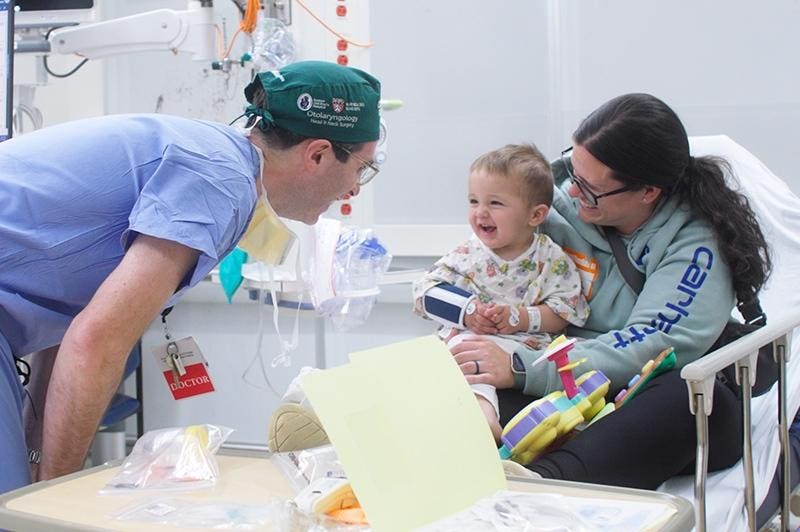
Miles, age 2, is one of the first patients at Boston Children’s hospital to receive gene therapy for hereditary hearing loss. He is now responding to his parents’ voices.
Joseph Piselli, Boston Children’s Hospital
Every 13 minutes, a baby in the United States is born deaf. Some of those babies have a rare genetic form of deafness in which the cells of their inner ear are normal but aren’t transmitting the signal to the brain.
“It’s like the phone is working, but the cable isn’t connected,” says Dr. Jeffrey Holt, a professor at Harvard Medical School and leading researcher in inner-ear gene therapies.
Now, after 25 years of research, that cable can finally be made to work: The first gene therapy anywhere in the world for any form of deafness has been approved by the Food and Drug Administration. In the pivotal clinical trial of 20 infants, children, and teens, 80% of participants achieved improved hearing sensitivity around six months after receiving the therapy, and upon longer follow-up, 42% of those treated achieved normal hearing. The therapy was safe and well-tolerated, with only transient minor side effects like ear infections.
“This is the first time in history that a brand-new gene therapy has been used as a treatment to restore hearing in children born profoundly deaf,” says Dr. Zheng-Yi Chen, an associate professor of otolaryngology at Harvard Medical School and a leader of other gene therapy trials for hearing loss in China. “They can hear whispers and they can speak. As a result, their life will be totally transformed. This sets the stage as a really good example for other gene therapies that can be developed and applied to humans.”
How it Works
The target of the therapy is a mutated gene called otoferlin, or OTOF, which blocks transmission of sound signals from the inner-ear hair cells to the brain.
A single injection delivers a working copy of the OTOF gene via an AAV (adeno-associated virus) vector directly into the inner ear (through the ear canal or behind the ear into the cochlea). But the OTOF gene is too large to fit inside the viral vector, so researchers cleverly split it across two vectors. Remarkably, once the gene is shuttled inside the cell, its two halves recombine around 90% of the time and produce a functional copy of the gene. The cells then start using the new working gene in place of the mutated one.
This dual-vector innovation is a new strategy, validated for the first time in a human disease. Researchers estimate that about 50 to 60 patients have received a form of this therapy across a handful of similar clinical trials to date worldwide. The newly approved therapy comes from Regeneron, which plans to provide the therapy for free to eligible patients, while Eli Lilly and several international groups are targeting the same mutation, including at the Karolinska Institute in Sweden and in China.
“We see children start hearing within three weeks,” says Dr. Chen. “They were completely deaf before. Initially it’s not so good, but it gets better for six months to one year, when they reach the best outcome, then maintain. We think the hearing gets better because the gene produces more of the right product.”
The longest follow-up so far is three years of hearing recovered with no decline. “That’s truly remarkable,” says Dr. Chen.
The Clock Is Ticking
The age of the child at treatment matters greatly, says Dr. Daniel Choo, director of pediatric otolaryngology at University of Cincinnati College of Medicine. He also serves as principal investigator for Eli Lilly’s OTOF gene therapy trial.
The ideal treatment is before age three, or even younger, when the brain is most primed to develop auditory and language processing.
The first two children that were treated at Cincinnati Children’s last fall went from profoundly deaf to the “bottom edge of normal” in three to four months, he says. They are siblings with the same mutation. The younger child, who was just over one year at the time of treatment, is now picking up speech faster. The older child, who was three and a half upon receipt, is still significantly speech delayed.
“Even if you bring back hearing, the language processing is not automatic,” Choo says.
For therapy to be given in the earliest ideal window, genetic diagnosis must happen first. Newborn screening can identify children born with hearing loss. Then the goal is to determine the cause and match the child to a therapy, if one exists.
Gene Therapy vs. Cochlear Implants
The current state-of-the-art treatment for hearing loss in children is a cochlear implant, which is typically given to children at around nine to 12 months old.
Cochlear implants convert sound to an electrical signal, which is effective but fundamentally different from natural hearing. Still, children can learn how to talk and hear if they receive the implant young enough. A teenager, for example, who was born deaf and receives the implant at age 15 may gain sound awareness but still struggle with speech and language recognition.
Gene therapy, on the other hand, restores native hearing through the ear’s own biology, which is closer to natural sound perception and therefore enables potentially better outcomes for speech and language development.
Both options have a role; since the approved gene therapy only covers a tiny fraction of the types of hereditary deafness, cochlear implants remain the standard of care for many patients. But there is a downside.
“Once you put in the cochlear implant, you burn a bridge,” Choo says. “With the current technologies and therapeutics, you can’t go back to a gene therapy. You have probably traumatized inside of the cochlea and developed scar tissue so natural, native hearing would never come back.”
Beyond OTOF
Since the field now has clinical proof of concept for a gene therapy, the door is open to future treatments. Each kind requires a tailored therapy, but shared AAV platforms could lower costs and accelerate timelines.
“Now the big question is which other forms of genetic hearing loss are amenable for gene therapy?” says Dr. Holt.
Researchers know of at least 150 genes that, if mutated, cause hearing loss. One of the next targets is GJB2, which occurs in 21% of all people who are born deaf. Over the next five to 10 years, Choo estimates we will probably have trials for gene therapies that may cover 40% of all genetic causes of deafness.