

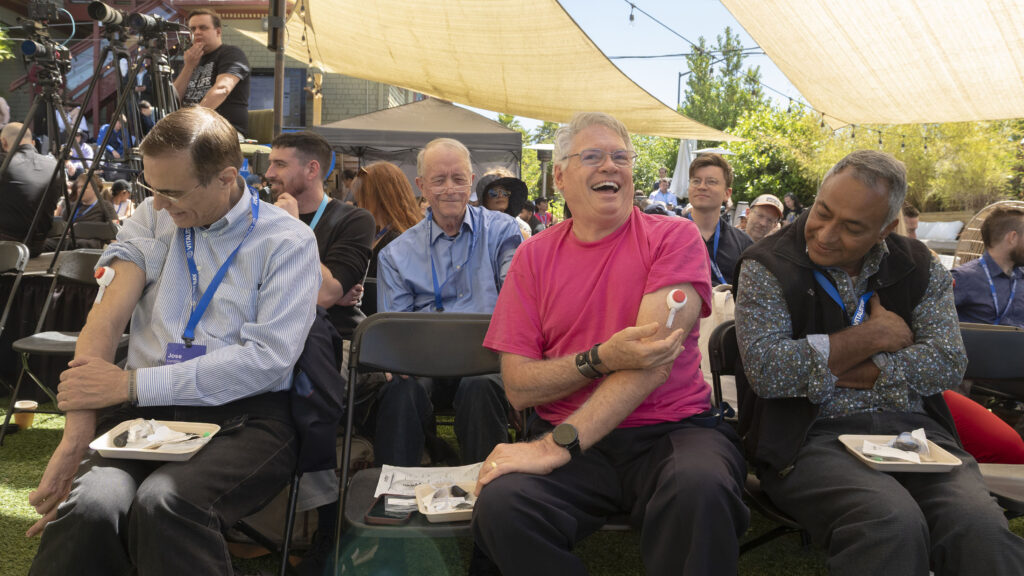
BERKELEY, Calif. — On a sunny Thursday morning, around 100 people sat on folding chairs beneath a lawn tent preparing to do a mass blood draw. Standing onstage with a tangle of morning glories as his backdrop, Robby Wade, CEO of at-home testing company Rythm Health, warned that the process might be a little chaotic given the size of the crowd.
Wade explained how to activate the heating pads by popping a small silver coin, prompting a chorus of admiring oohs from the audience as rays of warming crystallized gel spread like the sun. Within a few minutes, everyone, me included, had matching stick-on Tasso devices trickling blood from our upper arms into test tubes that promised to give insights into the health of our hormones, metabolisms, various organs, and biological age.
“It’s like Theranos, but it works,” said the gentleman sitting in front of me, who had recently given a talk on bodyoids — creating headless sacs of organs to replace aging people’s failing hearts and kidneys.
It was the first day of Vitalist Bay, a longevity conference-slash-festival launched last year that brings together founders, investors, biohackers, researchers, and the generally death-averse to discuss how to forestall, or even beat, our demise. Held at an event space (and rationalist AI doomer hub) called Lighthaven, the grounds were dotted with well-padded wicker patio furniture and taffy-pink rose bushes. Along with hearing talks on topics like cryopreservation and delaying menopause, attendees might opt to attend a workshop on longevity therapeutics led by a co-founder of BioAge Labs, drop by a Krav Maga lesson, or take a sound bath. The mood was buoyant, the Oura rings ubiquitous, the stakes existential.
“Are we just going to give up and die like every other generation?” Adam Gries, co-founder of the conference and larger Vitalist movement, asked in his opening remarks.
Giving up and dying had been basically my plan, though hopefully not for a long time. Perhaps that was because I hadn’t given enough thought, as the people at Vitalist Bay had, to considering the alternatives. As the field works to make the showdown against death and aging mainstream, the longevity community is now in the midst of shifting from “a movement to really more of an industry,” said Christine Peterson, co-founder of the Foresight Institute, which focuses on research on longevity and nanotechnology.
But they also know there’s more work to be done. Many longevity people at the conference identified as a major hurdle the widespread public skepticism that greets their mission, and the dismissive tone of headlines about “billionaires who want to live forever.” Even if some billionaires are in fact chasing immortality, they’re actually not investing enough in what’s still a comparatively small field, multiple people at Vitalist Bay told me. (In 2024, global investments in longevity companies more than doubled from the previous year, to $8.5 billion, according to the U.K. research organization Longevity.Technology.)
To longevity enthusiasts, the strange thing isn’t that they’re so focused on avoiding death. It’s why, given the brevity of human life and how quickly it can pass us by, everyone else doesn’t share their sense of urgency.


Body scans, blood tests, and bodyoids
Most people in the longevity community are focused on preserving their health as long as they can — either to make it to the current outer limits of longevity, about 120 robust years or so, or to last long enough that science achieves what’s known as longevity escape velocity, where advancements keep piling up so that there’s no limit on how long life might last.
Whatever one’s goal, it was clear from the companies with booths set up at Vitalist Bay that there are ample opportunities in the business of longevity. Most of these were focused on personalized medicine. Along with Rythm ($79 a month), I spotted biological age testing company TruDiagnostic ($499 for a one-time test), brain age testing company NeuroAge ($1,398 for the most popular plan), and sleep testing company Empower Sleep ($1,200 for the basic plan).

Parked on the street outside the conference were BodySpec vans where attendees could get free DEXA scans (normally $59.95 for a one-time scan) to find out their body fat, bone density, and muscle metrics. Speaking onstage on Friday, venture capitalist Tim Chang outlined the health-testing business model: give people at least one “green” (or good) result so the overall picture isn’t too depressing; sell them on subscriptions, interventions, and coaching so they can work on improving areas in yellow and red.
Making the quest for longer, healthier lives more accessible to people who don’t have the funds for a membership at a $20,000 longevity clinic was a major topic at Vitalist Bay. Peterson’s workshop, “Longevity for Non-Billionaires,” was standing room only.
Leading the discussion, Peterson emphasized that experimenting with products and tinctures meant to boost longevity is “not zero risk, but we know what the alternative is.” Audience members weighed the benefits of putting a NeoRhythm mat ($299) under their pillows to deliver localized electromagnetic pulses, or using a Somnee headband ($489) that delivers electrical currents before they hit the sack. The question to ask in the pursuit of longevity, Peterson said, is “what’s the most ambitious thing you can do that doesn’t violate the laws of physics.”

I stopped to talk with NeuroAge founder and CEO Christin Glorioso, a neuroscientist who was inspired to start the company because her grandmother developed Alzheimer’s. (Peterson’s mother had Alzheimer’s too; it was a common thread among attendees.) Using brain MRIs and blood biomarkers, the NeuroAge tests aim to help give people the tools to prevent dementia with both data and recommended interventions. Glorioso said she’d been able to grow her own hippocampus 1.5%, which she credited to some combination of hormone replacement therapy, better sleep, statins, VO2 max training, Norwegian 4X4 high-intensity interval training, and GLP-1 drugs.
Beside her was Stephen Hubbard, a buff director of business development at NeuroAge and leader of the Biotech Barbell Club, who was also leading weightlifting sessions elsewhere on the Lighthaven premises. I asked about the political breakdown of the longevity crowd, having just wandered away from a speech by the grandson of economist Milton Friedman about seasteading and charter cities. There were a fair amount of libertarians and some fans of the Make America Healthy Again movement, Hubbard said, though he did not count himself among their ranks. “Can’t we have sanity around vaccines and pullups?” he said.
Still, there’s only so far that pullups and data-informed sleep habits can take you. The 1517 Fund investor Danielle Strachman said onstage that she looks for founder pitches that sound like science fiction. That sentiment was echoed by Chang, the venture capitalist turned founder of the wellness club The Portal in Mill Valley, Calif.: “If at least half your investors don’t think it’s the stupidest idea they’ve ever heard, you’re not thinking big enough.”
One of the most popular ideas about how to bide our time till longevity escape velocity was organ replacement. Sebastian Giwa, a serial entrepreneur in cryopreservation whose latest company is called Maximize Bio, shared a slide onstage that outlined one vision: Injecting some younger bone marrow in your 40s, replacing your kidney in your 50s, your heart in your 60s, your brain tissue in your 70s and 80s, then a whole-body transplant so that you’re biologically 18 by the time you’re 90. He imagined other uses for cryopreservation as well: Perhaps children born with a fatal disease could be placed into cryopreservation until science has developed a cure. Giwa got a standing ovation from several people in the front row, including one man who wore a green T-shirt that doubled as a sales pitch: “May I bid on your cryonics life insurance?”

As to where those extra organs might come from, one option could be bodyoids — the aforementioned headless organ sacs. “What if we could obtain a supply of human bodies in an ethical way?” said Carsten Charlesworth, a postdoctoral student at Stanford University who’d co-authored an opinion piece for MIT Technology Review last year on the subject. “There’s logically no reason why it’s wrong.”
Companies like R3 Bio and KindBio are already working to develop bodyoids from animals like monkeys and pigs. Speaking onstage, KindBio CEO and anti-aging researcher Justin Rebo said he envisioned his company as creating a more ethical xenotransplantation system, requiring no conscious animals to die so that humans might extend their lives. He waved away a question about how the company’s efforts might apply to human bodyoids. “We’re not doing that.” (Meanwhile, the MIT Tech Review reported this spring that R3 Bio’s co-founder John Schloendorn had pitched the idea of “brainless clones” for humans, which R3 denied.)
Further in the realm of sci-fi, Daniel Burger, founder and CEO of the neuroscience startup EightsixScience, spoke about his proposal for gradual brain replacement in order to achieve immortality. First, gradually replace pieces of the brain with lab-engineered tissue mixed with small electronics. Then — because it’s still possible to get hit by a bus with a young, healthy brain — take the whole brain out and hook it up to a virtual avatar.
“My computer fails once every three to five years. This isn’t such a great strategy,” one audience member whispered.
Burger showed the audience the tattoo on his forearm: the phrase “I’m dying,” in all lowercase. “I don’t have hobbies,” he said.

‘Are we engineering ourselves into a whole new existence?’
Earlier at the conference, Gries had described the inaugural Vitalist Bay last year as an “event where there were the most people who hate each other but despite that, people show up.” The list of speakers this year included several figures likely to stir controversy, among them Aubrey de Grey, a leading figure of longevity who was fired from the research institute he co-founded in 2021 as part of an investigation into allegations he’d sexually harassed two women. Jordan Lasker, a blogger who goes by his online username Cremieux and whose theories promoting race science have been amplified by figures like Elon Musk, was also on the lineup.
“This stuff is nuanced,” Gries said of the invitees, saying that he was open to feedback on the conference organizers’ decisions. The red line, he said, was that if someone had “crossed the line into something prosecutable or which caused physical harm, then it would be an absolute no-go under any circumstances.”
But most of the people I met at Vitalist Bay were affable and curious. A surprisingly diverse group clad in Adidas, fueled by free samples of blueberry-pie-flavored David protein bars, they were ready to jump into conversations about the meaning of life or debate the biggest threats to progress in the field.
“My biggest fear is that 10, 20 years are going to go by and we’re going to end up with more unproven supplements and longevity clinics with zero social value,” said Raiany Romanni-Klein, a bioethicist with a forthcoming book called “Redesigning Aging” from Harvard University Press. “There’s just no rigor in the industry. One of my pet peeves is being mistaken for a wellness influencer.”
Romanni-Klein, a poised 32-year-old, was a runner, but she wasn’t experimenting with peptides or supplement stacks. She wanted people to be thinking bigger — epigenetic reprogramming, for example. A common complaint among longevity advocates is that the U.S. spends billions on trying to treat terminal diseases like cancer that tend to arise as we age, while focusing far less on forestalling aging itself. “Just because it’s a universal thing that we will grow frail and sick,” she said, “it doesn’t mean it’s not worthy of public investments.”
Ritesh Banerjee, a life sciences consultant, held forth on the potentially self-defeating nature of gradual organ replacement, given growing evidence about the connections between the gut microbiome and the brain. “Are we engineering ourselves into a whole new existence?” he asked as we shifted to make more room for people at the coffee urn.
Later, a twinkly-eyed Swedish man named Linus Petersson said his organization, Fund Longevity, had led international protests in April calling for more research dollars in the fight against aging. He showed me a photo of his children holding a sign, which he translated: “Stop aging, save my parents (Mom first).”
My co-workers had suggested I ask the people I met at Vitalist Bay how long they thought they’d live, as a way of understanding the scope of their ambitions. Now that the moment had arrived, I worried this might be rude. Was it impolite to broach the topic of death among people so dedicated to its eradication?


But the people I spoke with didn’t seem more scared of death than anyone else. They were just more conscientiously opposed to it, or maybe more confident about humanity’s chances of finding an alternative. One attendee told me that Nathan Cheng, Gries’ Vitalist Bay co-founder, was wandering around asking the same question. “You have to say ‘as long as I want’ or he doesn’t give you a free T-shirt,” he said. (The T-shirts worn by conference organizers and staff were quite covetable, the same slogan repeated five times in all-caps text: “More Life.”)
“Humans are so precious and wonderful, and our imagination expands to the scope that we allow it,” Gries told me. He guessed there’s an 80% chance he won’t make it past age 160; a 20% chance he lives long enough so that “the concept of lifespan doesn’t matter anymore.” Given more time on Earth, he said, “I would learn more physics and science. I would build projects with more people. I would explore things. I would express different aspects of creativity.”
It was easy to imagine wanting to keep basking forever in the palm trees and bougainvillea vines of Northern California, I thought. Perhaps nihilism prevails in New York because of all the subway delays and sidewalk rats.

The tide may be turning when it comes to the U.S. government’s receptivity to longevity research, said anti-aging researcher Jamie Justice, who along with entrepreneur Peter Diamandis is leading the XPRIZE Healthspan competition for therapies that restore muscle, cognition, and immune function. “Optimism is warranted,” she said, urging the audience to register for a public meeting on regulating anti-aging drugs led by the Reagan-Udall Foundation for the Food and Drug Administration along with XPRIZE and ARPA-H. Of regulators, she said, “we have their attention.”
Lots of attendees said they wanted to run a marathon at age 100 — or, in the case of Chong He, a partner at the longevity medicine startup LiveBeyond, to keep doing aerial acrobatics as a centenarian. Many more said, after checking how much leeway they had for optimism, that they thought they’d be able to live indefinitely.
But their visions for what they’d get up to until the heat death of the universe were sweet and ordinary. They wanted more time to read or try out multiple careers, go back to school, write a novel, explore different versions of themselves. Martin Borch Jensen, a co-founder and chief science officer of the anti-aging gene therapy startup Gordian, mentioned how much he enjoys the dinner parties that he throws with his fiance. What motivated many people at Vitalist Bay was not so much the chance to live forever, it seemed, but more freedom to enjoy all the different things that make them feel happy and fulfilled in abundance. For that, the typical human lifespan simply isn’t long enough.
One ebullient woman at a weight-lifting session predicted she’d live about 5,000 years. I asked what she’d do with all those bonus millennia. “I don’t know,” she said. “But I’d like to find out.”
STAT’s coverage of chronic health issues is supported by a grant from Bloomberg Philanthropies. Our financial supporters are not involved in any decisions about our journalism.