

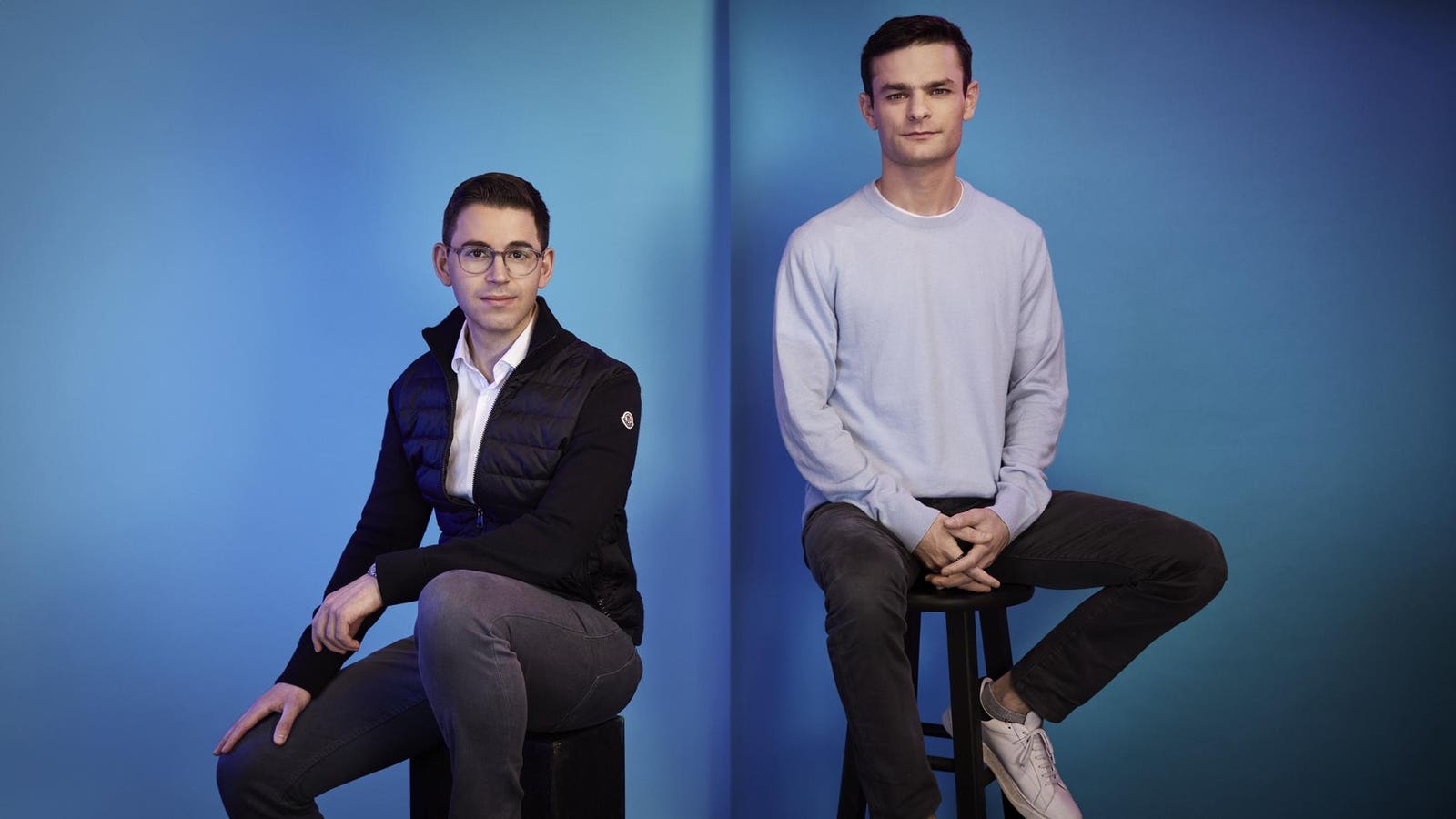
Chai Discovery cofounders Josh Meier (left) and Jack Dent
Cody Pickens for Forbes
L
ast June, when AI drug discovery startup Chai Discovery was just 15 months old, it released a new model that could design antibodies. Nearly 20 pharma companies reached out to talk. “It was like we dropped a bomb on the field,” Chai cofounder and president Jack Dent tells Forbes. “People were messaging on LinkedIn at 2 a.m., saying, ‘I am so excited I can’t sleep.’”
Drug discovery is one of the great promises of AI—scientists and investors alike hope that models could upend the laborious process of creating new therapies. Today, a single drug typically costs well over $1 billion and takes more than 10 years. The dream is for the technology to allow drug hunters to find potential therapies faster and with more precision, as well as to come up with treatments for diseases that had previously been considered “undruggable.”
“We want to raise the bar of medicines that are created,” says Chai cofounder and CEO Josh Meier. “It’s not just getting more medicines to patients, but better medicines.”
Despite being up against competitors that are older and have more resources, Chai Discovery has catapulted itself to the front of the AI drug discovery race. In January, the startup—newly valued at $1.3 billion—announced a deal with Eli Lilly, the $1 trillion (market cap) drug behemoth best known for its weight-loss drugs, to design multiple novel therapeutics with its AI model. Now, Chai tells Forbes exclusively that it has signed another big AI drug development partnership, this time with $63 billion (2025 revenue) Pfizer.
Earlier this year, the San Francisco-based company also quietly deployed the next iteration of its antibody design model, called Chai-3, which it claims is vastly superior to the Chai-2 one that put it on the map. “That got the Pfizer team really excited,” says Dent. The company now offers its earliest Chai-1 protein-folding model for free, which lets potential pharma company customers test drive some of its tech. Chai is in talks with more than 15 additional pharma companies, and hopes to sign more deals this year.
While the startup declined to disclose financial details of its agreements with Pfizer or Lilly, those deals should provide it with meaningful revenue. Other partnerships in the AI drug discovery space—such as Genesis Molecular’s recent deal with Incyte or Alphabet spinoff Isomorphic’s 2024 agreement with Lilly—have involved tens of millions of upfront payments with potential total deal value above $1 billion.
Chai, which was featured on this year’s AI 50 list, has raised more than $225 million from investors including OpenAI, General Catalyst, Menlo Ventures and Oak HC/FT. Now the company is in talks to raise an additional $400 million at a valuation of $3.4 billion, two investors familiar with the deal told Forbes. It’s still early, and the company has not yet chosen a lead investor, one of those VCs said. Chai declined to comment.
“The models were smoke and mirrors for a long time. We knew we had to make things literally 100 times better for it to be valuable for real drug discovery programs.”
Investors poured $11.4 billion into AI drug discovery companies globally in 2025, more than double the $5.6 billion of the previous year, according to VC database PitchBook. So far this year, that number is $5.5 billion, putting it on track to surpass last year. Isomorphic, Alphabet’s AI drug discovery spinoff, alone raised an eye-popping $2.1 billion in May. “There has been all this hope and expectation around AI in drug discovery, and people have become a little jaded because it was hard to put your finger on anything tangible,” Dent says. “But we are in a completely different universe than we were a year ago.”
Meier, 30, grew up in Teaneck, N.J., in a family of doctors and started programming at the age of 8. At Harvard, he considered becoming a physician before deciding to major in chemistry and computer science. “What I love about programming is you could scale your impact,” he says.
He met London-born Dent, 29, on their first day of Harvard classes. Dent, who studied computer science, had spent his teenage years building apps and games with friends. “I was a 14-year-old making money selling apps for 99 cents each and I was like, ‘Omigod, I’m set for life,’” he recalls.
After their graduation (both with a bachelor’s and a master’s) in 2018, Meier worked for OpenAI, Meta’s generative biology group and AI drug discovery firm Absci. Dent went to Stripe, where he gained a reputation as one of that company’s top engineers. It was an auspicious time to be working with AI. Every few months, Meier and Dent would meet up at a Portuguese restaurant in San Francisco (where Dent lived) or an ice cream spot in New York (where Meier was based) to compare notes as the rapidly evolving field exploded.
Google DeepMind launched its first AlphaFold protein database–for which its team subsequently won the Nobel Prize in chemistry–in 2021. By 2024, “we had this sense that everything in AI was about to start working big time, and the protein discovery field was lagging by a few years,” Dent says. They launched Chai that March with two additional cofounders Meier had met through working in the field, Matt McPartlon (who had also worked at Absci) and Jacques Boitreaud (from the French AI drug discovery firm Aqemia).
Together, they believed they could build a better AI model to speed up finding therapies. “Humans are just very bad at drug discovery,” Meier says. “It’s honestly miraculous we can make drugs at all with the tools available today.” They launched their first model, Chai-1, in just a few months.
I think it’s become very clear that they are winning the war. They are winning the commercialization war, and they are winning the model and product war.”
Most AI drug discovery companies’ deals focus on specific drugs, with big payoffs if they succeed. They also typically develop their own pipelines of therapeutics because the potential revenue from a blockbuster drug is too big to ignore. Chai took a different approach and sells access to its technology. “When we started, people told us the only way to make money is to make your own assets and become a drug company. That’s the dogma we had to challenge,” Dent says. He figures that in a world where drug companies will spend hundreds of millions of dollars for one promising molecule, a software engine that could spin up scores of potential therapies quickly would be extremely valuable.
“I think it was a brilliant insight that if you want to be the trusted one that traditional industries feel comfortable teaming up with, you cannot at the same time try to have your own little shop,” says Mikael Dolsten, who retired from Pfizer as president of worldwide R&D and is now on Chai’s board of directors.
Through its collaboration with Eli Lilly, the firm is working on accelerating the development of biologic drugs. These are therapies derived from natural sources such as proteins or cells, versus chemicals that are synthesized in a lab. Lilly chief information and digital officer Diogo Rau told Forbes in March that given the timetables for drug approval, it would be “mid-2030s, if not late-2030s” before any of its AI developed medicines are on the market. “It’s a big bet on the future,” he said at the time. (Pfizer declined to talk with Forbes about its collaboration with Chai.)
Annie Lamont, managing partner of Oak HC/FT and an honoree on the Forbes Midas List who spent a decade looking at AI drug discovery efforts before investing in Chai, says that the company’s commercialization efforts have gone faster than she’d expected. “I think it’s become very clear that they are winning the war,” she says. “They are winning the commercialization war, and they are winning the model and product war.”
It was Chai-3 that convinced Pfizer to sign on. The model doubles the success rate of the startup’s previous model and produces antibodies that bind 100 times more tightly to their intended therapeutics targets, according to the company. In drug discovery, targets like proteins, enzymes or receptors are like locks, and therapies are similar to keys that attach to them in order to treat disease. A tighter bind means a more effective treatment. “The models were smoke and mirrors for a long time,” Dent says. “We knew we had to make things literally 100 times better for it to be valuable for real drug discovery programs.”
The Chai-3 model’s higher success rate and tighter binding could be a big deal for realizing the longstanding hope that AI will transform drug discovery. “Tech people get excited about better, faster, cheaper, but a blockbuster drug can be $10 billion a year in revenue. Going from three years to three months is meaningful, but the bigger question is, ‘Can you make a medicine with massive impact?’” says Elena Viboch, managing director at General Catalyst, which co-led last December’s venture investment in Chai. We’re still a ways off from seeing if that’s truly possible.
The Chai-2 model allowed researchers to design from scratch full length monoclonal antibodies, which are increasingly important in the treatment of cancer and autoimmune diseases. The model was able to spin out antibody designs from scratch 16% of the time, compressing months of work in a wet lab to two weeks. But even though its molecules would bind to their targets—the key in drug development—they didn’t always do it well. That meant they still had to go through a lengthy process to improve their potency and safety, just like those discovered without the use of AI.
The improvements in Chai-3 bring it closer to being able to skip that process of refining molecules. The company said that in roughly half of cases, the molecules generated by Chai-3 bind to their targets as tightly as approved drugs. The founders also view this as a step towards being able to create antibodies that can bind to multiple targets at once, rather than just one, creating much more complex, precise therapies. “Most antibodies are just jamming up some targets. State-of-the-art is jamming two targets,” Meier says. “In the future, we will modulate targets in more powerful ways.”
Chai’s R&D team is already working on its next models. Eventually Chai could offer its drug company customers AI that can design small molecules and peptides, increasing its potential market exponentially, Dolsten says.
As the AI models continue to get better, the companies that build them are jockeying to sign deals with pharmaceutical companies, while the big drugmakers are testing them out. “There’s a general awareness among the pharma industry now that these technologies are working,” Dent says. “We’re past acceptance and into the excitement part of the adoption curve.”
With additional reporting by Rashi Shrivastava
MORE FROM FORBES