

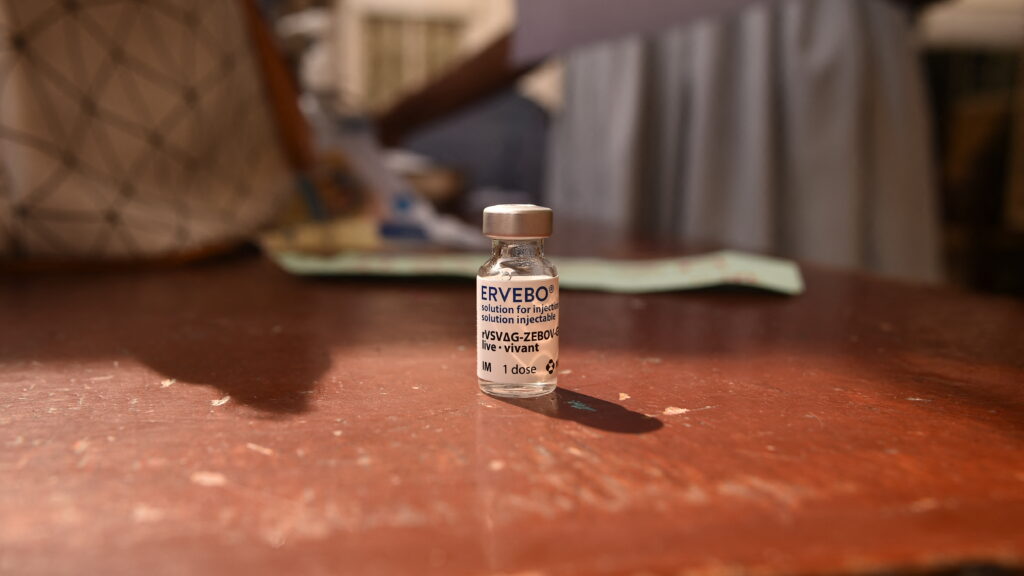
New data from a study in humans provides additional support to the idea that Merck’s Ebola vaccine Ervebo, licensed to target the Zaire species of ebolaviruses, could also offer some protection against another species currently circulating in a rapidly expanding outbreak in the Democratic Republic of the Congo.
The new paper, published Wednesday in the New England Journal of Medicine after previously having been posted online before peer review, is one of a growing number of studies pointing to the possibility that the vaccine could be used to target the Bundibugyo species of ebolaviruses.
These studies are in turn fueling an increase in calls to study use of Ervebo in the outbreak zone in the DRC, an idea that the World Health Organization has expressed lukewarm support for to date. The WHO’s vaccination efforts have prioritized testing Bundibugyo-specific vaccines, but those vaccines are still months away from being ready to be put into clinical trials in the outbreak zone.
In an email Wednesday, the WHO said its vaccines expert panel committee, the Strategic Advisory Group of Experts on Immunization, would study the idea further at its next meeting in early October.
“I believe we have now reached the point where this question should no longer be debated, it should be tested in a carefully designed prospective clinical study,” Edouard Lhomme, first author of the new study and a professor at the University of Bordeaux, in France, told STAT via email. “Preparedness is not only about developing the next generation of vaccines, it is also about rapidly learning whether the tools we already have can help save lives.”
It appears that one such study may be in the works. Bloomberg reported earlier this week that the Africa Centers for Disease Control and Prevention is planning a trial that would test a two-dose vaccine regimen in health workers; Doctors Without Borders, or MSF, is partnering with Africa CDC to conduct the trial. The Africa CDC had not responded to STAT’s questions about the proposed study at the time of publication of this article.
The trial appears to mimic one done in primates over a decade ago that showed increased survival rates in a small group of animals exposed to what should have been a lethal dose of Bundibugyo virus after having been inoculated with vaccines targeting the Zaire and Sudan species of ebolaviruses. IAVI, a nongovernmental organization that is developing an experimental Sudan vaccine that uses the same vaccine platform as Merck’s Ervebo, has doses of that vaccine and is in discussions with Africa CDC about making some available for the study.
“If there is alignment among the collaborating partners and key authorities in DRC to conduct the study, as well as protocol approval, we intend to supply doses of our investigational Sudan virus vaccine for the trial,” IAVI said in an email.
An international stockpile of vaccines controlled by the United Nations Children’s Fund (UNICEF), WHO, and other partners contains 500,000 Ervebo doses. Merck said via email that it shares the WHO’s concerns that the evidence supporting the possibility of cross-protection against the Bundibugyo virus is “very limited” and said doses from the stockpile can be released only at the request of UNICEF.
As of Monday, the confirmed case count in the outbreak in the northeastern part of the DRC was nearing 2,500, with close to 1,000 of those people having died. Those numbers make this outbreak the third largest on record and the fastest-growing outbreak to date.
Political instability and violence in the region, large numbers of displaced people, and distrust of the intentions of outsiders who are trying to help contain the outbreak have greatly hindered efforts to bring it under control, WHO Director-General Tedros Adhanom Ghebreyesus told STAT in an interview last month.
There are currently no licensed Bundibugyo vaccines available, though a number of NGOs that are developing specific vaccines for this species of the virus are scrambling to either make doses to test in the outbreak zone or are doing the preliminary safety and dosing testing — Phase 1 trials. But the start of those field trials is probably still months away.
Though the WHO did say Ervebo could be studied under strict clinical protocols, it raised concern that the cross-protection seen in the study of blood samples in laboratories might not translate into meaningful benefit in people. It suggested use of the vaccine could both undermine control efforts of this outbreak by generating “a false sense of security among affected communities and responders” who might then not take the precautions needed to avoid contracting Ebola, and could damage confidence in the Ebola vaccines for future outbreaks if people who were vaccinated later became infected.
In the weeks since the outbreak was declared underway, multiple research groups have studied blood samples taken from people who have received Ervebo over the years, looking for evidence of whether it generates antibodies that might protect against the Bundibugyo virus. While the results haven’t been wholly consistent, there appears to be a trend that suggests the vaccine does trigger production of what may be some cross-protective antibodies in some individuals, but the research groups have warned the only way to determine if those antibodies truly are protective is to test the vaccine in people.
Isaac Bogach, an author of a modeling study that looks at the question of whether Ervebo could help contain the outbreak, said the only way to answer the question is to conduct clinical trials.
“It is highly encouraging that clinical trials of novel Bundibugyo virus vaccines are now underway,” he said, referring to the Phase 1 trial that is being conducted in the U.K. of a Bundibugyo vaccine being produced by the Oxford Vaccine Group at the University of Oxford. That study, which tests for safety and determines the most effective and tolerable size of a dose, is needed before the vaccine can be tested in the field in a larger efficacy trial.
“At the same time, the growing body of evidence from animal studies and human immune-response data suggests that existing and licensed Ebola vaccines may provide some degree of cross-protection. Trials evaluating their effectiveness against Bundibugyo virus should be pursued in parallel, particularly given their immediate availability,” said Bogach, an infectious diseases specialist at the University of Toronto.
A commentary, published Monday in the journal The Lancet, also pushed for clinical trials of Ervebo, pointing to some suggestive data from the outbreak zone. This new Ebola outbreak is occurring in an area that a large Zaire ebolavirus outbreak — the second largest on record — ravaged in 2018 through 2020. During that period, more than 300,000 people in the region were vaccinated with Ervebo.
The authors of the commentary noted that as of June 24, only nine of 1,000 confirmed cases for whom vaccination status was known had received Ervebo in the earlier outbreak; all nine survived. Of the 242 fatal cases for which vaccination status was known at the time of the paper was written, none had died.
The commentary also cited as-yet-unpublished data on a cluster of eight infected health care workers who had a very high-risk exposure; they operated on a pregnant woman who was only later recognized as being infected with Ebola. Three were previously vaccinated; they survived. The five health workers who had not been vaccinated died.
The authors suggested that even if Ervebo offers less protection against Bundibugyo than it does against Zaire ebolaviruses — which would be expected — it could help. They pointed to the fact that the newest malaria vaccine doesn’t offer full protection, but because of the large burden that disease causes in afflicted countries, its impact has proved to be substantial when used in conjunction with other control measures.
“If the observed signals of [cross] protection prove genuine, decisions made during this outbreak might be remembered not only for the evidence they generated, but also for the lives they could help save,” said the authors, including noted DRC Ebola expert Jean-Jacques Muyembe-Tamfum.
There are still doubts about the impact Ervebo could have in the outbreak. One as-yet-unpublished study — it is posted online as a preprint — looked at successive blood samples taken over a five-year period from about 1,100 people who had been vaccinated during previous outbreaks. There was a sharp difference in the percentages seen to have developed antibodies to Bundibugyo virus in two regions of the country, with higher rates in the area near where the current outbreak is raging.
And the modeling study Bogach and colleagues conducted suggested that ring vaccination, the commonly employed approach for using Ebola vaccines — vaccinating people who have been in contact with known cases, and the contacts of those contacts — might be less useful in this outbreak because many cases are only coming to light after the individuals die, making contact tracing highly challenging. The WHO recently stated that two-thirds of confirmed deaths in this outbreak were people who never sought care and were only tested after their deaths.
“Low [case] ascertainment or delayed [contact] tracing could make a biologically active vaccine appear ineffective at population level,” the Bogach paper warned.
Paradoxically, if case detection and contact tracing improves, those measures in and of themselves would have a big impact on containment efforts, making the contribution of vaccines — if used in a ring vaccination strategy — potentially modest, the authors wrote. According to their modeling, a bigger impact could be seen in that situation if a community-wide vaccination approach were used.