

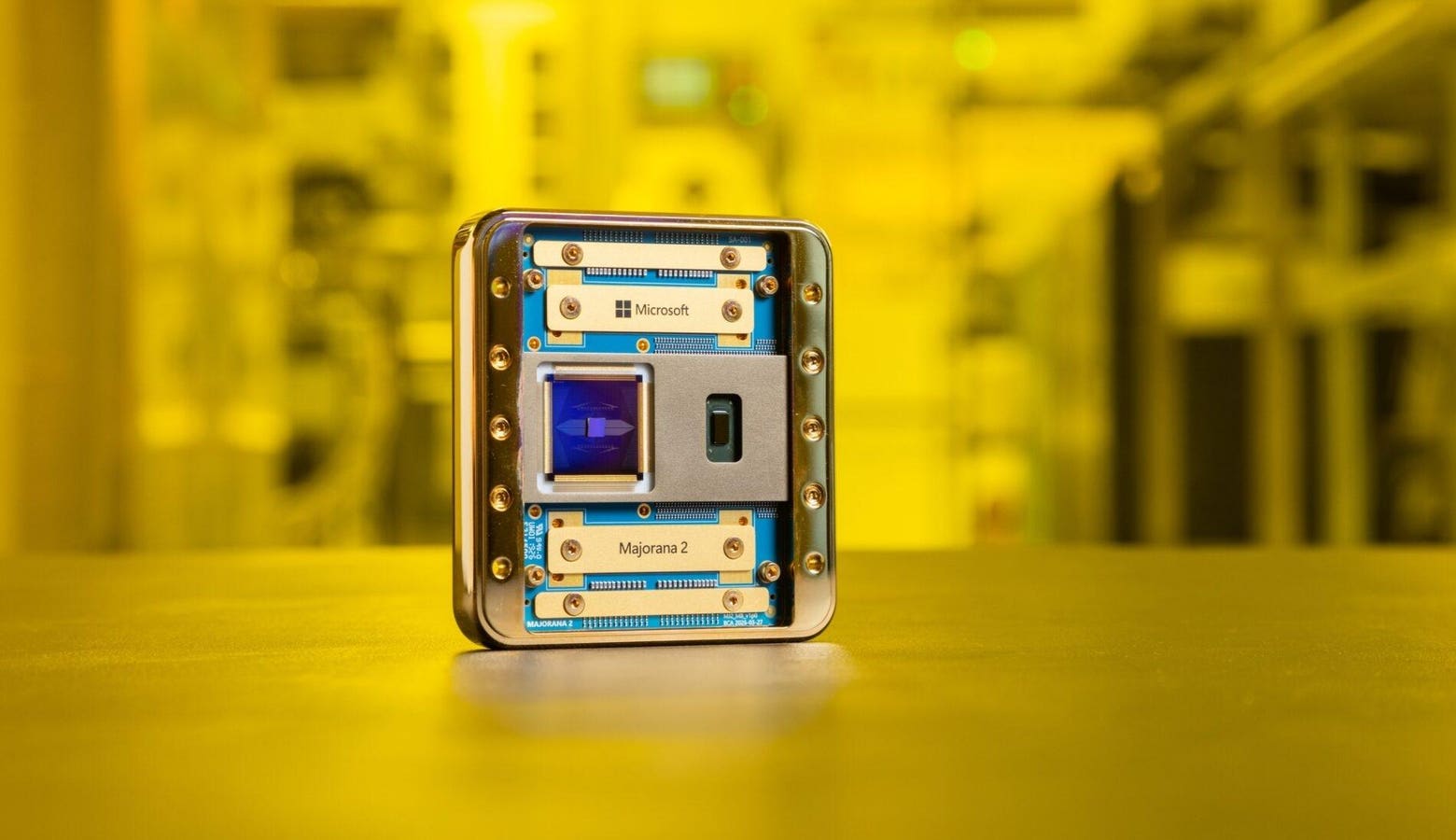
Majorana 2
John Brecher / Microsoft
Microsoft releases its second-generation quantum chip. Ultrasound could replace pacemakers. And why you shouldn’t skip breakfast. All that and more in this week’s Prototype. To get it in your inbox, sign up here.
Microsoft is doubling down on its quantum computing plans. In February of last year, it released its new class of quantum chip, Majorana 1. This week, it introduced a new version, Majorana 2, and the company is now rethinking its timeline for when it will be able to build a useful quantum computer.
“We used to talk about 2033 as a timeline for a scalable machine,” Zulfi Alam, Microsoft’s VP for quantum, told a press briefing this week. “And we are delighted to say right now that we are targeting 2029.”
Key to this aggressive change in timeline is the company’s claim that the quantum bits–aka qubits–stay together for an average of 20 seconds, about 1,000 times longer than the first-generation chip. This is one important metric for making quantum computing practical, because qubits are very fragile, susceptible to disruption. This introduces errors to calculations, which then take time to correct.
There are many different hardware paths to quantum computation, each with their own advantages and tradeoffs. Microsoft’s approach is what’s called a topological qubit, which offers hardware-based protection against the qubits’ natural fragility. This is a newer approach, so other technologies are ahead of Microsoft for now. (And some researchers in the industry have questioned the company’s claims, because it doesn’t publish its experiments to be replicated, relying instead on DARPA to validate them in order to protect its trade secrets.)
But the technology company is convinced it’s on the right path to make true quantum computing a reality. “This is effectively 1,000 times better than our previous generation,” Alam said. “So it’s not a step function. It’s literally a phase change.”
Discovery of the Week: Surgery-Free Pacemakers
Since their invention in the 1950s, millions of people have had their lives saved by pacemakers. Around 3 million Americans are currently walking around with one implanted inside them. These tiny devices use electrical currents to correct issues with a person’s heart rate and get them back to normal, helping to prevent heart failure.
The downside of having a pacemaker is that getting one requires surgery, as well as having the device permanently implanted. This poses the normal risks and side effects of surgery, the devices themselves require ongoing maintenance like battery changes or even firmware updates (like your printer). People with pacemakers also have to avoid things like radio transmitters, security wands, MRI machines and more to reduce the risk of malfunction.
That may change in the coming years thanks to a new invention: a non-invasive pacemaker. As described in the journal Nature Biomedical Engineering this week, this device uses ultrasound, rather than electricity, to stimulate heart beats by using sound waves to open “circuits” in the heart that trigger it to beat. The device itself is just a sticker, around the size of a postage stamp, placed on the chest and paired to a pocket-sized device with the needed batteries and electronics.
So far, the device has been successfully tested on rats as well as genetically engineered human heart tissue. In both cases, the researchers were able to sync irregular heart beats to the desired rhythm using ultrasound. Approval for humans is likely years away as a commercial device is developed, but if it can be made scalable and practical, it could change how people with heart conditions are treated.
The Hot Take: There Aren’t Humans To Put In The AI Loop
Each week, I ask investors for their take on tech trends within their industries. Today the answers come from Heather Widman, a partner at Building Ventures, who invests in “technologies that address labor, energy, and operational constraints across the built environment.”
Heather Widman
© David Shopper, 2021 courtesy Building Ventures
What tech is being overhyped right now?
AI copilots that assume there’s still a human in the loop–many industries don’t have the labor to “copilot” anymore. The real story isn’t AI replacing workers–it’s AI backfilling jobs the labor market has already abandoned. Investors are still underwriting many of these companies like SaaS, despite AI introducing real volatility in compute, energy, and margin profiles.
What should more people be talking about today?
Technologies that directly fill workforce gaps–AI agents, robotics, and systems that can independently run buildings, construction, and infrastructure. The U.S. construction industry alone needed ~500,000 additional workers last year to meet demand, and nearly a quarter of the workforce is nearing retirement; in building operations, up to 40% of the maintenance workforce is set to retire by 2030–the constraint isn’t productivity, it is capacity and the growing backlog of “jobs to be done.”
What are we all going to be talking about in five years?
Fully autonomous systems in the physical world–from self-operating buildings to software-driven construction and infrastructure. The shift will force investors to move beyond growth narratives and underwrite AI businesses more like infrastructure–where cost, reliability, and margin actually matter.
On My Radar
Quantum business: Beyond Microsoft’s new chip, there was a lot happening in the world of quantum computing this week. First, Quantinuum, a spinout of Honeywell, debuted on the Nasdaq this week, raising $1.68 billion in an upsized IPO. (The stock is down today, but so is the rest of the market.) Second, banking giant JPMorganChase announced a collaboration with chipmaker AMD and quantum computing company OQC to build a quantum AI research platform in London that uses advanced computing tech for commercially valuable problems. Finally, D-Wave released its updated roadmap to produce a commercial, fault-tolerant quantum machine by 2032.
Anthropic vs the Pentagon, week 14: Secretary of Defense Pete Hegseth told the D.C. Circuit Court of Appeals that he had denied a request to reconsider Anthropic’s status as a supply chain risk. Though it’s hard to parse that as having a lot of teeth when the National Security Agency, which is part of the Defense Department, is apparently using the company’s Mythos model to carry out cyberattacks. The AI giant also confidentially filed for an IPO this week, and it will be interesting to see what the company thinks about the risks its ongoing legal battle will have on its bottom line when the filings are made public.
The current state of the Strait: The Strait of Hormuz largely remains halted, though reportedly the U.S. Navy has successfully routed some commercial traffic through in the past couple of weeks. That’s continuing ongoing supply crunches of helium, fertilizer, natural gas and oil, the effects of which are still winding their way through the global economy and the worst may not be felt for weeks, even if traffic were to reopen today. The House of Representatives passed a resolution this week calling for the president to cease hostilities, though it still needs to clear the Senate. Despite constant suggestions for the past few weeks that the U.S., Iran and Israel are “close” to a deal, it doesn’t seem likely the situation will end anytime soon.
Pro Science Tip: Don’t Skip Breakfast–Eat a Bigger One
Trying to lose weight or eat healthier? (Or, like most of us, both?) Then listen to that voice in your head reminding you that “breakfast is the most important meal of the day.” A study from 2020, based on a survey of people’s dietary habits, found that people who eat larger breakfasts relative to their other meals tend to eat fewer calories and have better overall nutrition in their diets. And a study from 2022 found that people who ate larger breakfasts tend to have lower risk for metabolic syndrome–a cluster of related conditions such as diabetes, high blood pressure and abnormal cholesterol. These and other findings offer a pretty compelling bit of support for the old adage: “Eat breakfast like a king, lunch like a prince, and dinner like a pauper.”
What’s Entertaining Me This Week
After reading and enjoying Operation Bounce House by Matt Dinnamon (discussed here) I have finally gotten around to starting Dungeon Crawler Carl, the first in his popular series.
NEW ACHIEVEMENT: ONE OF US!
The author of this newsletter has joined the legions of fans obsessed with the postapocalyptic story of a pantsless man and his talking cat, who have been forced to play in a dungeon crawler style video game, but for real! With life or death stakes! All for the perverse entertainment of people watching from all over the galaxy! It’s pretty bleak and horrifying if you think about it, but there are enough jokes and action to keep readers endlessly entertained!
REWARD: Seven more books in the series to read, followed by months of impatient waiting for the next volume to come out. Congratulations.