

The school year ends. The worrying doesn’t. Why summer break can increase anxiety, loneliness, and emotional stress for both children and parents.
getty
By late spring, everyone is counting down to summer. Parents are exhausted by school logistics. Children are exhausted by school alone.
Then summer arrives, and for a brief moment everyone gets exactly what they wanted.
A couple of weeks later, however, we find ourselves looking back at the school calendar with nostalgia. And children discover that endless freedom is not always as awesome as it sounded in May.
From a mental health perspective, summer can bring forth a different set of issues — most of them subtle enough that families don’t recognize them until problems begin to surface.
For children, the loss of structure, social routines, school support and daily supervision can create disruption. For parents, summer often comes with its own quiet anxiety: long stretches of the day that feel less predictable, harder to manage and more difficult to monitor.
And we haven’t even touched upon screen time. Yet.
In clinical settings, these patterns are familiar.
The Summer Scaries Are Real
Beneath the longer days and relaxed schedules, many parents find themselves carrying a quiet but persistent anxiety.
Part of this is practical. During the school year, children’s days are entirely structured and supervised. In summer, that framework vanishes in late May or early June.
Parents worry about what happens during unsupervised hours, especially in households where adults are working during the day. Screen time becomes harder to monitor (as if it were ever easy). Sleep schedules drift. Meals become irregular. Days lose the familiar rhythm.
This anxiety is not irrational. In many cases, it reflects something important: children often do better with predictable routines than adults realize.
For some kids, summer freedom feels restorative. For others, it can feel dysregulating.
Loneliness Does Not Take The Summer Off
Summer can also intensify social isolation, particularly for children who rely heavily on school for friendship, social interaction and emotional stability.
Without daily contact with peers, some children become more withdrawn, lonely or emotionally flat. Others compensate by retreating further into screens. 73% of Gen Z report feeling alone sometimes or always. The U.S. Surgeon General has called loneliness a major public health concern, with social disconnection carrying measurable mental and physical health effects.
Parents sometimes miss this because summer activities can create the appearance of engagement. But not every child has camp, travel or built-in social opportunities.
An important insider tip: summer can also be one of the easier times to access mental health support. Some therapists have greater scheduling flexibility during summer months, particularly in morning hours, as portions of their pediatric caseload shift due to camps and travel. Families who have been considering support may find it easier to act during this window.
Screen Time Becomes The Default
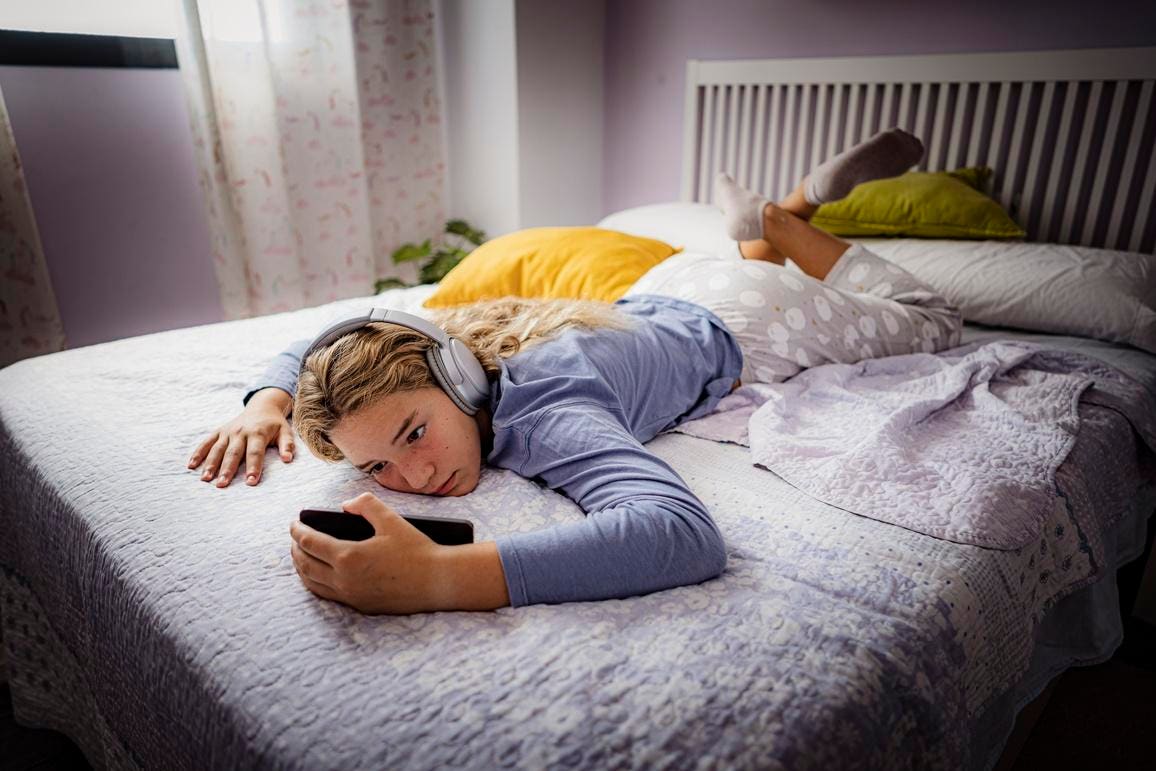
Screen time deserves its own category because summer changes the equation entirely. Teens already average more than eight hours of entertainment screen time a day, and without the built-in structure of school, those hours can expand in ways that affect sleep, mood, and emotional regulation.
What may have been a few hours after school can quietly become a full-day backdrop during summer mornings and afternoons.
This is not simply a concern about entertainment. Excessive screen use can crowd out sleep, movement, face-to-face interaction, boredom-driven creativity and the routines that help children regulate mood and behavior.
The goal is rarely perfection. But maintaining boundaries around wake times, device use, meals and activity remains important because routines often act as emotional scaffolding.
Many Families Underestimate The Loss Of School-Based Support
For some children, school provides more than academics.
It provides access to counselors, social workers, psychologists, behavioral check-ins, structured adult oversight and emotional monitoring that families may not fully realize they depend on until summer arrives.
Parents often worry about this gap but delay planning until problems emerge.
Children with anxiety, ADHD, depression, emotional regulation challenges, learning differences or social struggles may feel this loss more acutely.
Summer planning should include thinking beyond camps and activities. Families may need to ask: What support disappears when school ends, and how are we replacing it?
The Environmental Factor Parents Rarely Think About
One of the more overlooked summer mental health risks may have nothing to do with parenting habits at all. Or TikTok. Or Instagram.
Summer often exposes children to higher levels of air pollution, wildfire smoke, ozone, and extreme heat. These environmental stressors are not just physical health concerns. A growing body of research has linked them to increased risks of anxiety, depression, ADHD symptoms, reduced self-regulation, and higher rates of mental health-related emergency department visits during periods of extreme heat.
A 2023 study in JAMA Network Open looked specifically at children, adolescents, and young adults and found that higher ambient temperatures were associated with increased mental health-related emergency department and hospital encounters across youth populations. Some emerging research suggests these risks may be even more pronounced in vulnerable populations. A 2025 study of youth with ADHD found that heatwave exposure was associated with higher rates of emergency visits related to major depression and suicidal crises, particularly among adolescents.
These exposures do not affect every child equally. But they add another layer to a season already associated with disrupted routines and behavioral stress.
Summer Does Not Need To Become A Free-For-All
Parents do not need to turn their homes into miniature schoolhouses once June arrives. But children, it turns out, often need more structure than what we may know as summer suggests.
Adults tend to imagine freedom as a relief. Children tend to experience it differently. The disappearance of routines, schedules and familiar expectations can feel less like liberation than drift. Days blur together. Bedtimes slide. Screens fill empty spaces. Social connections become more sporadic. What begins as flexibility can slowly become disorientation.
The summers that seem to unfold most smoothly are rarely the most tightly managed. They simply retain a few fixed points: a consistent wake-up time, opportunities for movement, some degree of social connection, reasonable boundaries around screens and, when needed, access to emotional support.
Summer can be restorative. It can provide the breathing room that children and parents alike often crave.
But for some children, too much unstructured freedom comes with its own challenges. And the difficulty is that those challenges rarely announce themselves. By the time parents notice the shift in mood, motivation or behavior, weeks of summer may have already passed.