

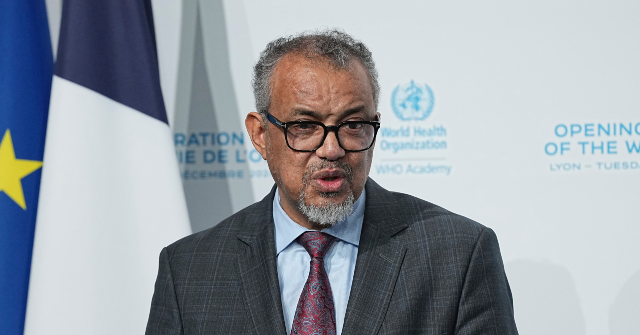
The head of the World Health Organization (W.H.O.), Tedros Adhanom Ghebreyesus, waded into the ongoing controversy surrounding Somali soccer referee Omar Artan on Wednesday, celebrating the sporting official after the U.S. government denied him entry due to alleged ties to terrorist organizations.
Artan flew into Miami International Airport this week in preparation to become the first Somali national to officiate matches in the FIFA World Cup, the world’s most prestigious soccer tournament. He later told reporters that he was subject to 11 hours of interrogation and denied entry into the country. American officials later told journalists that Artan posed a national security threat due to the finding of ties to terrorist organizations. Multiple reports suggested that the links discovered were ties to the jihadist terrorist organization Al-Shabaab, an al-Qaeda affiliate.
The referee has since denied that he posed a threat to the United States and expressed disappointment at his inability to participate in the World Cup. The tournament is being hosted by America, Mexico, and Canada jointly; FIFA has not offered any explanation for why it did not attempt to help Artan officiate matches in either of the other two host countries, or whether he would have faced similar barriers to entry there.
Addressing the situation in the Somali language on Wednesday, Tedros applauded Artan as “one of the best referees in Africa” and wrote a heartfelt message of support to the referee.
“Omar, I am so sorry for what happened. You reached the pinnacle of your career, and you inspired a generation in your country by getting there,” Tedros wrote. “Being denied the opportunity you deserved doesn’t change that. This will not be the end of your story.”
“The world is with you, and wishes you patience, perseverance, and the ability to referee big international matches again. We are with you, Omar,” the statement shared on social media concluded.
Tedros had previously published the message in English on Tuesday.
The W.H.O. chief did not associate his message to any of his official duties at the head of the United Nations health agency, nor is it clear if there is any relationship between Tedros’s position and career and the workings of FIFA. As head of the W.H.O., Tedros’s primary task is addressing international public health emergencies.
Currently, the W.H.O. should be addressing the ongoing Ebola outbreak originating in the Democratic Republic of the Congo (DRC), which has taken lives in both the DRC and Uganda. Tedros personally visited eastern DRC in late May, vowing to take personal responsibility for the management of the outbreak. In addressing the situation there, Tedros has publicly objected to the use of travel restrictions on Africans and those present in the outbreak area, claiming that they are unhelpful to stop the spread of disease.
“Blanket travel restrictions imposed by some countries are disrupting supply chains and hindering the response,” Tedros asserted last week. “WHO recommends exit screening at airports, ports and border crossings to prevent the exportation of cases and contacts. We ask countries that have imposed blanket travel restrictions to lift them.”
The U.S. government has imposed travel restrictions on individuals coming into the country from DRC, Uganda, and South Sudan. This has impacted the DRC soccer team, which qualified to play in the World Cup for the first time in over half a century. The team abided by American requirements that individuals seeking entry to America from affected countries enter a 21-day monitoring period for symptoms of Ebola to ensure that they do not later test positive for the virus. The DRC is scheduled to pay its first match in Houston, Texas, on June 17, against Portugal.
“We are proud to be going to the World Cup. There’s also a strong sense of responsibility to make a good showing of ourselves and of our country,” DRC coach Sebastien Desabre said in remarks published by FIFA on May 20. “Thanks to our Congolese fans who followed us all through our campaign. We will give our all to make everybody proud and show the best image of Congo Democratic Republic.”
In Artan’s case, U.S. Customs and Border Protection (CBP) explained in comments to the press that evidence surfaced that Artan could pose a threat to the United States through associations with terrorists.
“This individual was seeking admission to the United States. Upon further inspection by CBP [Custom and Border Protection], derogatory information, including association with suspected members of terror organisations, was discovered,” CBP explained, according to the BBC, “making the traveller ineligible for admission to the United States under the Immigration and Nationality Act (INA).”
“President Trump’s administration will not allow any security threat to enter our country – full stop,” CBP asserted.
Reports later surfaced identifying the terrorist threat in question as the Somali jihadist group al-Shabaab.
In comments to the radical leftist publication New York Times, Artan lamented on Tuesday that he was “disappointed” and “just simply a referee who’s trying to live his dream.”
“Mr. Artan told The Times that border officials had asked him repeatedly if he had ever met anyone from the militant group,” the outlet shared. “He said he had replied that he knew nothing about Al Shabab and was simply a soccer referee going about his business.”
Following the eruption of the controversy, a statement began circulating on social media, later shared by the local news organization the Somali Guardian, allegedly from al-Shabaab, condemning the United States for denying Artan entry.
“The case of Omar Artan serves as the latest and most damning proof that American policy extends beyond security concerns to encompass broad ethnic discrimination,” the alleged statement, which Breitbart News could not independently verify, condemned. “Artan’s case demonstrates that U.S. decision-making is driven not by security concerns or the imperative to counter ‘extremism,’ but rather by racial and ethnic prejudice targeting Somalis as a whole.”
The president of FIFA, Gianni Infantino, dismissed criticism of the American decision to block Artan’s entry, asking those outraged to “chill.”
“We always try to make the situation as positive as possible and to find solutions. Sometimes we manage, other times not,” he told reporters. “When I say to chill, I don’t mean to chill and do nothing. I mean to trust us that we are working behind the scenes.”