

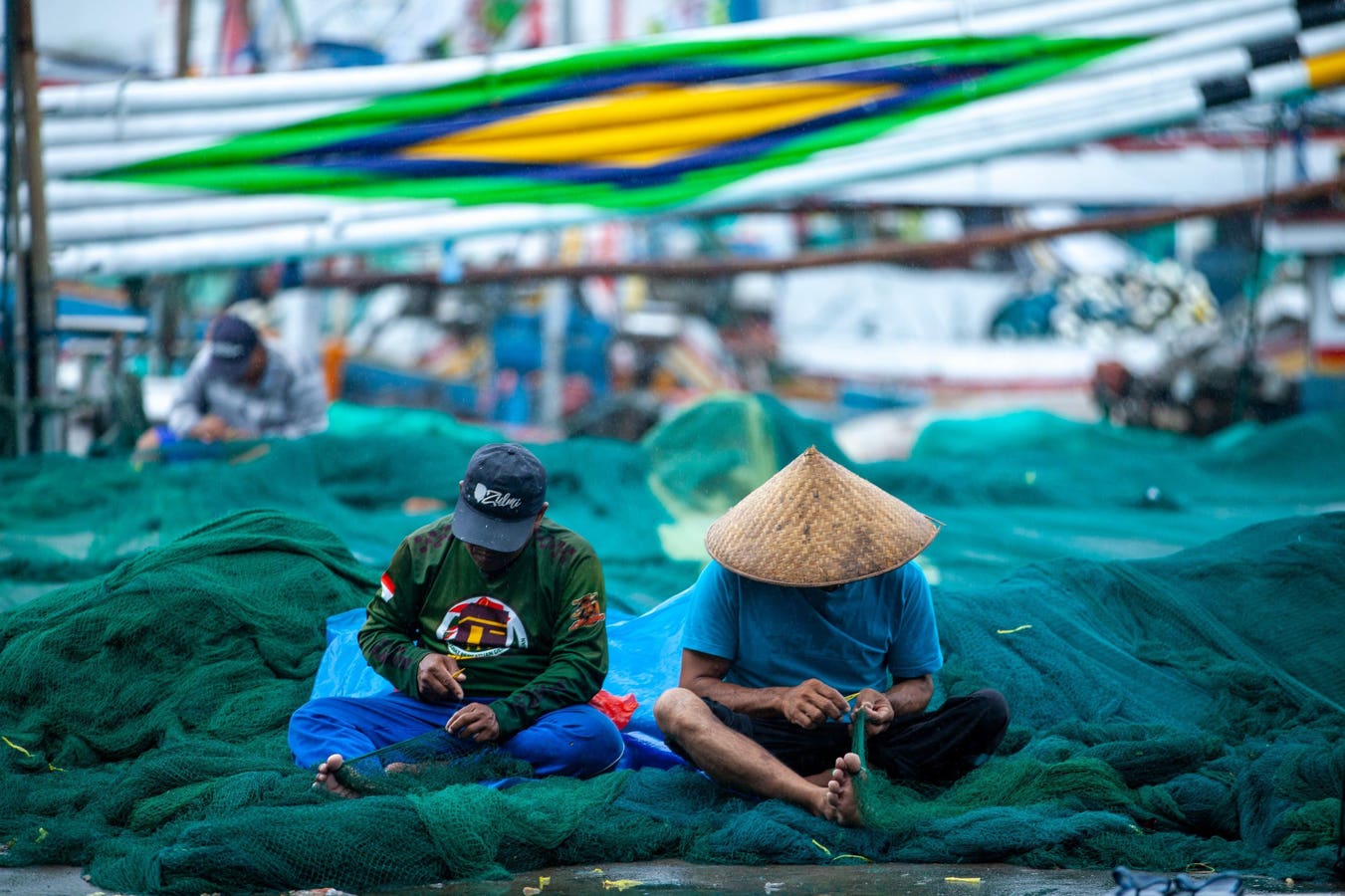
The Freedom Fund hosted a community of practice meeting from 3-6 July where we brought together our partners to share best practice. During this time, there were also two site visits to our partners, Indonesian Migrant Workers’ Union (SBMI) and Inti Solidarituas Buruh (ISB). The fishing vessel workers are fixing the nets of the vessels which are ported at Muncar. Muncar is the biggest fishing port in the eastern part of Java, Indonesia. During the low tide and full moon, most of the vessels don’t go sailing. The Freedom Fund hosted a community of practice meeting from 3-6 July where we brought together our partners to share best practice. During this time, there were also two site visits to our partners, Indonesian Migrant Workers’ Union (SBMI) and Inti Solidarituas Buruh (ISB).
Armin Hari/The Freedom Fund
On paper, Indonesia’s tuna fishing industry is a model of compliance. The vessels are licensed, the ports regulated, and the supply chains audited. But beneath that veneer of legality lies a starker reality. Thousands of fishermen are trapped on these boats, their passports withheld, wages docked, and basic medical care denied. They work punishing hours in atrocious conditions, subject to chronic sleep deprivation and minimal rations while keeping Western supermarket shelves stocked at artificially low prices. What registers to most as an economic or human rights issue is, in practice, also one of the most undercounted public health crises quietly eroding our collective well-being.
As the centenary of the global treaty to end slavery approaches, leaders must stop viewing human trafficking as an adjacent social cause and start treating it as part of our collective human wellbeing. The extreme exploitation that drives modern slavery accelerates chronic disease progression and blocks access to care just as effectively as geography or income. Further, the compounded psychological trauma of forced labor creates lifelong morbidity that communities absorb without ever diagnosing its root cause.
To better understand what the first true international human rights treaty has accomplished – or not – in the past 100 years, I sat down with Nick Grono, CEO of the Freedom Fund, and author of How to Lead Nonprofits: Turning Purpose Into Impact to Change the World to discuss modern-day slavery, well-being, and effective change.
Nicole Roberts: Thank you for taking the time to talk about what the past 100 years have meant when it comes to progress and the exploitation of our fellow humans. Can you start by digging a little deeper into the example you brought up on the tuna fishing industry?
Nick Grono: Sure. I went to Indonesia last year to meet some of the fishermen in person. This is a big and economically important industry. In theory it’s carefully regulated. But a number of those I met told me how they were tricked into joining vessels with a promise of good wages and a better life for their families. The reality turned out to be much darker. Some captains withheld their passports and wages, blocked them from leaving the ship – even when they fell ill after weeks of working in intolerable conditions – and forced them to subsist on salty water, fish carcasses, and just a few hours of sleep. Bear in mind that Indonesia produces much of the tuna fish that we eat in the United States and the United Kingdom. This is modern slavery, and it is the hidden subsidy that keeps tuna prices low at Western supermarkets.
Roberts: This is currently happening across industries worldwide – from clothing to mobile phones. And yet, 100 years ago this year, there was a global commitment and promise to end slavery.
Grono Yes, exactly. In 1926, diplomats gathered beneath the high ceilings of the League of Nations in Geneva to draft the world’s first international treaty abolishing slavery. But they were focused on the form, and not the substance of slavery. They would not have recognized what I saw on that boat as slavery at all. And that is precisely the problem.
Let’s be clear, that treaty was a truly important milestone in the fight against slavery. It was the first true international human rights treaty, boldly declaring that the “status or condition of a person over whom any or all of the powers attaching to the right of ownership are exercised” was an abomination that must be eradicated.
But reflecting on that moment of high diplomatic purpose, I am struck by the gulf between their vision and the reality we face today. Today, fifty million men, women, and children remain trapped in modern slavery. They toil in African mines to extract the minerals that power our phones and are coerced into commercial sexual exploitation across the globe. They may not be legally “owned” by their exploiters, but they are fully controlled and exploited by them.
For those who survive, the long-term consequences of trauma on both physical and mental health are often severe – out of the IOM’s database of 10,369 trafficking survivors across 94 countries, 54% experienced physical and/or sexual violence. This rings true around the world. A UN report found that 59% of trafficked migrants interviewed on Thai fishing vessels had witnessed the murder of a fellow worker, and 61% of members of a bonded laborer community we work with in Nepal showed symptoms of depression.
Roberts: Is it right to ask, then, whether the 1926 Convention was a failure?
Grono: It is tempting to think so. But looking at the anti-slavery movement today, I see the Treaty not as a failed ending, but as a flawed beginning – one that we can improve upon. Reflecting on the profound debates and limitations surrounding the convention, as well as the 15 years I’ve spent leading two different organizations that work to stop modern slavery, three lessons should guide the next century of abolition. First, we must define slavery by reality, not just law. Second, we must mobilize resources and measure what matters. And third, those affected must be architects of their own liberation.
Roberts: You said we must look at this crisis through a reality lens, not just a legal one. Help me better understand that as it impacts lives and well-being.
Grono: The 1926 Convention focused on chattel slavery, which is the legal ownership of one person by another. It failed to anticipate how slavery would evolve. Today, slavery rarely relies on legal ownership. Instead, it thrives on economic coercion, debt bondage, and the exploitation of vulnerability. What I saw in Indonesia illustrates this clearly: regulations and licenses offered the veneer of safety, yet men were trapped and exploited in conditions they could not easily escape. Legal frameworks alone did not protect them.
Consider Esther, a young woman from a Nairobi neighborhood whose life was derailed by the absence of a birth certificate. When she reached the age where national exams required one, officials repeatedly sent her home. Her father held the only copy, and denied her access, and her mother couldn’t navigate the bureaucracy to secure a replacement. Deprived of schooling, she left home at 11 to find work, only to be overworked and refused pay as a domestic worker, then drawn into dangerous informal networks. Even after getting a second chance through a local charity, she still cannot apply for formal employment or start a business without the very paperwork that once blocked her education.
No one legally owns Esther. But a missing birth certificate trapped her. Her story, and what I witnessed in Indonesia, shows that to address slavery today, we have to dismantle the systems that allow it to persist, like entrenched vulnerability, gaps in the rule of law, and social discrimination. Without active enforcement, laws meant to protect people like Esther and the men on that boat remain meaningless.
Roberts: Second, you said measure what matters. That makes sense, but it is so difficult, especially in spaces where so much is hidden from view and hidden in plain sight. Like in your example of Esther, and a piece of paper she wasn’t allowed to have. How do we measure what matters, and then, as you say, effectively mobilize resources?
Grono: Measurement is key, and to properly measure and understand what we are fighting, we need proper funding. The League of Nations had high ideals but no enforcement mechanism and no funding. Today, the anti-slavery sector still operates with chronic underfunding relative to the scale of modern slavery. Governments and philanthropists must provide flexible, multi-year support to tackle a crime they all deplore. This allows frontline organizations to plan, adapt, and succeed. Collaboration is essential. No single actor can tackle this alone. Pooling expertise and resources strengthens accountability and multiplies impact.
But resources alone are not enough. The diplomats of 1926 measured success by the number of signatures on a page. Today, we must measure success by lives changed, not just our own activities. That requires rigorous data, clear accountability, and a commitment to evaluating interventions by their real-world impact. Without this discipline, even well-funded programs risk falling short of their promise.
Roberts: Your last point was that those affected must be the architects of their own liberation. If people are in bondage and being actively exploited, how can we collectively support them, lift them up, or do whatever is necessary for them to lead their own freedom?
Grono: This is perhaps the most important lesson for us all. If you look at photos of the 1926 signatories, you see a room full of white, male diplomats, many representing colonial powers. The people actually subject to slavery were discussed, but they were not in the room. That needs to change.
Take Ethiopia, for example. Survivors of trafficking and child domestic work now lead organizations that shape strategy, advocate for safer migration, and provide peer-to-peer support for others at risk. These groups are no longer passive beneficiaries of external programs. They design interventions grounded in lived experience, hold institutions accountable, and transform communities from within. Their leadership demonstrates that real impact comes not from top-down mandates, but from empowering the people who know the problem best.
Roberts: Thank you for that tangible example. If there was one takeaway you could give us, to significantly improve the next 100 years, what would it be?
Grono: At this centenary, we should not despair at the persistence of slavery, but recommit to finishing the work. The 1926 Treaty gave us the moral foundation. Now it is up to us, through systems change, survivor leadership, and relentless collaboration, to ensure that 100 years from now, slavery is finally a distant memory.
The conversation has been edited and condensed for clarity.