

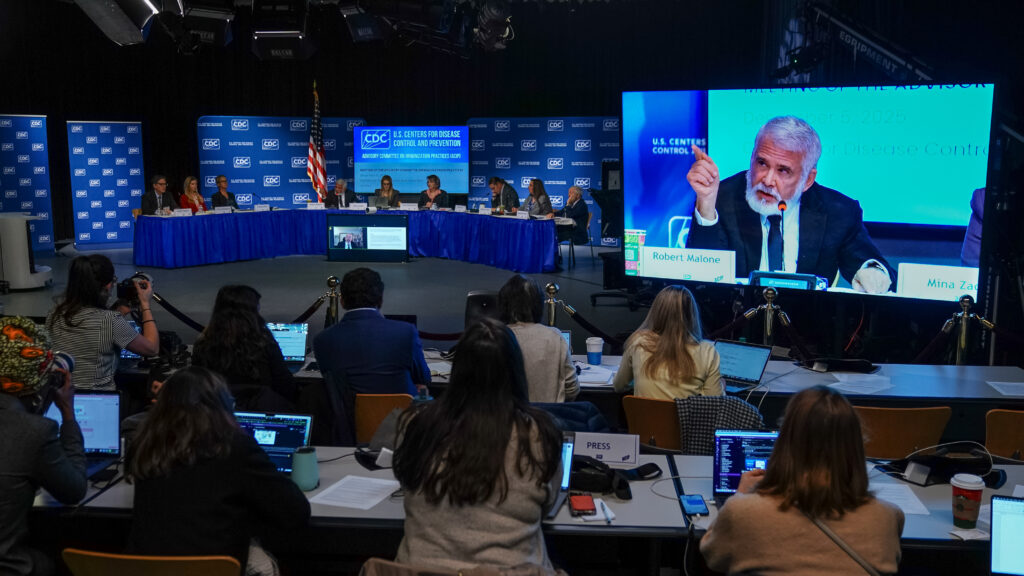
A new charter for the panel that advises the Centers for Disease Control and Prevention on vaccine use substantially refocuses the responsibilities of the committee, downplaying its role in recommending the use of new vaccines and giving it responsibility to assess alternatives for disease prevention.
Whereas previous iterations of the committee’s charter stressed the importance of vaccine research-relevant experience in the selection of its members, the new version, posted to the CDC’s website on Thursday, merely stipulates that the panel as a whole should “represent a balanced range of scientific, clinical, and public health expertise relevant to the Committee’s mission” — a broad umbrella under which people with little experience in vaccines or vaccination policy might conceivably fit.
Public health experts interpreted the new document as a way for health secretary Robert F. Kennedy Jr., a longtime critic of vaccines, to try to circumvent a court challenge to his reconfiguration of this committee, known as the Advisory Committee on Immunization Practices.
Kennedy fired the previous committee en masse last June and replaced it with a coterie of vaccine skeptics, people who had little to no experience in running vaccine clinical trials, assessing trial results, or even applying vaccination recommendations — the kinds of expertise that members of the influential panel had traditionally had, and which earlier iterations of ACIP’s charter demanded of its members.
After the move was challenged in court, a federal judge found in a preliminary ruling that most of the members of the new committee lacked the qualifications to fill their duties, leaving the ACIP in limbo. Prior to this administration, the committee met three times a year, in February, June, and October. It has not yet met this calendar year. The administration has appealed the ruling.
“When the court tells you that many of your appointments fail to meet the charter criteria and therefore the results of their deliberations must be set aside, change the charter,” Sara Rosenbaum, professor emerita of health law and policy at George Washington University’s Milken Institute School of Public Health, told STAT in an email.
“The dramatic changes in the ACIP charter underscore the Secretary’s overarching goal — to superimpose on the science itself his deep prejudice against one of the truly surpassing achievements in child health,” Rosenbaum said, speaking of vaccines. “He has done this by taking one of the nation’s most respected scientific advisory bodies, altered its mission to somehow support his preferred aim of somehow proving that vaccines are dangerous, altered the qualifications of its advisors, and stacked its operations with staff who share his views.”
Paul Offit, a pediatrician and vaccine expert at Children’s Hospital of Philadelphia, agreed.
“RFK Jr. is trying to retrofit the charter to make it so that the people that he brought in … qualify. So therefore, he’s trying to make it so that we don’t have an expertise that can best advise us,’’ he said.
The new charter is dated May 14. Several news outlets have reported having seen copies of it in the weeks since. But it’s not clear why it has only been posted now, and the Department of Health and Human Services, which oversees the CDC, has not answered previous questions about why it had not been posted. An earlier version of the charter, signed by Kennedy in March, was deemed to be invalid.
Richard Hughes, the lawyer who brought the legal challenge against the reformatted ACIP on behalf of the American Academy of Pediatrics, said the new charter is aimed at trying to make a Kennedy-selected committee less vulnerable to legal challenge.
“The March charter was an overt attempt to shift ACIP’s focus to match Kennedy’s vaccine agenda — vaccine injury, cumulative exposure, vaccine components, mRNA platforms, and safety gaps — while adding non-traditional liaison groups and moving control closer to CDC leadership,’’ he said in an email.
“Here, they are simply trying to minimize what they are doing on paper to avoid the legal consequences of their manipulation of the committee. The same architecture remains: looser expertise requirements, the changed liaison mix, more controllable and more aligned with Secretary Kennedy’s vaccine agenda, and less direct acknowledgement that ACIP recommendations drive [Vaccines for Children] access and insurance coverage,” Hughes said.
Vaccines for Children is the federal program that ensures children from families without health insurance who cannot afford vaccines have free access to all recommended immunizations.
Charlotte Moser, a member of the former ACIP who was fired by Kennedy in June 2025, expressed concern about the refocusing of the committee’s responsibilities, especially the emphasis on finding alternatives to vaccines for disease prevention.
“The revised text suggests that rather than focusing on how to effectively and safely use vaccines, the committee should be comparing vaccines with ‘other preventive measures’ and advising on ‘gaps and limitations in evidence,’” Moser said.
The suit that has placed the ACIP in limbo is ongoing, with the two sides of the case filing a status report to the judge presiding over it Wednesday. The government and lawyers representing the American Academy of Pediatrics, among other groups, have disagreed on what materials that will be considered in the case should be confidential.