

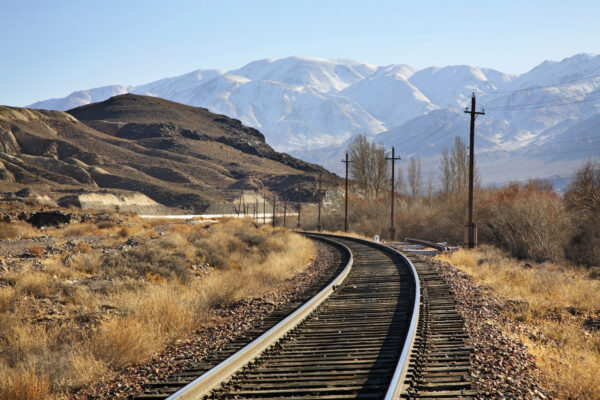
Kyrgyz President Sadyr Japarov has described the China-Kyrgyzstan-Uzbekistan (CKU) Railway project as “not just a transport corridor, but an important strategic bridge connecting the countries of the East and West.” In 2024, then-Chair of the Cabinet of Ministers of Kyrgyzstan Akylbek Japarov referred to it as “a road of life.”
The CKU Railway project, connecting Kashgar in China’s Xinjiang to Andijan in Uzbekistan via Kyrgyzstan, has been under discussion for more than 20 years, with progress sluggish due to a range of complicating factors. While the economic, infrastructure, and political benefits are clear for all three states, challenges to the project have arisen related to Sinophobic sentiments among some opposition, the risks of a debt trap, disagreements over track gauge size, security and environmental concerns, and hesitation over increasing dependence on other regional powers.
Despite these challenges, some of which are yet to be completely solved, the project finally took a concrete step forward with the signing of a final construction agreement in Beijing on June 6, 2024. Since July 2025, the CKU has been under active construction.
The final plan charts a 530 km pathway, with about 304 km passing through Kyrgyzstan’s Tien Shan mountains. The route will connect Kashgar to Andijan, passing through Torugart, Makmal, and Jalal-Abad in Kyrgyzstan.
The project features 50 bridges and 29 tunnels. Kyrgyzstan’s mountainous terrain, and the region’s seismic risks, pose significant engineering and construction challenges. The total length of the tunnels is 104.83 km, with excavation ongoing in all of them, including eight tunnels longer than 5 km. The plan features three major tunnels – Naryn No. 1, Kosh-Dobo, and Fergana – each over 12 km long.
Earthworks have started on some sections, with roadbed formation underway, and 192.323 km of temporary roads have been built along the railway’s path to aid in construction. Four transformer substations have been installed, 2,095 utility poles have been constructed, and 259 km of power lines have been strung, also to support the massive project.
Around 2,000 Kyrgyz citizens are involved in the ongoing construction, out of a total of 5,000 workers. By the end of 2026, officials are aiming to have 5 percent of the CKU built.
A joint project company (JPC) was established in Kyrgyzstan under local law, with China holding 51 percent, Kyrgyzstan 24.5 percent, and Uzbekistan 24.5 percent. The project is valued at $4.7 billion for the Kyrgyz section, with China lending $2.35 billion – half the total – and the remaining 50 percent to be invested by the other countries, with Kyrgyzstan contributing around $700 million. Kyrgyzstan will finance half of its share – 12.25 percent – from the state budget, and China will provide the remaining portion as a $305 million loan for a 25-year term.
Based on conservative estimates from the feasibility study, the initial freight volume is expected to be between 5 and 8 million tonnes annually, increasing to 13-15 million tonnes over the long run. In November 2025, Hikmatulla Rakhmetov, the head of Uzbekistan’s state railway company, Temir Yullari, said that construction of the CKU could be completed two years early, with previously planned completion set for 2030.
Among the challenges the three states have overcome via compromise is the issue of gauge. They settled on a track gauge of 1,435 mm for the line from Torugart to Makmal, which is considered narrow gauge by Chinese standards. Near Makmal, however, the track will widen at a transshipment station, marking the start of the 1,520-mm-gauge section. The length of the Makmal-Jalal-Abad section is 145 km, and Torugart-Makmal is 160 km. A wheelset exchange facility will be set up in Kyrgyzstan at Makmal station. A narrow-gauge line will connect to this station from China, and a broad-gauge line will extend farther toward Uzbekistan. The transshipment station will perform functions such as breaking up and assembling freight and transfer trains; loading, unloading, transshipping, and sorting containers and cargo; weighing railcars and cargo; and transferring railcars between 1520 mm and 1435 mm gauges.
Other issues persist and will require dedicated and detailed diplomacy to manage.
Environmental concerns pose a major challenge, as large infrastructure projects often entail ecological risks, especially when tunnel drilling and explosives are involved. The railway’s impact could be substantial due to Kyrgyzstan’s delicate mountain ecosystems and high seismic activity. Possible outcomes include deforestation, glacial melt, water contamination, ecosystem damage, and worsening living conditions in the area.
Recently, contractors for the CKU railway were fined by the Kyrgyz environmental agency for violations.
Land acquisition and resettlement of residents along the planned route are among the major ongoing challenges for Kyrgyzstan and demand proper and sustained attention from decision-makers as the project moves forward. Residents along the railway route will need to be relocated. Land acquisition and resettlement may lead to social tensions, especially if local communities see compensation as inadequate or view decision-making as lacking transparency and public participation.
During the construction of the CKU railway, 214 houses in Kyrgyzstan will reportedly be demolished – 191 in the Jalal-Abad region and the remaining in the Naryn region. The Ministry of Transport of Kyrgyzstan has hired an independent valuation firm to complete property assessments. The final report has been submitted to the Cabinet of Ministers for review, and compensation for affected residents is now underway; but not everyone agrees with the compensation amount. Some citizens are dissatisfied with their property valuations, and there is not yet unanimous approval from the local population. For instance, according to a Kaktus.media report, two citizens have disagreed with the amount of compensation the state intends to provide them. Public meetings are ongoing to address these and other issues related to compensation and land rights for locals affected by the construction.
The significance of the CKU project lies in the reduction of the transit distance from East Asia to the Middle East and Southern Europe by 700 km, and the cutting of transit times by up to 10 days. It also promotes the development and use of natural resources along the route, offers direct transport access to hydrocarbon resources in Persian Gulf countries, and enhances transport infrastructure in the Central Asian nations. Additionally, it provides a new, efficient outlet to both Pacific and Persian Gulf ports, stimulates international trade, tourism, and economic cooperation, and aims to connect disjointed railway sections in northern and southern Kyrgyzstan to develop a domestic railway network.
The “project of the century” is currently in its active stage. Despite several challenges, new opportunities are anticipated once the CKU becomes fully operational across all three nations.
For China, this involves boosting its transit capacity, developing its western regions, and fostering economic growth. For Kyrgyzstan and Uzbekistan – landlocked Central Asian nations – the aim is to become more open and better connected to the world by serving as transit countries. The two Central Asian countries will also benefit economically, socially, and politically. Economic benefits include payments for the transit of goods; social benefits include employment opportunities for the local population, many of whom must travel for work to Russia or European countries as labor migrants due to a lack of local jobs. During construction, many locals are involved, and local businesses also benefit. Politically, the CKU aims to foster a stable and equitable partnership among the regional countries and diversify transit routes, reducing reliance on certain other regional actors and increasing Central Asia’s connectivity with the world more broadly.