

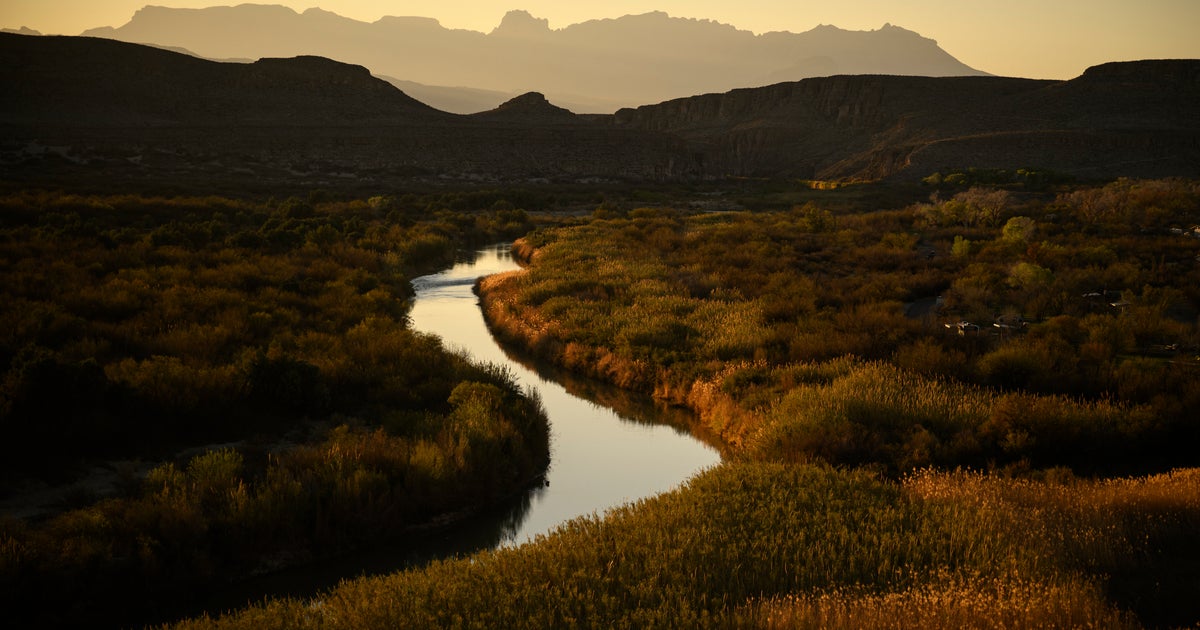
A contentious, long-running battle over the construction of border security infrastructure in Big Bend National Park entered a new phase this week, as residents and landowners documented bulldozers and other heavy machinery being moved into the South Texas park.
Trucks bearing the logo of Southwest Valley Constructors, a subsidiary of Kiewit Infrastructure West, were also spotted and documented by Keep Big Bend Wild, a nonpartisan advocacy group dedicated to protecting the park.
Last May, the Trump administration awarded $1.7 billion ― at the time, the largest-ever awarded for border construction ― to the company “for border wall in Big Bend.”
($1.7 billion is equivalent to roughly 60% of what the Trump administration allocated to run the entire National Park Service in 2026: $2.88 billion.)
Even though SVC’s contract explicitly says “border wall,” Customs and Border Protection claims no conventional wall will be built. But specifically what they’re doing, and where, remains somewhat of a mystery.
Video shared with JS by No Big Bend Wall, a community coalition opposed to border wall construction in the park, shows bulldozers uprooting trees this week, carving a broad path through a formerly pristine desert wash.
A map of the proposed Customs and Border Protection projects has been quietly changed over time.
In February, CBP rolled out plans for 112 miles of a “primary border wall system” through the park. In March, some segments had been replaced with “detection technology.” In April, CBP took the map offline entirely, only to bring it back in May ― again with more changes.
“They have made it a mission to obfuscate and make this as confusing of a process as possible,” Laiken Jordahl, national public lands advocate at the Center for Biological Diversity, told the Texas Tribune. “From constantly changing the online smart wall map — I mean, they’ve made dozens and dozens of changes to that thing without announcing any of them — to taking it down entirely.”
A June 2026 CBP planning document now calls for 17 miles of a ”non-contiguous vehicle barrier system” that will alternate between 4 and 6 feet high, and the construction of 205 miles of patrol roads that are up to 24 feet wide.
Additional infrastructure may include “fiber optic cables, utility poles, power cables, surveillance cameras, access and patrol roads and utility shelters.”
The National Park Service didn’t respond to a request for comment.

In February, the Trump administration waived 29 statutes to allow construction to begin, including the Endangered Species Act; the Clean Water Act; the Clean Air Act; the Native American Graves Protection and Repatriation Act; and the National Environmental Policy Act, a landmark 1970 law which requires federal agencies to evaluate their environmental impacts before moving forward with construction.
(A lawsuit contending the Trump administration illegally waived those statutes is wending its way through the courts.)
Bob Krumenaker, a former superintendent of Big Bend and the chair of Keep Big Bend Wild, told Marfa Public Radio there are “more effective, less destructive, and far less expensive” ways to increase border security.
“There’s no logic,” he said. “ It looks like they’re gonna do all sorts of things, which are almost the most destructive things that they can do for virtually no purpose.”
The Border Patrol’s “Big Bend Sector” accounts for just 1.6% of all CBPs apprehensions since 1960, according to data compiled by the Washington Office on Latin America, a human rights advocacy group:
The disfigurement of Big Bend mirrors Trump’s literal scarring of America and American communities elsewhere.
Roughly 70 miles to the north, in the small Texas town of Presidio, the Department of Homeland Security plans to build a border wall through the town’s levee system, despite concerns from town leaders that it could flood the town.
Perhaps nowhere is the literal scarring of America more pronounced than in the nation’s capital, where Trump: