

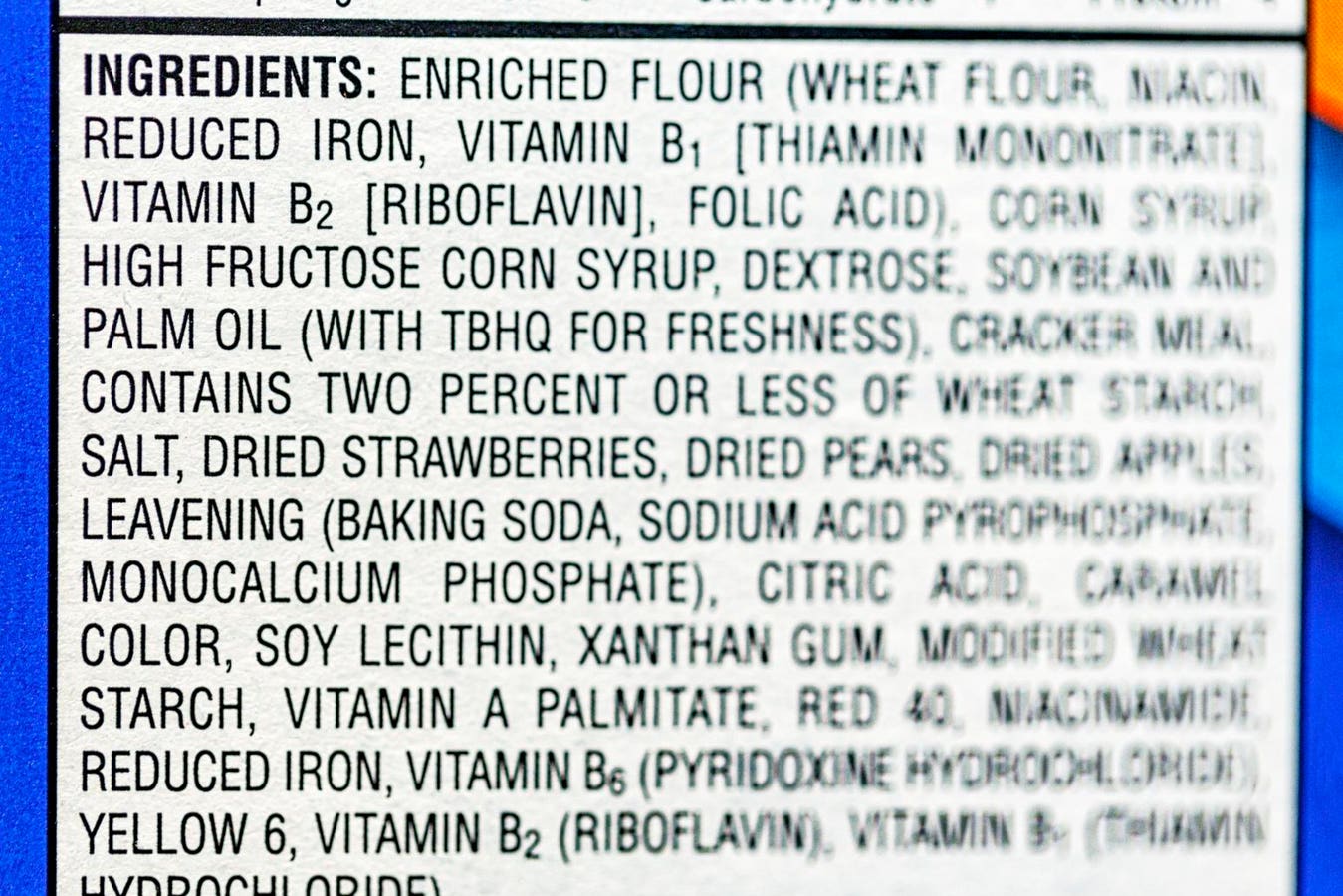
Under current rules, manufacturers can add substances to the American food supply without ever notifying the FDA — a practice the agency’s proposed GRAS rule would end.
getty
For nearly 70 years, a company could add a new substance to the American food supply without ever telling the federal government. On August 10, the FDA moved to change that, proposed a rule that would require manufacturers to notify the agency before marketing ingredients they have deemed on their own are safe to eat.
Health and Human Services Secretary Robert F. Kennedy Jr. unveiled the proposal alongside Acting FDA Commissioner Kyle Diamantas, who said it would close “critical information gaps” about what is entering the food supply. Public comments can be submitted until December 9, 2026.
The Original Idea Behind The “Generally Regarded As Safe” Exemption
Under the Federal Food, Drug, and Cosmetic Act, a food additive is defined as any substance whose intended use results in it becoming a component of food (e.g. being directly added) or affecting food’s characteristics (migrating out of the packaging).
Anything meeting that definition requires FDA approval before use. FDA also sets limits on how much can be added and for what purpose. The law then writes several categories out of the definition: pesticide residues, color additives, substances sanctioned before 1958, new animal drugs, supplement ingredients and substances that are “generally recognized as safe” – or GRAS.
The GRAS exemption is a loophole that has allowed manufacturers to not seek FDA approval for a wide variety of food additives. The original intention of GRAS was different than how it’s used today. When Congress passed the 1958 Food Additives Amendment, the idea was that substances like salt, vinegar and yeast should not be routed through a formal approval process. The exemption is most often determined directly by food manufacturers. And that is the whole problem: a company can reach the conclusion that a substance is GRAS, and the ingredient is lawful.
The FDA spent decades trying to get a handle on this. It tried publishing comprehensive lists. Finally, it gave up. In 1972, it launched an affirmation petition process, and by 1997 abandoned that as too slow, proposing instead a voluntary notification program.
Here’s how voluntary notification works. The manufacturer reports the FDA their conclusion. They then receive a letter saying the agency has no questions. The practice acquired a name: self-affirmation. A manufacturer convenes its own expert panel, documents a rationale, files it in a drawer, and starts selling.
Gras Exemption Has Now Become The Default For Food Additivies
An Environmental Working Group analysis published last July found that roughly 99% of new food chemicals introduced since 2000 reached the market through GRAS. Companies filed 863 GRAS notices for new substances. They filed food additive petitions 10 times; of those, seven were approved.
Importantly, those 863 notices were from companies that chose to tell the FDA. Many more didn’t. The FDA’s estimates that as of January 2011, more than 10,000 additives were in use in food, including roughly 1,000 in human food whose GRAS conclusions had never shared with the agency.
A follow-up EWG investigation in March identified 111 self-affirmed chemicals in commerce that had never undergone public safety review, and 49 of them in thousands of products in the USDA’s Branded Foods Database. Here are some of the categories: plant extracts, fermentation- and fungi-derived proteins and supplement ingredients repurposed as food additives.
These are precisely the substances least likely to satisfy the original meaning of “generally recognized,” since many are novel compounds that have not existed long enough for a consensus to form around whether they are safe or not.
What The New FDA Proposal Changes
The proposed rule does one thing: it converts a voluntary program into a mandatory one.
It does not create premarket approval. The FDA acknowledges it lacks statutory authority to do so. If the new proposal is implemented, a company would have to submit a GRAS notice before marketing a self-determined GRAS substance. This would cover direct ingredients and food-contact substances, unless an exception applies. However, it may keep selling while the notice is pending.
The FDA proposes a 45-day window to decide whether a submission is complete enough to file, then a 180-day review with the option of two 90-day extensions.
Failing to notify would not render a food “adulterated” or illegal. Instead, noncompliance would become a factor in prioritizing which substances receive post-market scrutiny and potential enforcement.
Exceptions cover several circumstances: substances with an FDA no-questions letter, those affirmed GRAS by regulation, ingredients of natural biological origin widely consumed, and substances already vetted by FDA.
Importantly, no products currently on the shelves would get banned or retested in the current version of the proposal rule. For substances in commerce before a final rule takes effect, companies could file a streamlined submission within one year. This would include several elements: the substance, its conditions and levels of use, and evidence of prior commerce. No scientific basis is required, though the FDA does recommend including it.
Submissions would populate a public list. Yet, they would not denote FDA approval. Mandatory notification takes could effect 18 months after the effective date, which is 60 days after publication of the final rule.
Why The FDA Is Doing This Now
The agency’s justification is that many products have been self-affirmed yet later found to be harmful. That includes: stevia leaves and crude extracts, caffeinated alcoholic beverages, delta-8 THC, tara flour and ashwagandha.
Tara flour is a commonly used example. Introduced through self-affirmation as a protein ingredient in a meal-delivery product, it was linked to roughly 400 adverse event reports in 2022. This including both liver injury as well as hospitalizations. The FDA had never received a notice for it.
In April 2024 the agency concluded the use did not meet GRAS standards, making it an unapproved food additive. Had a notice been filed, the FDA wrote, it could have told the company what evidence was missing before it was released into the food supply.
“This system leaves the public unprotected,” said Maricel Maffini, a researcher and co-author of the EWG report. “The FDA only acts after people are harmed.”
Will The Proposed Rule Ensure Food Safety?
The short answer is no. The rule only creates a public list, telling the FDA what exists. It does not guarantee safety.
The Center for Science In the Public Interest (CSPI) president Peter Lurie warned that companies could still sell before or during notification. Additionally, he argues, mandatory notification without enforcement is not really an effective process. Consumer Reports’ Brian Ronholm said the proposal risks preserving the status quo. There is also a resourcing question: the FDA has not estimated the staffing needed to absorb a surge in notices.
There is also an open legal question. The FDA grounds mandatory notification in its general authority to prescribe regulations for efficient enforcement. Yet the agency said in 2016 that it lacked express authority to require GRAS notices.
Importantly, there is another pathway to action: the states are also already implementing laws around food additive disclosures. New York’s Food Safety and Chemical Disclosure Act passed both chambers this spring and awaits Governor Kathy Hochul’s signature.
It would require any company using a self-affirmed GRAS substance in food sold in New York to file a detailed safety report with the state, published in a searchable database. It also states that trade secret data cannot form the basis of a GRAS conclusion. More than 30 states introduced related bills this year.
For a national manufacturer, a New York filing obligation arriving before a federal one is a very real concern.
What The Proposal Could Mean For Consumers
If the proposal is implemented, nothing is likely to change on the food shelves this year or next. Labels still do not distinguish FDA-reviewed ingredients from self-affirmed ones. No consumer facing tool will be available until a public list exists. A final rule is realistically two to three years out if it survives challenge.
Over the longer run, four things will decide whether the rule matters. First, whether it survives: the FDA is stretching general enforcement authority to require notices for substances Congress deliberately exempted.
Second, and most likely to move first, whether states force the issue anyway. New York’s disclosure law would put actual safety dossiers in a searchable public database. Manufacturers won’t reformulate for one state.
Third, manufacturers may choose quietly drop ingredients they would rather not defend in public, not the FDA saying no.
In the end, for the first time in seven decades, the FDA is asking to be told what is in the food supply. That is a real change. Whether the agency gets the authority to demand answers and has staff to read them are questions for Congress rather what will come in public comments this fall.