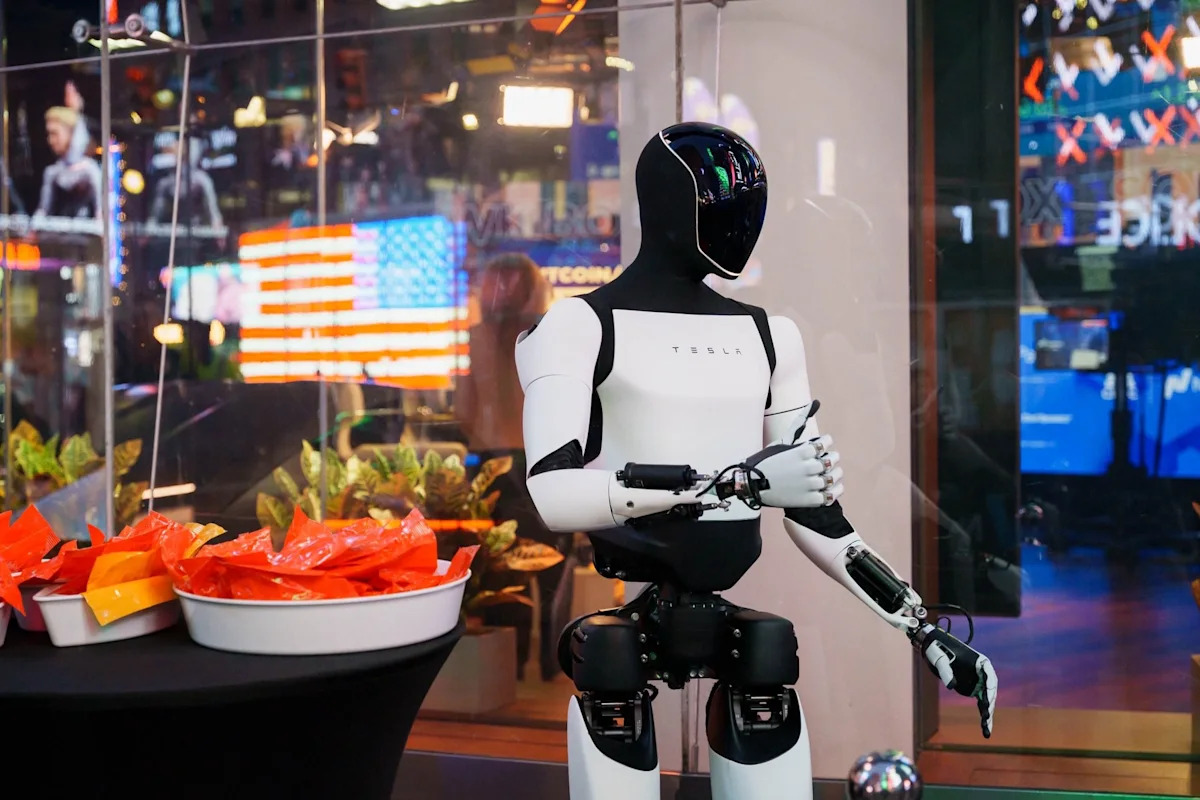
Goldman Sachs raised its 2035 humanoid robot forecast nearly 5x to 6.5 million units, now valuing the market at $138 billion.
Each humanoid robot carries between $3,000 and $6,000 in semiconductor content, potentially generating up to $39 billion in annual chip demand at full scale.
Picks-and-shovels suppliers like semiconductor and automation companies offer a smarter entry than betting on which humanoid robot manufacturer wins.
Just released. Our analysts combed the entire stock market and named the ten best stocks to buy right now, and NVIDIA made the cut. Enter your email to see the other nine names and why NVDA earned its spot. The report is free. Enter your email and see the full list.
Artificial intelligence is moving out of the data center and into the physical world. Autonomous vehicles, warehouse robots, and increasingly capable machines are giving AI a body, creating what Goldman Sachs calls “physical AI.” The investment opportunity could be much larger than the market for humanoid robots themselves. Every machine needs processors, memory, sensors, motors, and software, creating a new demand stream for companies already supplying the AI economy.
Tesla Optimus on X
Goldman Sachs is getting much more confident about that opportunity.
Goldman Just Rewrote The Robot Forecast
In its recently published 80-page Physical AI report, Goldman Sachs raised its 2035 forecast for humanoid robot shipments to approximately 6.5 million units, up from about 1.4 million previously. That is a nearly fivefold increase. The bank also raised its 2030 forecast from 256,000 to 890,000 units and its 2026 estimate from 51,000 to 75,000.
Goldman now estimates the 2035 humanoid market could be worth roughly $138 billion, compared with its previous $38 billion estimate. The revision reflects faster advances in AI, falling hardware costs, and growing investment in physical automation.
That does not mean 6.5 million robots are guaranteed to show up. Goldman still identifies reliability, limited real-world training data, autonomy, and cost as obstacles. The important point for investors is that the bank increasingly sees those problems as engineering challenges rather than reasons to dismiss the market.
Free Report, Just Released
Why NVDA Made Our Top 10 List
24/7 Wall St has helped investors make money for over two decades, and our top analysts just finished ranking the definitive Top 10 Stocks To Buy Now. Not the ten biggest companies. Not the ten everyone is arguing about. The ten best stocks to buy right now.
And NVDA made the cut. See who else did.
The report is free, and you can see why we think each stock is a top investment today.
Goldman expects humanoids to gain traction in logistics and warehousing, and the reason is simple: Warehouses are structured environments where robots can perform repetitive tasks, yet they contain enough variation that traditional fixed automation struggles. Goldman expects automotive manufacturing to follow as another major deployment market.
Amazon (NASDAQ:AMZN) is particularly interesting because it already operates more than 1 million robots across more than 300 facilities. Goldman estimates its broader automation efforts could produce about $72 billion in cumulative service-cost savings from 2026 through 2030, potentially adding as much as 240 basis points to operating margins in an upside scenario.
Tesla (NASDAQ:TSLA) also has a direct stake in the trend through its Optimus humanoid program, while Goldman identifies automotive manufacturing as a likely second wave of adoption.
The Chip Opportunity May Be Bigger
Here is where the thesis gets more interesting for investors. Goldman estimates each humanoid could contain $3,000 to more than $6,000 of semiconductor content, including computing, analog and mixed-signal chips, and edge storage. At 6.5 million units, that translates into roughly $19.5 billion to $39 billion of annual semiconductor demand.
Nvidia (NASDAQ:NVDA) is an obvious beneficiary because physical AI requires increasingly powerful computing at the edge. But the opportunity will not belong to one chipmaker. Goldman’s estimates point toward a broader ecosystem of processors, memory, sensing, and control hardware.
That makes physical AI potentially more valuable to semiconductor investors than simply betting on the eventual winner among humanoid manufacturers.
Key Takeaway
In short, Goldman Sachs’ nearly fivefold increase to 6.5 million humanoid shipments by 2035 is a signal that physical AI is moving from science-fiction story to potential industrial market.
Still, investors should not treat the forecast as a guarantee, even as Morgan Stanley has been more bullish, predicting 1 billion humanoid robots by 2050. RBC Capital Markets says it will become a $9 trillion market by then. But the numbers are large enough to matter. A $138 billion humanoid market and up to $39 billion of annual semiconductor content would create a new leg of AI infrastructure demand.
For now, the smarter play is to focus on the picks-and-shovels suppliers — particularly leading semiconductor and automation companies — rather than trying to predict which humanoid robot will win the popularity contest.
Got $1,000? NVDA Made Our Top 10 List. Here’s Who Else Did
If you have cash sitting in your account right now, give this two minutes. After more than two decades of helping investors beat the market, our top analysts at 24/7 Wall St. put together a definitive report on the Top 10 Stocks To Buy Today. And NVDA was one of them.
They combed the entire market. It’s not 10 ideas, not 10 stocks everyone is talking about, it’s what their research points to as the 10 best stocks to buy right now, and it’s free. Read more here and see which stocks made the list –>>
Contact editorial@247wallst.com for any questions or corrections.