

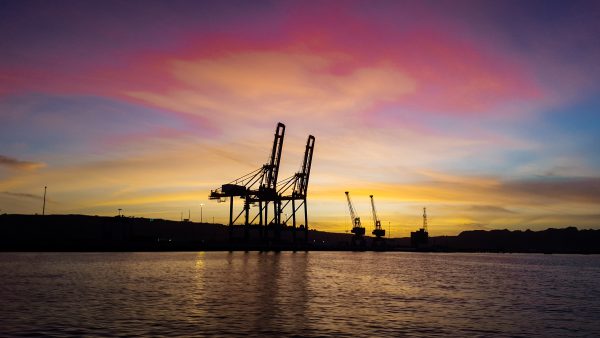
Pakistan and Oman are discussing a strategic maritime agreement to designate Pakistan’s Gwadar Port and Oman’s Sohar Port as sister ports. Pakistani officials say the agreement will help the two ports work more closely on operational matters and create fresh opportunities for trade and investment between the two countries.
This is the latest in a series of developments in recent months that have elevated Gwadar’s profile amid growing uncertainty over shipping through the Strait of Hormuz, driven by the Iran-U.S. war.
Gwadar Port is located on Pakistan’s southwestern coast in Balochistan. It sits roughly 400 kilometers from the Strait of Hormuz. It is a deep-sea port developed primarily with Chinese financing and technical support under the China-Pakistan Economic Corridor (CPEC). The port is operated by the China Overseas Port Holding Company, which holds a long-term lease of 40 years, while the Gwadar Port Authority retains overall ownership and regulatory oversight of the project.
However, the port’s full operational realization faces persistent internal challenges. Security in the province of Balochistan remains volatile as militant groups continue to target infrastructure projects and foreign personnel. These ongoing insurgent threats have delayed commercial expansion, raised security costs, and created caution among international investors regarding long-term commitments.
Gwadar Port Authority Chairman Noor-ul-Haq Baloch said last week that the sister-port initiative is not just tied to the current disruptions or uncertainty around the Strait of Hormuz but is part of Pakistan’s long-term strategic vision. Once finalized, the agreement would facilitate greater trade and collaboration between the two ports, he said. It would allow them to explore shared commercial opportunities. Moreover, discussions are also underway for potential Omani investments in the Gwadar Free Zone along with possible joint ventures in logistics, warehousing, and fisheries.
Furthermore, Baloch outlined several practical dimensions of the partnership. “First is the knowledge exchange about port operations. Second is mutual training of port officials. Third is if a shipping line is coming to Pakistan and Oman, the sister ports can collectively offer a discount to that particular line — this is called a commercial arrangement,” he explained. “Fourth is the operational aspect in which sister ports give priority to each other’s ships.”
Beyond Oman, Gwadar’s strategic potential rests on its role as an alternative transit route for other regional economies. Arguably, the idea of strengthening maritime links allows Pakistan to offer landlocked Central Asian countries the shortest overland access to international sea lanes.
In recent years, Pakistan has intensified diplomatic efforts to operationalize Gwadar by capitalizing on the harbor’s rising geopolitical importance. While Islamabad has been rolling out incentives for shipping lines and businesses seeking to diversify supply chains, Pakistan’s policymakers appear to be drawing on the port’s external linkages by leveraging the broader geopolitical environment.
Pakistan’s heightened attention to building on Gwadar’s external linkages began gathering momentum with the outbreak of the Russia-Ukraine war in 2022. Since then, proposals to link Gwadar with the Russia-backed International North-South Transport Corridor (INSTC) have been put forward. Russia is keen to secure alternative trade routes and warm-water access to the Arabian Sea amid Western sanctions and disruptions to its traditional European corridors. In May this year, Russian Deputy Prime Minister Alexei Overchuk confirmed that Moscow and Islamabad are discussing linking Gwadar Port with the INSTC.
Clearly, the Iran-U.S. conflict and the subsequent pressures on the Strait of Hormuz have prompted renewed international attention on Gwadar. Amid these developments, the port’s primary value appears to have emerged largely from geopolitical circumstances in the region and beyond.
Much of the discussion among Pakistani officials centers on the idea that Gwadar can provide alternative logistics and potential energy routing benefits during periods of regional instability. There is little focus on making infrastructure, connectivity and incentives that Gwadar is currently offering, or planning to offer, that would make it competitive or superior to those available at other ports across the region.
Pakistani officials need to align their efforts with the idea that regional instability in any form will not automatically translate into lasting economic gains for Gwadar. That said, the longer-term outlook for Gwadar remains promising in terms of its strategic attractiveness to major powers, particularly those in the Asia-Pacific region. The port clearly holds the potential to serve as an effective bridge linking Pakistan to western China, Central Asia, and, potentially, markets further afield in Africa.
The task before the Pakistani government is to act swiftly to address structural shortcomings so that the existing geopolitical opportunities can be transformed into durable economic value.