

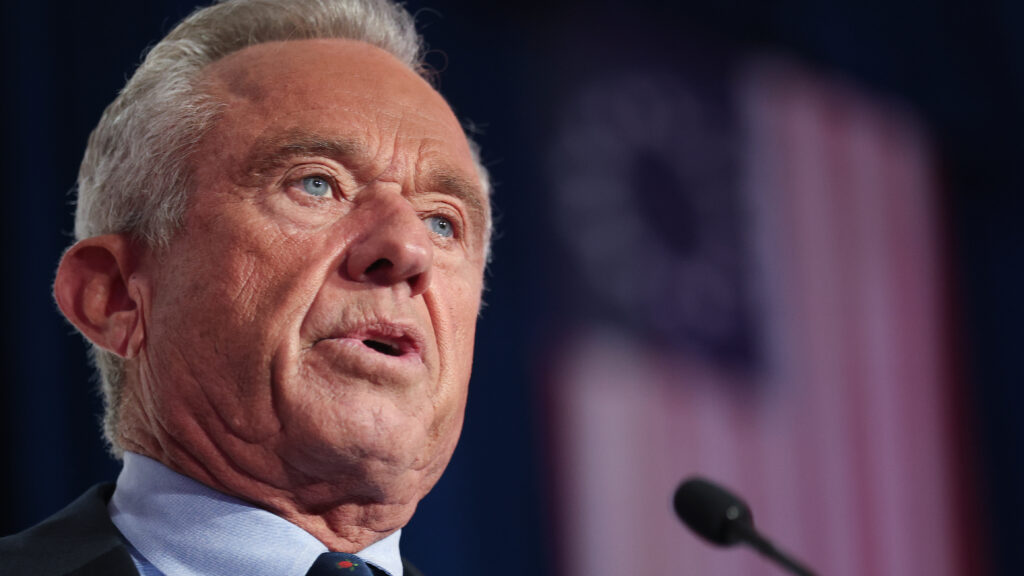
WASHINGTON — Health secretary Robert F. Kennedy Jr. on Thursday named eight new members to the U.S. Preventive Services Task Force, an influential panel of experts who assess the evidence behind a wide array of preventive medical services.
Five of them are medical specialists in fields such as gastroenterology and oncology. That’s a major departure from the past, when the panel was made up of generalist clinicians. Another is a finance professor who has expertise in health insurance.
In an opinion piece published Thursday by Fox News, Kennedy defended the appointment of specialists to the panel, and noted that eight members picked during President Biden’s administration remained as well.
“[P]reventive medicine does not stop at the boundaries of any one discipline. It encompasses cancer detection, cardiovascular disease, medical imaging, pediatric care, diagnostic technologies, chronic disease, and other areas where specialized clinical knowledge can sharpen the evaluation of evidence,” he wrote.
The independent body, known as the USPSTF, has significant power to determine what preventive services health insurers are required to cover. Its recommendations are the reason Americans can get screening colonoscopies at no cost, or free access to drugs that help prevent HIV.
But the 16-person panel has been largely defunct since President Trump and health secretary Robert F. Kennedy Jr. took power. The panel hasn’t met in more than a year, after its meetings were canceled by Kennedy. The most recent news on the USPSTF website dates back to August 2025.
The addition of new members may signal that the task force will now get back to work, though what it may focus on is not clear. Before the Kennedy-backed pause, the group had signaled it was working on recommendations related to breast cancer genetic screening, pediatric autism disorder screening, and cervical cancer screening, among others.
Another problem for USPSTF is that it is supported by the Agency for Healthcare Research and Quality, a small division within the Department of Health and Human Services that was decimated by U.S. DOGE Service-driven cuts. According to the Office of Personnel Management, the agency went from nearly 300 employees in 2024 to 84 in 2026.
“The infrastructure that provides them their reviews to provide evidence-based recommendation is not as secure as it once was,” Katherine Hempstead, senior policy adviser at the Robert Wood Johnson Foundation, told STAT.
The American Medical Association expressed concern about the makeup of the new slate of experts in a statement, calling it a “significant departure from the Task Force’s traditional membership.”
“We believe maintaining a strong primary care voice must remain central to its work,” the group said in a statement.
“The task force is built around people who deliver preventative care, not people who deliver care after a positive test,” said Aaron Carroll, president and CEO of AcademyHealth, which supports health researchers. Specialists, he said, are often brought into meetings and discussions to explain why the tests they perform should be covered, but rarely sit on the panel to avoid conflicts of interest. The conflict of interest page is listed as “currently under review.”
Kennedy has been critical of the group. Two members — vice chairs John Wong and Esa Davis — were fired in letters sent to them by Kennedy on May 11. The letters, viewed by STAT, said they were terminated due to a review of the current appointments.
Last year Kennedy said he planned to remove panel members, viewing them as too “woke,” but no new members had been named until now. His ability to remove members may be traced to a Supreme Court ruling issued in 2025, in the case Kennedy v. Braidwood Management, which established that the expert task force is under the authority of the health secretary.
The new members are:
- Seth Corey, the chair, and a pediatric hematologist-oncologist at Cleveland Clinic. Corey’s research specifically revolves around bone marrow disorders. He has been supportive of efforts by National Institutes of Health director Jay Bhattacharya to restructure how the agency conducts research and grants funding, per his social media. Corey ran as a Democrat in a 2021 special election for a House seat, and described his campaign as “socially progressive.” But records from Open Secrets also show that a Seth J. Corey in Cleveland, Ohio, who described himself as a doctor, donated $250 in 2020 to Jews Choose Four More Years, a Donald Trump super PAC.
- Patrick Hunter, a pediatrician at Pensacola Pediatrics in Florida. Hunter has written critically about gender-affirming care for minors. In 2022, he was a signatory on a resolution calling for the American Academy of Pediatrics to revisit an earlier policy supporting gender-affirming care. As a member of the Florida Board of Medicine, he suggested that puberty blockers could lower IQ.
- Ronald Karlsberg, a cardiologist who is a clinical professor of medicine at Cedars-Sinai Medical Center and at the David Geffen School of Medicine at the University of California Los Angeles. According to his biography at a medical group he worked at, he has special interest in digital imaging and electronic medical records. He also founded the National Institute for Cardiovascular Research Institute and Innovation, which supports research into cardiovascular disease.
- Venkatesh Murthy, a professor of preventive cardiology at the University of Michigan, also has an interest in cardiac imaging, and leads a lab that is teaching artificial intelligence to identify mechanisms of cardiovascular disease.
- Stephen Parente, a health finance professor at the University of Minnesota’s School of Management. He served as a senior adviser to the secretary for health economics at HHS under the first Trump administration, and on the White House Council of Economic Advisors during the same time period. In March 2020, he was the health policy architect of the Provider Relief Fund, an HHS program that distributed $135 billion to hospitals and other providers to help make up for lost revenue and expenses related to the pandemic.
- Goldie Stands-Over-Bull, a family medicine physician at Texas Native Health, who is passionate about “patient autonomy” and “culturally-competent care,” according to her biography. She is an enrolled member of the Crow Tribe. In 2024, she spoke at a First Nations Heritage Month Celebration in UT Southwestern, where she highlighted health care accessibility challenges faced by Native Americans.
- Louis Wilson, a gastroenterologist at Wichita Falls Gastroenterology Associates in Texas, who has written a number of posts on the Medicare physician fee schedule and telehealth reimbursement for the American College of Gastroenterology
- Dennis Wulfeck, a diagnostic radiologist at RadPartners MBB Radiology in Florida, where he’s spent nearly three decades, according to his LinkedIn.
This article has been updated with more information on the new members and with comment from the American Medical Association and AcademyHealth.