

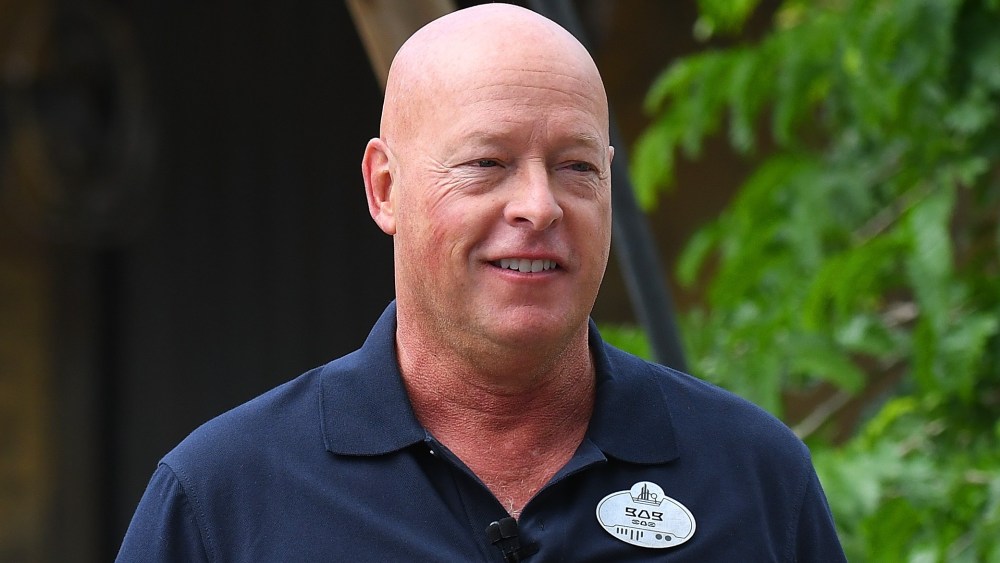
Bob Chapek expounds at length about his termination from Disney and his belief that ex-CEO Bob Iger stabbed him in the back in his forthcoming book, “Behind the Castle Walls.”
Chapek, in recounting his 30-year career at the Mouse House, offers a number of other revelations in the memoir. Variety obtained an advance copy of the book, which publishes on Sept. 29.
“This is the story of how I fought and scraped and bled and worked my way into the top position of the Magic Kingdom, the places I shaped, and the forces I encountered along the journey,” Chapek writes in the book’s introduction.
Chapek, the one-time head of Disney’s theme parks division, assumed the Disney CEO job in February 2020 — as Iger’s hand-picked successor — right before the COVID-19 pandemic hit the U.S. After a series of missteps, the Disney board ousted Chapek in November 2022 and called Iger back into service. Iger stepped down as CEO this March, replaced by former parks head Josh D’Amaro.
Here are key takeaways from the book:
Iger Considered Himself ‘The Modern Reincarnation of Walt Disney’
Chapek recounts an exchange with Iger — who is mentioned 121 times in the book— years before the CEO changeover. The two were talking about the role of Disney’s chief executive officer, and Chapek remarked, “No one is bigger than the company.” To Chapek’s surprise, Iger responded, “You know, that may be true of other CEOs, but I like to think that I’m a little different.”
“He went on to say, it seemed to me in that moment, that he considered himself the modern reincarnation of Walt Disney. As a result, he wasn’t just the next CEO to come along. He thought he was somewhat unique and special in the history of Disney CEOs. I was surprised, because it did not match up to the façade.”
‘The Most Awkward Press Conference Ever’
In the book’s introduction, Chapek recalls his interview with CNBC on Feb. 25, 2020, alongside Iger after Chapek’s appointment as CEO was announced. Recalling that both men “unintentionally wore basically matching outfits — black suits with white button-downs,” Chapek compares it to a scene from the movie “Twins” with Arnold Schwarzenegger and Danny DeVito.
“Bob Iger seemed intent on making sure people knew we weren’t the same,” Chapek says. “In hindsight, I should have seen some clues that things were somewhat off.”
According to Chapek, “As the interview progressed, I found myself somewhat distracted — not so much by the questions, but by Bob’s demeanor. He didn’t appear to be a man relieved of the responsibilities of one of the world’s most influential companies. Instead, he looked uncomfortable, perhaps even miserable. No, he looked more than that. With his arms crossed, I could see that he was angry.”
Chapek Says He Did ‘Nothing’ Wrong, and That Iger Had an ‘Incredibly Difficult Time’ Letting Go of CEO Job
Chapek maintains in the book that Iger was “the real reason” the board dismissed him.
“From the moment he announced my appointment, he clearly regretted it and seemed to initiate a relentless three-year campaign to push me out,” he writes. “From day one as CEO, I had respected the board’s decision to have him remain as executive chairman, directing creative endeavors and overseeing the transition until late 2021. I’d always made it clear I had big shoes to fill. But I’d never expected t endure a drawn-out, purposeful undoing of my leadership.”
Continues Chapek: “This was not a happy time for Bob. Because of his own feelings about the company and his place in it, he was having an incredibly difficult time with the idea of moving on.”
“My abrupt dismissal hurt my reputation, leaving those close to me, outsiders, and some within the kingdom trying to figure out what I did wrong,” says Chapek. “The answer, again, is nothing. I have tried to live my life to leave an impeccable personal legacy. If I ran for political office — which I have no plans to, by the way—no one would find any scandals.”
Chapek Recounts Disney’s ‘Don’t Say Gay’ Blow-Up in Florida
Chapek discusses Disney’s response — and lack of response — to the Florida Parental Rights in Education Act, aka “Don’t Say Gay,” which was designed to limit discussion about gender and sexual identity in state schools from kindergarten through third grade. In 2022, the legislation “became a lightning rod for the larger cultural divide that the COVID pandemic had inflamed,” Chapek writes.
“While the board and I were having internal discussions about how to respond to the legislation, which had yet to officially pass, Bob tweeted, ‘I’m with the President [Biden] on this! If passed, this bill will put vulnerable, young LGBTQ people in jeopardy.’”
“That tweet made my job all the harder getting the Florida legislature to soften the bill. Instead, Governor DeSantis and his allies became even more entrenched,” write Chapek. As CEO, “I believed we should stop short of making a political statement that could be misrepresented by the press, or by either side of the argument.” An internal memo to Disney staffers “explained our belief that the company would be more effective ‘working behind the scenes’ with Governor DeSantis and the legislators, rather than publicly denouncing the bill.”
At this point, according to Chapek, Iger “likely smelled blood in the water” and “he continued to reach out to the creative community he was working with — the writers, animators, directors, actors, etc. — to express his regret” over Disney’s inaction on the Don’t Say Gay bill. In a CNN interview near the end of March 2022, Iger said, “Sometimes it’s just a matter of right and wrong.”
“He was implying none of this would have happened on his watch, and all this was a simple and
clear decision for the company. To him, it was the perfect opportunity to use the situation to show he was right, and I was wrong,” says Chapek.
Chapek claims that “it was outside political groups and not our employees” behind the demonstrations of Disney’s lack of a stance on Don’t Say Gay. But the growing pressure made it impossible for Chapek to stay on the sidelines. On March 11, 2022, “I began our shareholder meeting by reading the statement: ‘Thank you to all who have reached out to me sharing your pain, frustration, and sadness over the company’s response to the Florida “Don’t Say Gay” bill,’ I said. ‘Speaking to you, reading your messages,
and meeting with you have helped me better understand how painful our silence was.’”
But Chapek’s “sudden reversal became headline news, and the reports were brutal. Critics portrayed me as weak for backtracking within forty-eight hours and apologizing for my misstep… the conflict. Then Governor Ron DeSantis labeled Disney a ‘woke corporation.’”
“Meanwhile, Bob Iger receded into the background. Even though his tweet heard ’round the world had sparked the firestorm, during the ensuing legal battle, which spanned months and cost the company tens of millions in legal fees, not to mention untold damage in PR among other demographics, he now remained publicly silent,” Chapek asserts.
Iger Blamed Chapek for High Prices at Disney Parks but Did the Same Thing
Chapek recalls that one of Iger’s first remarks “after I was out was that Disney’s prices were too high. He announced, ‘In our zeal to grow profits, we may have been a little bit too aggressive about some of our pricing. I think there’s a way to continue to grow that business but be smarter about how we price so that we maintain that brand value of accessibility.”
But, as Chapek tells it, Iger went on to do the same thing: “In reality, over the following two years, he increased prices a number of times.”
Chapek Says He Became CEO Because ‘I Kept My Head Down’
“I became CEO, in part, because I never tried too hard to promote myself,” says Chapek. “I saw several of my colleagues, people who held leadership positions in the company, try a little too aggressively to set themselves up as heir apparent to the throne, only to see Bob Iger have them escorted from the castle.”
However, he writes: “The reality is, Bob Iger was never going to see anyone as his equal, or even as worthy to be his successor.”
Chapek Touts ‘Huge Win’ After Raising Prices at Disney Parks
When Iger promoted Chapek from president of consumer products to chairman of Walt Disney Parks and Resorts in 2015, he writes, he felt that “I had arrived.”
In the book, he discusses the division’s move to implement change its pricing model — which was deeply unpopular with fans of Disney’s theme parks. “I raised prices and restricted access relative to the price of the pass for the annual passholders, both to serve the shareholders and to try to improve the experience of the vast majority of park visitors,” he writes.
“Still, when you announce a price increase to over one million customers, some of them are going to complain. And they did. That’s mostly all they did, though. When I announced the first round of price increases on annual passes, Disneyland had 1.1 million passholders. After the first round of increases, the number of annual passholders dropped to one million, but revenue increased due to the higher ticket prices.”
Says Chapek, “I considered that a huge win.”
Iger’s Leadership Style: ‘Management by Pronouncement’
Iger would announce major new initiatives publicly through the press, “and then we would read it and know there was no room for debate as it was already announced,” Chapek writes.
One example: Chapek, who was president of Buena Vista Home Video, was “caught off guard” by Iger and then-CEO of Apple Steve Jobs’ plan to release movies on platforms like Apple’s iTunes Store in October 2005. “It seemed to me that neither Bob Iger nor Steve Jobs wanted to run it by anyone, so they wouldn’t have to debate it. I would have preferred to be included, of course, but after a decade of working with Bob Iger, I was used to his style.”
Disney’s move to digital movie distribution produced irate phones calls from retail partners, according to Chapek, who were outraged that it would threaten DVD sales. “With the Christmas sales season just weeks away, I found myself on the phone with the CEO of Walmart, who was unhappy. Before I could hang up, the CEO of Target was waiting on another line, ready to take his ire out on me as well. You want to talk about screaming; it was one of the biggest beatdowns I’ve ever experienced.”
The First Time He Met Iger
In the ’90s, Chapek met Iger for the first time. “At a dinner for some of the corporate hierarchy, as president of Buena Vista I was introduced to the head of ABC. Thin, tan, and with an easy smile, Bob Iger introduced himself. Casually, he asked if I had a family,” Chapek writes.
“‘I sure do,’ I replied. ‘I’ve been married for twenty years.’ Iger paused, smiled briefly, and then said, ‘To the same woman?’ ‘Absolutely,’ I said without smiling.”
“I loved my job. But at no point did I ever forget what my top priority on this planet was. At that time, she needed me more than ever,” Chapek says, discussing the leukemia diagnosis of his wife, Cindy. (She recovered after a bone-marrow transplant from her brother.)
John Lasseter Called Direct-to-Video ‘Return of Jafar’ Movie, Which Was a Big Success, ‘Terrible’
At Disney’s home video division, Chapek spearheaded a sequel to “Aladdin,” dubbed “The Return of Jafar,” which was released in 1994. It was panned — both inside and outside the company. “The industry press, including publications like The Hollywood Reporter and Variety… did openly criticize the movie. John Lasseter, a founding member and then an executive producer at Pixar, went so far as to call it ‘terrible.’”
But the movie would go on to reach nearly $300 million in sales. The original movie had netted $217 million in the U.S. and over $500 million worldwide.
“Why was there such vocal criticism aimed at the movie?” Chapek writes. “Likely because a bunch of upstart TV animators in their twenties had created something that generated five times the profits of a typical theatrical release, at the behest of some packaged goods professionals who’d previously worked in the cheese, athletic shoes, and cat food industries.”
His First Encounter With ‘Disney Magic’
Chapek, born on Aug. 21, 1960, grew up in Hammond, Indiana, outside of Chicago. His family took yearly trips to Floria, and they visited Disney World when it first opened in 1971. His favorite attraction was the Pirates of the Caribbean.
“One reason why I so enjoyed my time working for Disney is that, on these childhood trips, I learned firsthand how real the Disney magic was. You truly felt like you were entering a different place altogether, just by walking through the Magic Kingdom entrance,” he writes. “The first thing you see, of course, is Cinderella’s Castle. These days it may seem silly, in a world of constant digital distraction and virtual reality, but in 1971 you didn’t exactly see castles all the time. So, just being in a place that featured buildings, designs, costumes, and characters you knew only from a movie theater or television screen was surreal in the most captivating way.”
‘Hazing’ at Disney
On his first day at Disney in 1993, in the marketing department of Buena Vista Home Video in Burbank, Chapek had a strange experience.
“While getting settled at my desk amid my predecessor’s papers, a six-and-a-half-foot male staff member entered my office, closed the door behind him, and leaned against it. He stared at me for a moment before unbuckling his pants as if he intended to tuck in his shirt, but then deliberately let them drop to the floor. For another few long moments, he just stood there with his pants around his ankles. Welcome to Hollywood.”
Chapek continues, “He never explained his actions. I can only surmise that he wanted to test whether the new guy from a Midwest flyover state could handle the West Coast environment. It was like a more ‘adult’ version of the hazing I had experienced in the corn processing plant.”
Reps for Disney and Iger have declined to comment on Chapek’s allegations. Disney insiders are said to be viewing the book as a one-sided revisionist history.
Published by Simon & Schuster’s Gallery Books imprint, “Behind the Castle Walls: My Thirty Years at the Happiest Place on Earth,” weighs in at 272 pages. Chapek co-wrote the book with author Don Yaeger.
According to Simon & Schuster’s bio for Chapek, he currently is “engaged in a variety of advisory, consulting and board positions.” He divides his time between Florida and Los Angeles with his wife, Cindy.