

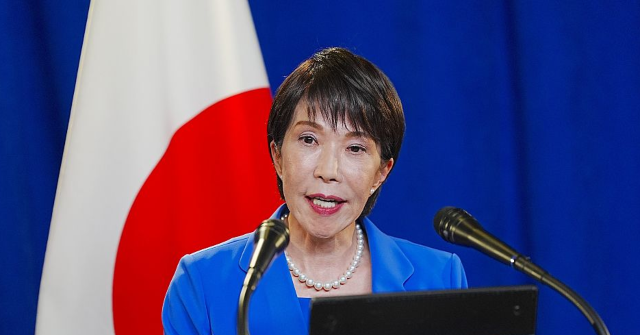
Japanese Prime Minister Takaichi Sanae announced this week that her government will establish Japan’s first national security agency with an eye toward creating an external intelligence operation similar to the American CIA.
Takaichi made the announcement at the first meeting of a 17-member expert panel on intelligence and counterespionage on Monday. She said it was time for Japan to step up its game on intelligence gathering because of the sophisticated threats surrounding it.
“In the region surrounding Japan, China and North Korea are strengthening their military capabilities while we are also seeing closer cooperation between China and Russia, as well as between Russia and North Korea,” she told reporters after the meeting.
“We must strengthen our intelligence capabilities to ensure public safety and protect the national interest,” she declared.
The victorious Allies dismantled most of Japan’s spy networks after World War II, and the pacifist postwar Japanese public was not enthusiastic about rebuilding an intelligence gathering machine. The United States agreed to provide foreign intelligence as part of its security arrangement with Japan as a patchwork of small agencies scattered through the Japanese bureaucracy handled local matters.
This state of affairs persisted until the mid-1980s, when modern Japan launched its first centralized intelligence agency, the Cabinet Intelligence and Research Office (CIRO). This office did not dramatically expand national intel operations, although it provided central organization. Japan did not even have a solid system for classifying state secrets until 2013.
CIRO plugged along for decades, surviving without reforms even after Japan grew more concerned about terrorism during the rise of the Islamic State. The game changer was a dramatic increase in Chinese espionage following the election of the hawkish Takaichi, Japan’s first female prime minister, in October 2025.
The Chinese Communist regime expressed loathing toward Takaichi after she said in November 2025 that Japan might respond to a Chinese invasion of Taiwan. China has been nearly psychopathic in its fury against Japan ever since the prime minister made that comment.
Japan is also increasingly worried about Russia, which has some territorial disputes with Tokyo and has demonstrated considerable belligerence since invading Ukraine in 2022. After the Ukrainian invasion, most Western countries made a point of booting as many Russian spies as possible from their soil — and a lot of those dislodged spies ended up in Japan, often using jobs with Russia’s Aeroflot airline as cover.
The Russians proceeded to go on an industrial espionage binge, stealing Japanese technology to use against Ukraine. A disturbing number of Japanese components that were restricted from export to Russia have been turning up in the debris from Russian missiles that struck Ukrainian buildings.
Takaichi mentioned the theft of advanced technology by foreign intelligence operatives as one reason for creating the security agency in her remarks on Monday. She also cited the danger of foreign influence and disinformation operations.
In May 2026, the Japanese parliament approved the creation of a successor agency to the CIRO called the National Intelligence Bureau (NIB). At around the same time, Japan loosened its restrictions on exporting lethal weapons and established a board to review foreign investments comparable to the Committee on Foreign Investment (CFIUS) in the United States, which further angered China. Taken together, these measures signaled a shift under Takaichi to a more aggressive defense policy.
The NIB was explicitly intended to become an intelligence service on par with the CIA and other members of the “Five Eyes” Western intelligence alliance. The NIB and its supervisory agency, the National Intelligence Council — which the prime minister personally chairs — were officially established in July, and are scheduled to receive an influx of personnel, funding, and legal authority in the coming months. Takaichi has expressed a desire to have the NIB playing on the same level as the CIA by March 2028.