

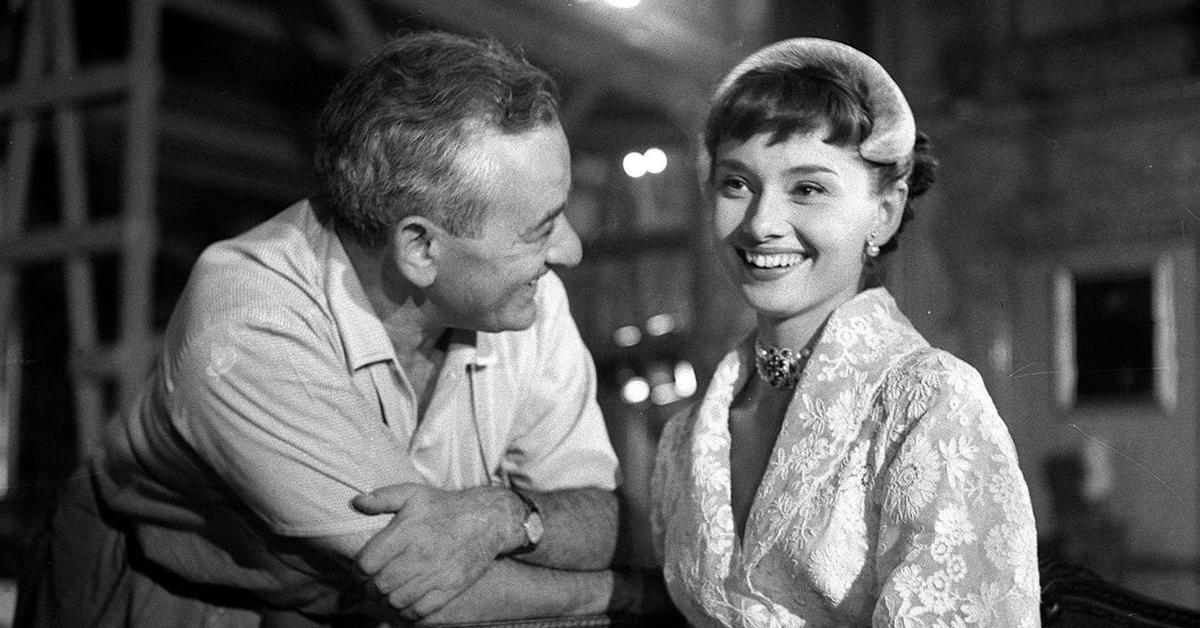
In 1953, Roman Holiday introduced a 24-year-old Belgian-born former dancer named Audrey Hepburn to the world, RadarOnline.com can reveal. The romantic comedy costarring Gregory Peck would become a big hit, earn Hepburn an Academy Award for Best Actress, and change the direction of her life.
All of it came as a surprise to the beloved actress. “I did bits in movies, but that was to earn an extra buck. That wasn’t going to be my career,” she recalled.
A casting director had seen Hepburn on Broadway in Gigi and offered her an opportunity to audition for Roman Holiday‘s Princess Ann.
It was a perfect fit.
“For most of her youth, Audrey grew up among the Dutch aristocracy,” said Robert Matzen, author of Dutch Girl: Audrey Hepburn and World War II and Warrior: Audrey Hepburn. “Her performance, delivery and bearing all were authentic.”
And like the film’s heroine, Hepburn was a bit naive about the world. “I had a very European upbringing, and it may have been this aura of being rather square,” she said. “I was very young in my behavior.”
With her large, dark eyes and rail-thin figure, Hepburn also didn’t look like other Hollywood actresses. The film’s director, William Wyler, liked that she was the antithesis of bombshells like Marilyn Monroe.
“She did not have curves, she was almost androgynous in some ways,” said Matzen. “There was no one like her.”
On the set in Rome, Peck, who played Joe, an American journalist who becomes Ann’s guide to the outside world, was patient and gracious about showing the young actress the ropes. “They developed a good friendship that really endured the rest of her life,” said Matzen.
Wyler, the director, also made Hepburn feel comfortable. “If you’re asked to pretend to be a princess, nothing’s more fun,” said Hepburn. “I think I was very lucky because I was sort of Willy’s baby… because he discovered me and nurtured me. He was very protective of me.”
She only ran into trouble when the script required her to cry for the scene where Ann and Joe part. “I had no idea how to come by these tears,” Hepburn said.
“Out of the blue, [Wyler] came over to the car and gave me hell. He said, ‘Look, we can’t stay here all night, can’t you cry for God’s sakes?’ Willie had never spoken to me like that, ever. I broke into such sobs, and he shot the scene and that was it.”
The director later apologized for yelling at her.
“That’s how you learn. He knew with me there was no point in trying to teach me,” said Hepburn. “He would just make me cry.”
Roman Holiday premiered in New York on Aug. 27, 1953, and was an immediate hit.
Hepburn was called the new Garbo, and women all over the world began copying her hairstyle and clothing.
“Suddenly she was set for life. It allowed her to pick whatever vehicles were right for her,” said Matzen of the actress, who would go on to star in other classics including Sabrina, Funny Face and Breakfast at Tiffany’s. Hepburn confessed: “I was totally unaware of the great significance of doing my first [American] movie.”
Her success might have come as a surprise to her, but not to everyone.
“We all knew,” said Gregory, “that she was going to be an important star.”