

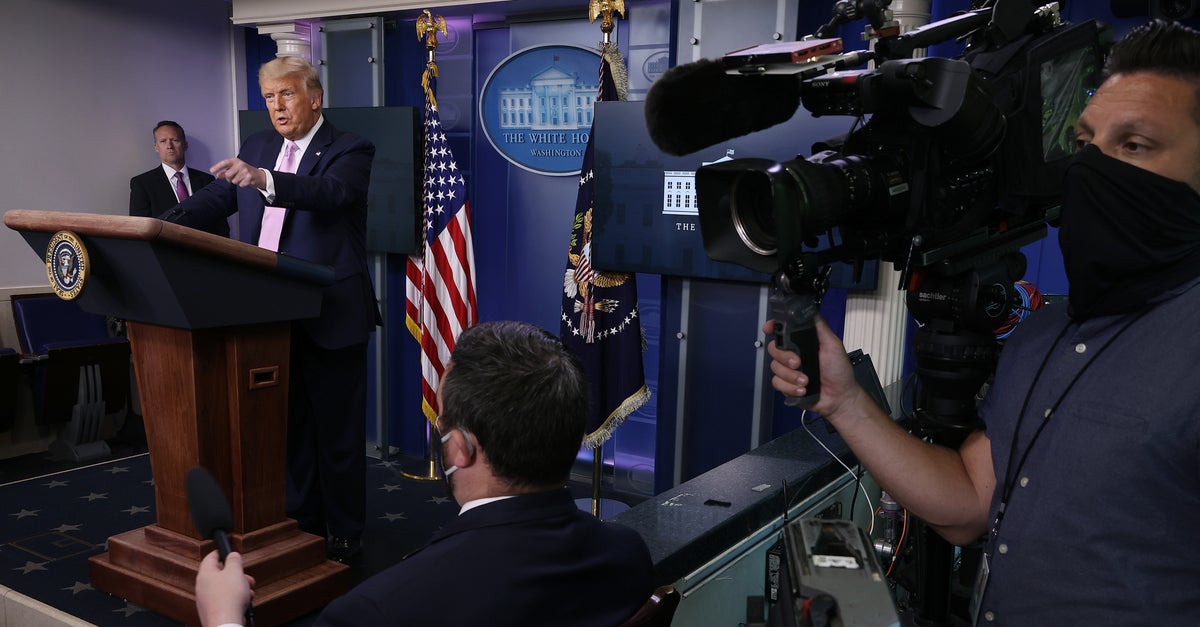
WASHINGTON — While a lawsuit against the president moves ahead, a federal judge ruled on Tuesday that CNN, Politico and MS NOW must be allowed to resume coverage at the White House following a ban Donald Trump slapped on the outlets last month.
“The Court will grant [a motion for a preliminary injunction]…finding that Plaintiffs are likely to succeed not only on their due process claim, but also on their two First Amendment claims,” U.S. District Judge Timothy Kelly, a Trump appointee, wrote in his order.
The news outlets claimed that Trump had retaliated against them for their coverage and had unlawfully discriminated against them because of their viewpoints. Additionally, they argued that Trump didn’t provide them with sufficient due process prior to implementing the ban.
In his order, Kelly expressed skepticism about the administration’s argument that the ban was necessary to protect national security.
“To begin, there is no evidence that President Trump relied on any of the ‘reporting incidents’ that purportedly ‘threatened national security/and or spread falsehoods’ referenced in the September 22 letters when he decided to revoke Plaintiffs’ hard passes, or any direct evidence that national security was even on his mind then,” Kelly wrote.
Kelly put a temporary restraining order on Trump’s Sept. 18 press ban last month after finding that it was likely unconstitutional.
Trump abruptly issued the ban in September and accused the outlets of publishing “fake news” about his administration. Trump argued that outlets shouldn’t be able to report “FICTION AND LIES” when covering him. When first announcing the ban from the Oval Office, Trump did not cite any particular report or issue with a specific outlet or reporter. Rather, he said it was “really just cumulative stories over the last few years” that prompted the decision.
In court, however, lawyers for the Trump administration argued that the president barred the outlets from covering the White House because of “national security” concerns. As JS reported, the Justice Department claimed that reports about the president’s ballroom on the grounds of the White House and the Iran war and depleted ammunition levels threatened national security.
When issuing the temporary restraining order on Sept. 24, Kelly said he found “nothing in the record” to support that claim.
Instead, the judge noted that when Trump banned the outlets, he “focused on the alleged lack of truthfulness and negativity” of the reporting.
The affected journalists’ press badges, which grant them access to the White House complex and allow them to fulfill press pool duties, were returned less than a day after Kelly’s initial order. However, since then, the White House has continued to restrict access.
On Oct. 5, CNN reported that the administration stopped Politico reporters from boarding Air Force One and that a small group of the network’s reporters who travel with the president as part of an out-of-town travel press pool were also denied access.
Lawyers for the outlets argue the ban is a violation of the First Amendment and told the judge that the timing of the administration’s complaints gave away Trump’s real intent: Letters and notices denigrating journalists’ professionalism or lack of decorum arrived only after the outlets sued.
Lawyers for the Trump administration insist that access to the White House is a “privilege not a right” and that the president should be allowed to deny access “even for viewpoint discriminatory reasons.”
Ahead of a hearing on the preliminary injunction request by the news outlets on Oct. 8, U.S. attorney Brett Shumate filed a lengthy motion defending Trump’s decision by suggesting that presidents in the past “picked and chose” reporters they wanted to cover them or granted others “special access.” Further, the government claims the White House complex is “not a ‘forum’ at all” and therefore the White House “has no obligation to call on reporters.”