

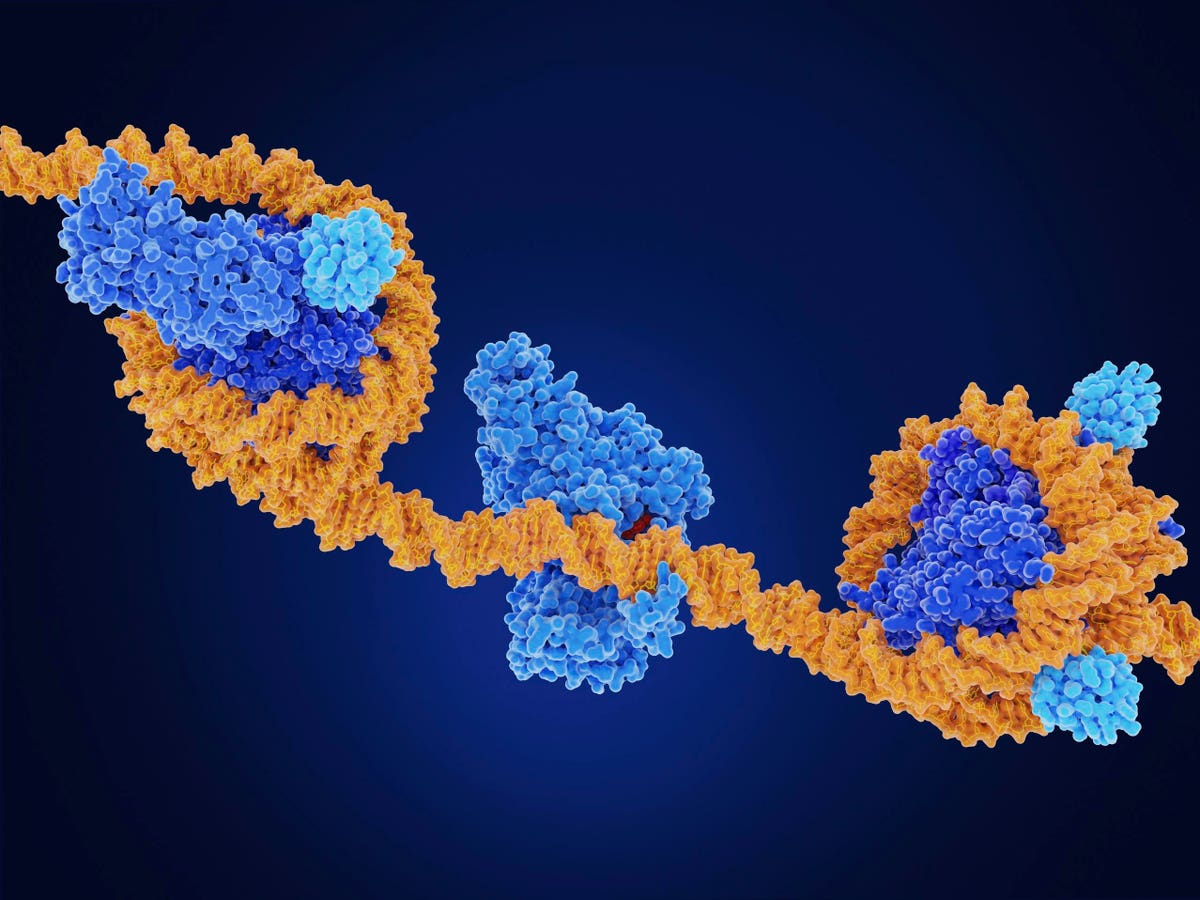
Epigenetics in action: DNA (orange) and histones (dark blue), which are proteins that DNA wraps … [+]
Have you ever wondered why identical twins can develop different diseases?
Take, for example, the hypothetical twins Bob and Jim. Bob eats a diet of sugary, low-fiber food and doesn’t get much exercise. Jim, on the other hand, runs every morning after eating a bowl of oatmeal, and drinks red wine in moderation.
You can probably guess that Bob’s lifestyle puts him at a higher risk of certain types of cancer and diabetes. But why? He and Jim share the same DNA after all.
It’s because we are the product of both what our genes do and how they do it. The sequence of our genes can directly change from exposures like sunlight and smoking. But there are also exposures that don’t change our genes, and still manage to impact our health.
This is due to a phenomenon that evolved eons ago to help organisms adapt to their environment: Epigenetics. Your epigenome consists of molecular instructions that can silence, tweak, or activate your roughly 20,0000 genes depending on the exposures you accumulate over time, such as from nutrition, toxins, or pollutants.
“Mother Nature literally inscribes memories on our genes as we go through life,” explained Fyodor Urnov, professor in the department of molecular and cell biology at UC Berkeley and a leading pioneer in the field of therapeutic genome editing. “Some of these memories are good. It’s nice that our genes remember that we were once exposed to something, and we have to be ready for that again. But some of these memories are bad. If you don’t get enough fiber in your diet, the memory on your genes will not be the ones you want…and you’ll want to erase them.”
Enter the field of epigenetic editing: a set of technologies that began in the late 1990s, which have “ripened to the point where we can now erase memories or inscribe memories,” Urnov said. “We can selectively silence one gene on one specific chromosome. The truly striking thing about all of this is that these epigenetic processes are a hallmark of pretty much all multicellular organisms, and that means agricultural crops as well.”
It may therefore be no coincidence that this year, we are seeing exciting developments in both health and agriculture for this relatively new field, which some researchers call the “younger sister” of genome editing.
A Landmark Monkey Trial
At the recent annual meeting of the American Society of Gene and Cell Therapy (ASGCT), a biotech company called Tune Therapeutics, based in Durham, NC and Seattle, WA, presented the first data showing that epigenetic editing in non-human primates had repressed a gene associated with high cholesterol.
The gene, called PCSK9, is shared by both monkeys and humans, and blocking it is known to reduce LDL cholesterol, lowering the risk of coronary heart disease.
The researchers at Tune gave three macaque monkeys a single dose of the epi editor, which repressed the PCSK9 activity levels up to 98 percent over six months of observation, which is ongoing. Remarkably, the monkeys’ LDL cholesterol fell 56 percent.
Urnov, who is a co-founder of Tune and member of the Scientific Advisory Board, put the significance of the results in perspective: “If you do something in a rat, it’s like rowing across San Francisco Bay, but doing it in a monkey is like sailing across the Atlantic. It’s a different level of challenge.”
Specialists in this field are quick to point out that epi editing is not superior to gene editing, but rather another tool in the therapeutic toolbox, with its own distinct applications. In many diseases, for example, it is essential to delete or change genes directly, such as with sickle cell disease, which is caused by a single “misspelling” in the DNA code.
But many other diseases arise when normal DNA is expressed in problematic ways, due to exposures that throw off the epigenome.
In fact, 90 percent of the genetic risk factors that make us susceptible to common diseases are not actually changes to the DNA coding sequence, but rather changes to the instructions for what the genes do.
Stanley Qi is an associate professor of bioengineering at Stanford and a CRISPR pioneer who served as a doctoral candidate in the lab of Nobel Prize winner Jennifer Doudna. He likened epigenetic editing to the way that emphasis and punctuation can change a sentence’s meaning: “It’s not changing the script of the language; we change how the language is spoken and alter its meaning to the correct grammar.”
Qi predicted that within two years, we’ll see the first phase 1 trials of epi medicine in humans. He is also the founder of an epi editing company, San Francisco-based Epic Bio, which has promising preclinical data for a type of muscular dystrophy disease. Another such company, Boston-based Chroma Medicine, has effectively suppressed the PCSK9 gene in mice.
One of the benefits of this approach is that the desirable change or changes would only need to be introduced once through a single dose of a transient editor. Then, that epigenetic memory – like a new comma in a sentence — will be copied by the cell and passed on to all the future dividing cells. (Note: the change would not be passed onto future offspring.)
While stable, the changes are theoretically reversible, though this has yet to be demonstrated experimentally. The changes could also be partial and nuanced. Instead of an “on” or “off” switch, think more bass, less strings in an orchestra. And one of the biggest potential advantages of using this set of technologies is to change the expression of multiple genes at once – something that would be incredibly challenging to do with genome editing.
The list of disease areas that could be potentially addressed through this approach is long. It includes cancers, autoimmune diseases, neurological diseases, and multifactorial genetic diseases.
Meanwhile, humans are not the only ones who stand to benefit from tweaks to our epigenome.
A More Durable Heirloom Tomato
Plants, too, use this trick of adapting to their environment through epigenetic memory. Now, scientists are already mimicking nature to produce desirable outcomes.
Sound Agriculture, a biotech company based in Emeryville, California, has just brought to market the world’s first epigenetically modified produce: an heirloom tomato that lasts longer than a regular heirloom without spoiling.
“People love the flavor of heirloom tomatoes, and they tend to have higher nutritional content,” said Travis Bayer, Sound’s co-founder and chief technology officer. “But the problem with a lot of heirlooms is that it’s not a very robust fruit because it wasn’t grown for the modern system and supply chain. So, we wanted to dial down the expression of a gene that’s responsible for fruit degradation.”
Sound’s team germinated the seeds of an heirloom tomato in a solution for several days exposing it to a specially designed bio-based molecule that lowered the activity of the target gene. Then they planted those seeds in a greenhouse and grew them like any other tomatoes. When the fruits were ripe, the team found that the skin no longer broke down and spoiled after three to five days on the shelf like a regular heirloom. Instead, the new version, which they dubbed the “Summer Swell,” lasted eight to ten days at peak flavor.
The Summer Swell tomato has sweeter flavor and longer peak ripeness, improving the experience for … [+]
Most conventional crop breeding takes between five and seven years to release a new variety. But with the tools of epigenetics, the time is dramatically faster.
“We went from an idea on a whiteboard to the first fruit we could taste and test in about four months,” Bayer said. “It’s like rapid prototyping for plant genetics.”
The new tomato is the first, but it won’t be the last. Sound, with a variety of partners, is already working on making row crops like corn and soy more efficient in their use of resources and more resilient to environmental stresses. They are also tweaking additional types of produce like leafy greens and specialty veggies.
In the long-term, such crops could prove to be a boon for both growers and consumers.
“Epigenetic editing could improve their adaptability to drastic changes in climate,” noted Qi of Stanford. “Like if it is very cold at night and very hot during the day.”
Twenty-five years ago, both epigenetic medicine and food were blue sky dreams on a piece of paper.
Now, those efforts are starting to bear literal fruit. And this is just the beginning.
Thank you to Kira Peikoff for additional research and reporting on this article. I’m the head of Leaps by Bayer, the impact investment arm of Bayer AG. We invest in potentially breakthrough technologies to overcome ten of humanity’s greatest challenges, which we call “Leaps,” including to cure genetic diseases and to provide next-generation healthy crops. Sound Agriculture is one of the 55+ companies in our portfolio.