

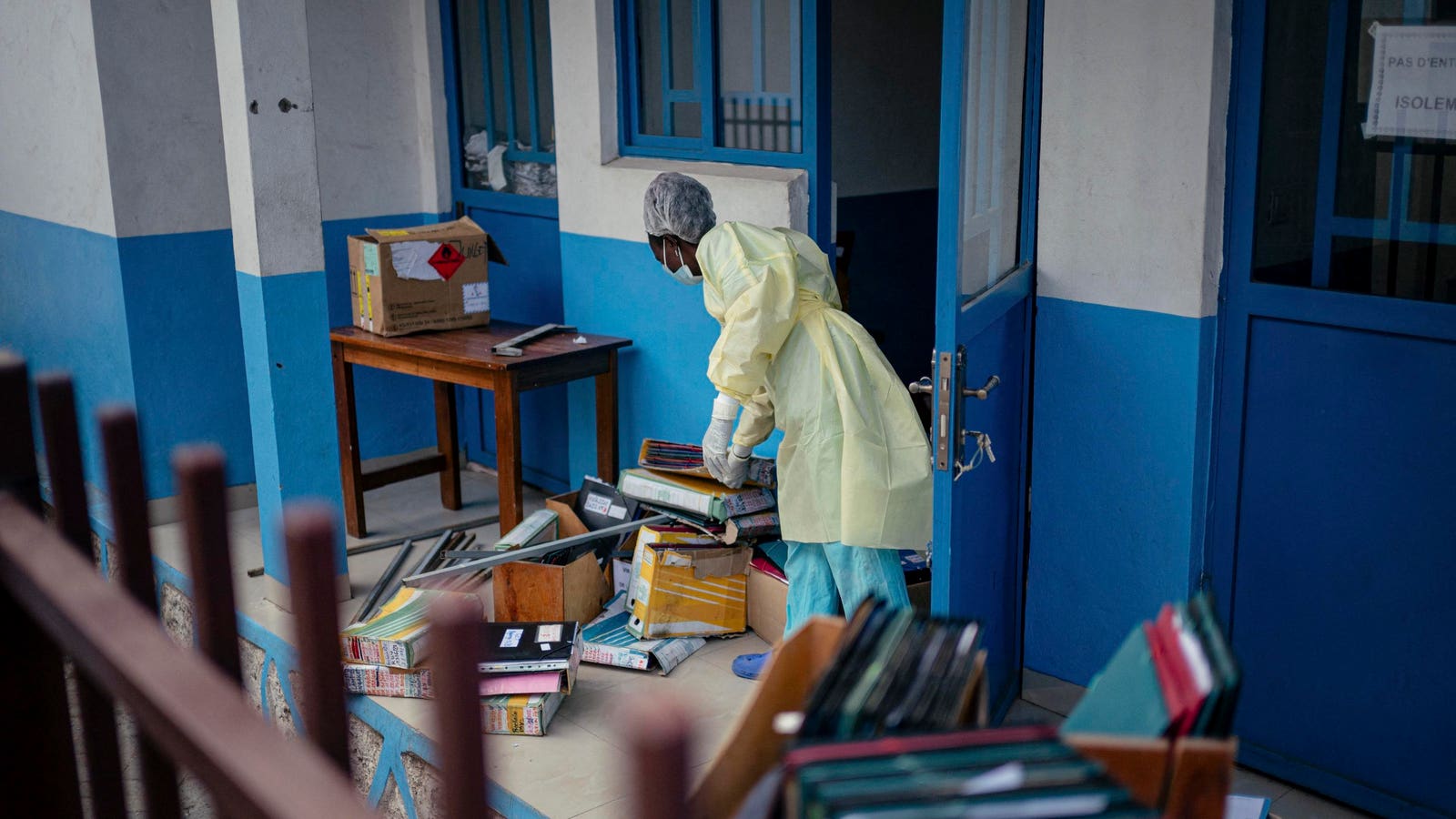
Staff members at CBCA Virunga Hospital prepare rooms intended for possible suspected Ebola cases following official announcements in Goma, on May 17, 2026. A first case of Ebola virus infection was reported in Goma, a major city in eastern Democratic Republic of Congo. The WHO declaring an international health alert on Sunday. (Photo by Jospin Mwisha / AFP via Getty Images)
AFP via Getty Images
As of the morning of May 18, 2026, an American physician was on his way to Germany after being diagnosed with the Bundibugyo strain of Ebola. Dr. Peter Stafford, a medical missionary treating patients at Nyankunde Hospital in Bunia, the Democratic Republic of Congo (DRC) since 2023, developed symptoms the prior weekend and tested positive.
Six close contacts, including fellow missionaries and his wife, have been relocated to Germany for monitoring. The World Health Organization (WHO) declared the outbreak a Public Health Emergency of International Concern on May 17th, 2026. To date there are 531 suspected and confirmed cases of Ebola with at least 131 deaths.
U.S. public health systems responded quickly. The Center for Disease Control and Prevention (CDC) invoked Title 42 to restrict entry for non-U.S. passport holders who have been in DRC, Uganda or South Sudan within the past 21 days. The State Department warned against travel to DRC. The Department of Homeland Security (DHS) has implemented screening at ports of entry.
With an American infected and others being monitored, here’s a reasonable question: if someone exposed to the outbreak walks into a U.S. emergency department this week, what would actually happen?
The Healthcare System Built To Detect And Contain Outbreaks
In 2014, when Thomas Eric Duncan was diagnosed with Ebola at Texas Health Presbyterian in Dallas as the first case on U.S. case of the outbreak, there was no national framework for managing Ebola in American hospitals.
The experience drove the federal government to build one from scratch. Today, the infrastructure exists today reflects twelve years of planning.
There are now 13 federally funded Regional Emerging Special Pathogen Treatment Centers (RESPTCs). These are anchored at institutions like Johns Hopkins, Denver Health, NYC Health + Hospitals/Bellevue and Corewell Health in Michigan. The facilities maintain dedicated biocontainment units with negative-pressure rooms, level-A personal protective equipment (PPE) stockpiles, trained teams and protocols covering everything from patient admission to waste disposal to healthcare worker monitoring.
The National Emerging Special Pathogens Training and Education Center (NETEC) certifies frontline hospitals, runs national transport drills and serves as the operational backbone of the response. A 2025 federal program called STAND extended funding to a second tier of centers, broadening the geographic reach.
The system is being activated now.
Here’s How Hospitals Screen For Ebola
Screening begins at the front door. CDC guidance directs all healthcare facilities to implement a ‘detect and protect’ protocol at first contact, be it triage or registration. Any patient presenting with fever, headache, myalgias or gastrointestinal symptoms is asked two questions: Have you traveled to an affected region in the past 21 days? Have you had contact with anyone known or suspected to be infected? Now, that means DRC, Uganda and South Sudan.
If the answer is yes, the protocol kicks in. The patient is moved to a private room which minimizes exposure to other patients and staff. The clinical team dons full droplet and contact precautions: gown, gloves, eye protection and N95 respirator at minimum.
Only essential personnel enter. The hospital’s infection control officer is notified, and the local or state health department is contacted before any specimen is collected or tested.
Testing for suspected Ebola requires a controlled chain of custody. Standard hospital labs are not equipped for this. Specimens are packaged under strict biosafety protocols and sent to a state public health laboratory or directly to CDC’s Atlanta facility which is specifically equipped to detect the Bundibugyo strain of Ebola.
This is exactly the issue that allowed cases to accumulate in DRC before the outbreak was confirmed. In America, the notification chain to CDC is what ensures the right test gets ordered.
Here’s The Detailed Process of Ebola Screening
Here’s a potential scenario: an American aid worker returns from three weeks in Ituri province in DRC, feels well at customs at Dulles Airport in Northern Virginia, yet later he develops fever and headache on day five. Following CDC guidance, he calls ahead before going to an ED (Note: This call ahead very important).
The hospital activates its travel-related illness protocol before arrival. A staff member in PPE meets him in the ambulance bay bypassing the waiting room. Then, a small dedicated team manages the initial evaluation. The infection control officer is paged. The state health department is contacted. A rapid epidemiological assessment establishes the exposure history, and specimens are packaged and shipped to the state lab with the CDC involved in every step.
While results are pending which typically required four to eight hours, he remains in isolation. Every clinician who enters his room is logged by name, time and PPE status.
If the test for Ebola positive, he would transferred to the nearest RESPTC under a specialized transport protocol. In the mid-Atlantic region, that would likely be the NIH Clinical Center or the University of Maryland’s biocontainment unit.
His contacts including family members, fellow travelers, the triage staff who first saw him enter a 21-day public health monitoring program with daily symptom check-ins.
Here’s What To Know About the Bundibugyo Strain of Ebola
Bundibugyo is the rarest of the four ebolaviruses. This is only the third detected outbreak in recorded history. There are no approved vaccines or treatments for it. For the Zaire strain, the rVSV-ZEBOV vaccine (Ervebo) was a significant outbreak control tool.
For Bundibugyo, treatment is entirely supportive. This includes fluid resuscitation, electrolyte management and organ support. The case fatality rate historically ranges from 30% to 50%. That is lower than the Zaire strain which is 60% to 90%. The CDC is working to accelerate monoclonal antibody therapy development.
For Americans who have recently been in DRC, Uganda or South Sudan, CDC’s guidance is specific: monitor for symptoms: fever, headache, muscle pain, weakness, vomiting, diarrhea and unexplained bleeding for 21 days from the last potential exposure. If symptoms develop, call the ED before you go, or the state or local health department first, or call 911 and tell the dispatcher about your travel history.
Dr. Stafford’s case illustrates emergency response in motion. An American physician who understood his exposure risk, recognized his symptoms and is now receiving coordinated care . His contacts are being monitored. Contact tracing is underway.
The infrastructure built after 2014 — the RESPTC network, NETEC, the Health Alert Network, CDC’s laboratory capacity for rare filovirus subtypes like the Bundibugyo Ebola strain exists precisely for this moment. As the outbreak continues to evolve, this is the system that will be tested.